

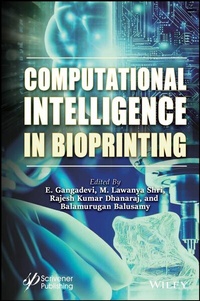
Computational Intelligence in Bioprinting
Description

The book provides a comprehensive exploration of the evolving field of bioprinting in regenerative medicine and is an essential guide for professionals seeking a thorough understanding of the field.
Computational Intelligence in Bioprinting provides a comprehensive overview of the evolving field of bioprinting in reformative medicine, defining the process of printing structures using viable cells, biomaterials, and living molecules. The primary goal is to provide substitutes for tissue implants, which might lead to eliminating the requirement for organ donors, as well as to transform animal testing for the learning and analysis of disease and the growth of treatments. The book offers a comprehensive overview of bioprinting technologies and their applications, emphasizing the integration of computation intelligence, artificial intelligence, and other computer science advancements in the field. By harnessing the power of computational intelligence techniques such as AI, machine learning, optimization algorithms, and data analytics, existing hurdles can be overcome and the full potential of bioprinting can be unlocked.
The book covers an extensive range of topics, including bio-ink formulation and characterization, bioprinter hardware and software design, tissue and organ modeling, image analysis, process optimization, and quality control.
Audience
The book is aimed at professionals, practitioners and researchers in the fields of bioprinting, tissue engineering, and computational intelligence in medicine.
More details
Other editions
Additional editions
Persons
E. Gangadevi, is an assistant professor in the Department of Computer Science at Loyola College in Chennai, India. She has published two patents, authored / edited two books, more than 20 research papers in international journals and many book chapters.
M. Lawanya Shri, PhD, is an associate professor at the School of Information Technology and Engineering, VIT, Vellore, India. She has two patents, more than 50 articles in refereed journals and international conferences, and contributed many chapters to books.
Rajesh Kumar Dhanaraj, PhD, is a professor at the School of Computing Science and Engineering at Galgotias University in India. He has authored/edited more than 25 books on various technologies, 21 patents, and 50+ articles and papers in various refereed journals and international conferences.
Balamurugan Balusamy, PhD, is an associate dean to students at Shiv Nadar University at the Delhi-NCR Campus in Noida, India. He has authored/edited more than 80 books as well as over 200 contributions to international journals and conferences.
Content
- Cover
- Title Page
- Copyright Page
- Contents
- Preface
- Chapter 1 The Emergence of Bioprinting and Computational Intelligence
- 1.1 Introduction
- 1.2 Related Study
- 1.3 Understanding the Basics of Bioprinting and Computational Intelligence
- 1.3.1 Bioprinting: The Basics
- 1.3.2 Computational Intelligence: The Basics
- 1.3.3 Applications of Bioprinting and Computational Intelligence
- 1.4 The Role of Computational Intelligence in Bioprinting
- 1.5 Applications of Bioprinting and Computational Intelligence in Medicine
- 1.6 Bioprinting and Computational Intelligence in Tissue Engineering and Regenerative Medicine
- 1.7 Advancements in Bioprinting and Computational Intelligence Technologies
- 1.8 The Ethical and Regulatory Implications of Bioprinting and Computational Intelligence
- 1.9 The Future of Bioprinting and Computational Intelligence: Opportunities and Challenges
- 1.10 Case Studies: Bioprinting and Computational Intelligence in Action
- 1.10.1 Trends in Computational Intelligence and Bioprinting
- 1.10.2 Challenges in Computational Intelligence and Bioprinting
- 1.11 Conclusion
- References
- Chapter 2 Design, Architecture, Implementation, and Evaluation of Bioprinting Technology for Tissue Engineering
- 2.1 Introduction
- 2.2 3D Bioprinting
- 2.3 Material Characteristics
- 2.3.1 Printability
- 2.4 Mechanical Properties
- 2.5 Biomaterials
- 2.6 Design, Architecture of 3D Bioprinting
- 2.6.1 Inkjet Bioprinting
- 2.6.2 Laser-Assisted Bioprinting (LAB)
- 2.6.3 Extrusion Bioprinting
- 2.7 3D Bioprinting Tissue Models
- 2.8 3D Multimaterial Bioprinting-Development of Complex Architectures
- 2.9 Implementation and Evaluation
- 2.10 Bone
- 2.11 Cartilage
- 2.12 Soft Tissue Engineering
- 2.13 Vascular Tissue
- 2.14 Skin
- 2.15 Biocompatibility and Control of Degradation and Byproducts
- 2.16 Conclusion
- References
- Chapter 3 Design and Development of IoT Devices: Methods, Tools and Technologies
- 3.1 Introduction to IoT Devices and 3D Bioprinting
- 3.2 Methodology for Designing IoT Devices for 3D Bioprinting
- 3.3 Additional Considerations in IoT Device Design for 3D Bioprinting
- 3.4 Tools for Developing IoT Devices for 3D Bioprinting
- 3.4.1 Microcontrollers and Development Boards
- 3.4.2 Sensors and Actuators
- 3.4.3 Communication Protocols
- 3.4.4 Software Development Kits
- 3.4.5 Cloud Platforms
- 3.4.6 3D Printing Software
- 3.4.7 CAD Software
- 3.4.8 Simulation Software
- 3.4.9 Data Analytics Tools
- 3.4.10 Cybersecurity Tools
- 3.5 Techniques for Developing IoT Devices for 3D Bioprinting
- 3.5.1 Agile Development
- 3.5.2 Rapid Prototyping
- 3.5.3 Test-Driven Development
- 3.5.4 Continuous Integration
- 3.5.5 Modular Design
- 3.5.6 Power Optimization
- 3.5.7 Data Processing Techniques
- 3.5.8 Quality Assurance
- 3.5.9 Cybersecurity Techniques
- 3.5.10 Standardization
- 3.6 Case Studies of IoT Devices for 3D Bioprinting
- 3.7 Future Directions in IoT Devices for 3D Bioprinting
- 3.8 Conclusion
- References
- Chapter 4 AI-Based AR/VR Models in Biomedical Sustainable Industry 4.0
- 4.1 Introduction
- 4.2 Mixed Augmented Reality
- 4.2.1 SDK in Augmented Reality
- 4.2.2 Application Scope of Augmented Reality
- 4.2.2.1 Video Capabilities
- 4.2.2.2 AR Toolkit Technology
- 4.2.2.3 Quality of Tracking System
- 4.3 AR Technology
- 4.3.1 High Level Augmented Reality
- 4.3.2 Limitations of Enhanced Image
- 4.3.3 Limitations of CAD Model
- 4.3.4 Augmented Reality in Manufacturing Sector
- 4.4 Requirement of Augmented Reality
- 4.4.1 Capability of AR
- 4.4.2 Computational Hardware Capabilities
- 4.4.3 Symbol-Based Tracking Software
- 4.5 Conclusions
- References
- Chapter 5 Computational Intelligence-Based Image Classification for 3D Printing: Issues and Challenges
- 5.1 Introduction
- 5.2 Brief Concepts
- 5.2.1 3D Printing Tools
- 5.2.2 Artificial Intelligence-Based Digital Marketing
- 5.2.3 Automated Machine Learning Prediction System
- 5.3 Role of Artificial Intelligence in Industry 4.0
- 5.3.1 3D Printing Process
- 5.3.2 Enhancement in Machine Learning
- 5.3.3 Genetics-Based Machine Learning
- 5.3.4 Slicing Technique in 3D Model
- 5.3.5 Printing Path Trajectory
- 5.3.6 Improvement in Computational Simulation
- 5.3.7 Improving Service-Oriented Architecture
- 5.3.8 Capabilities of Cloud Computing
- 5.3.9 Hamming Distance Technique
- 5.3.10 Improving Knowledge Skills
- 5.3.11 Object Detection Algorithm
- 5.3.12 Improvement in Manufacturing Defects
- 5.4 Conclusion
- References
- Chapter 6 Role of Cybersecurity to Safeguard 3D Bioprinting in Healthcare: Challenges and Opportunities
- 6.1 Introduction
- 6.2 Related Work
- 6.3 Creation of 3D Objects and Printing
- 6.3.1 Benefits of 3D Printing
- 6.3.2 Bioprinting
- 6.3.3 A Flow Diagram Depicting the Bioprinting Process
- 6.3.4 Datasets Used in Bioprinting
- 6.4 Schematic Diagram of 3D Bioprinting
- 6.4.1 3D Bioprinting Strategies
- 6.4.2 Comparison Among the 3D Bioprinting Approaches
- 6.4.3 Materials Used in Bioprinting
- 6.4.4 Bioprinting in Diverse Domains
- 6.5 Cyberthreats Posed to Bioprinting
- 6.5.1 Challenges and Opportunities of Cybersecurity in Bioprinting
- 6.5.2 Proposed Solutions
- 6.5.3 Combating the Cybersecurity Risks of 3D Bioprinting
- 6.5.4 Blockchain Technology and Bioprinting
- 6.5.5 A Comparative Survey of Cyberthreats in Additive Manufacturing Technology
- 6.6 Conclusion
- References
- Chapter 7 Legal and Bioethical View of Educational Sectors and Industrial Areas of 3D Bioprinting
- 7.1 Introduction
- 7.2 Current 3D Bioprinting Market Trends
- 7.3 Legal and Ethical Perspectives
- 7.4 Regarding the Introduction and Advancement of 3D Bioprinting
- 7.4.1 Current and Potential Paths for Bioethical Discourse
- 7.4.2 Legal Concerns with the Introduction of 3D Bioprinting Into Clinical Practice
- 7.4.3 Ethical Concerns with the 3D Bioprinting of Artificial Ovaries and Their Use in Clinical Settings
- 7.5 Conclusion
- 7.6 Future Scope
- References
- Chapter 8 Optimizing 3D Bioprinting Using Advanced Deep Learning Techniques A Comparative Study of CNN, RNN, and GAN
- 8.1 Introduction
- 8.2 Convolutional Neural Networks in Optimization of 3D Bioprinting
- 8.3 RNN in Optimization of 3D Bioprinting
- 8.4 Generative Adversarial Networks (GAN) in Optimization of 3D Bioprinting
- 8.5 Datasets Used for Optimization of 3D Bioprinting
- 8.6 3D Slicer Medical Image Segmentation Dataset
- 8.7 Sensor Data
- 8.8 Open Organ Database Dataset
- 8.9 Proposed Model
- 8.10 CNN U-Net
- 8.11 RNN Long Short-Term Memory
- 8.12 Wasserstein Generative Adversarial Network
- 8.13 Process of Combined Model
- 8.14 Conclusion
- References
- Chapter 9 Research Trends in Intelligence-Based Bioprinting for Construction Engineering Applications
- 9.1 Introduction
- 9.2 Analysis of Bioprinting
- 9.3 Model Development in Bioprinting Technology
- 9.4 3D Bioprinting Academic Institutions in the World
- 9.5 Emerging Bioprinting Technology
- 9.5.1 Opportunities
- 9.5.2 Challenges
- 9.6 Development in Bioengineering
- 9.7 Evolution of Patent Trends in Bioprinting
- 9.8 Conclusions
- References
- Chapter 10 Design and Development to Collect and Analyze Data Using Bioprinting Software for Biotechnology Industry
- 10.1 Introduction
- 10.2 Digital Technology in Bioprinting
- 10.2.1 Shape of Bioprinting
- 10.2.2 Heterogeneity Units of Material
- 10.2.2.1 Tissue Improvement
- 10.2.2.2 Formation of Biomaterials
- 10.2.2.3 Biomaterial and Biological Factors
- 10.2.3 Dynamic Changes in Fabrication Process
- 10.3 Designing Techniques in Bioprinting
- 10.3.1 Data Processing in Biomedical Imaging
- 10.3.2 Process Bioprinting Techniques
- 10.3.3 Interaction of Bioink Formulation
- 10.4 3D Bioprinting
- 10.4.1 Optimized Bioprinting
- 10.4.2 Modifying Crosslinking
- 10.4.3 Multiple Crosslinking
- 10.4.4 Enhance Bioprinting
- 10.4.5 Hybrid Bioprinting
- 10.5 Enhanced Biotissue Printing
- 10.5.1 Integrating Thickness of Engineered Tissue
- 10.5.2 Integration and Enhancement of Cellular Interaction
- 10.5.3 DNA with a Smart Biomaterial
- 10.5.3.1 Biomaterials
- 10.5.3.2 Reactive Hydrogel to External Stimuli
- 10.5.4 Simulation
- 10.6 Conclusion
- 10.7 Future Work
- References
- Chapter 11 Cyborg Intelligence for Bioprinting in Computational Design and Analysis of Medical Application
- 11.1 Introduction
- 11.2 Next Generation of Bioprinting
- 11.2.1 Medicine Management
- 11.2.2 Varieties of Bioprinting Material
- 11.2.2.1 Thermoresponsive Materials
- 11.2.2.2 Biocompatible Polymers Materials
- 11.2.2.3 Endophyte Biocompatible Polymers Materials
- 11.2.2.4 Photo-Conductive Polymer Materials
- 11.2.2.5 UV-Assisted in 3D Printing
- 11.2.2.6 Sensitivity Polymeric Materials
- 11.2.2.7 Macromolecules Materials
- 11.2.2.8 Dual-Sensitive Materials
- 11.2.3 Biosensing Scaffolds
- 11.3 Biosensors and Actuators
- 11.3.1 Fabricated Scaffold Tissues
- 11.3.2 Vascularizing Tissues
- 11.3.3 4D Bioprinting Neural Tissue
- 11.3.4 Longitudinal Deformation
- 11.3.5 Uses of Biomedical Appliances
- 11.4 Enhancing Technology in Bioprinting
- 11.5 Conclusion and Future Work
- References
- Chapter 12 Computer Vision-Aides 3D Bioprinting in Ophthalmology Recent Trends and Advancements
- 12.1 Introduction
- 12.2 Digital Laser Printing Techniques
- 12.2.1 Tissue Engineering Industry
- 12.2.1.1 Printing Biomedical Structure
- 12.2.1.2 Electrochemical Bioprinter
- 12.2.1.3 Nozzle Free Printing
- 12.3 3D Printing Biological Material
- 12.3.1 Optical Quality of 3D Printing Technology
- 12.3.2 Repair Damage Tissue
- 12.3.3 Eye Blindness
- 12.3.4 Medicine Company
- 12.3.5 Artificial Prosthetic Eye
- 12.4 Conclusion and Future Work
- References
- Chapter 13 Intelligent Image Classification for 3D Printing in Industry 4.0
- 13.1 Introduction
- 13.2 Advantages
- 13.3 Methodology
- 13.4 3D Printing Technology
- 13.4.1 Automating Selection of Best Tasks
- 13.4.2 3D Printing Performances Analysis
- 13.4.3 Choose High-Performance Material
- 13.4.4 3D Printing Problem Solving
- 13.5 ANN Methods
- 13.6 Conclusions
- References
- Chapter 14 Bioprinting and Robotics Engineering: Applications, Recent Progress, and Future Directions
- 14.1 Introduction
- 14.2 Background
- 14.3 3D Printing
- 14.4 3D Printing Applications
- 14.4.1 Tooling for Prototyping and End-Use Parts
- 14.4.2 Industrial Uses of 3D Printing
- 14.4.2.1 Aviation
- 14.4.3 Which Are Some of the Most Typical Items Produced Using a 3D Printer?
- 14.4.4 Wing and Propellers
- 14.4.4.1 Role of 3D Printing Automobile Industry
- 14.4.4.2 Automobile Quality is Improved via Rapid Prototyping
- 14.4.4.3 Tool Customization
- 14.4.4.4 Trying to Lose the Most Weight Possible
- 14.5 Recent Progress in 3D Printing
- 14.5.1 Unmanned Aerial Vehicles (UAV)
- 14.5.2 Medicine
- 14.5.3 Organs and Tissues May Be Printed via Bioprinting
- 14.5.4 Smart Building
- 14.5.5 Sand Dunes
- 14.5.6 Metal Engraving
- 14.5.7 3D Printing's Use in Robot Construction
- 14.5.8 Characteristics
- 14.5.8.1 Robots Are Not Like Other Industrial Items
- 14.5.8.2 Design Versatility and Rapid Prototyping
- 14.5.8.3 Lower Output Figures
- 14.5.8.4 Robot Types and Applications
- 14.5.8.5 Independent
- 14.5.8.6 Submarine Robot
- 14.6 Future Directions in 3D Printing
- 14.6.1 Robots That Clean Solar Panels
- 14.6.2 Factory Robots
- 14.6.3 Case Study
- 14.6.4 Adding the Dataset to the Notebook
- 14.6.5 Basic Information
- 14.6.6 Inference from Heatmap
- 14.6.7 Inference from Model
- 14.6.8 The Coefficients Suggest the Following
- 14.7 Conclusion and Discussion
- 14.8 Future Scope
- References
- Chapter 15 3D Bioprinting Technology Optimization Using Machine Learning
- 15.1 Introduction
- 15.2 Human Organs Printed Through 3D Printers
- 15.2.1 Prioritize Cell Membrane
- 15.2.2 Prediction-Based Algorithms
- 15.2.3 Bioimaging through CAD Software
- 15.3 Predictive Trial and Error 3D Printing
- 15.4 Conclusions
- References
- Index
- EULA
