

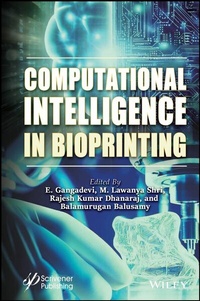
Computational Intelligence in Bioprinting
Description

The book provides a comprehensive exploration of the evolving field of bioprinting in regenerative medicine and is an essential guide for professionals seeking a thorough understanding of the field.
Computational Intelligence in Bioprinting provides a comprehensive overview of the evolving field of bioprinting in reformative medicine, defining the process of printing structures using viable cells, biomaterials, and living molecules. The primary goal is to provide substitutes for tissue implants, which might lead to eliminating the requirement for organ donors, as well as to transform animal testing for the learning and analysis of disease and the growth of treatments. The book offers a comprehensive overview of bioprinting technologies and their applications, emphasizing the integration of computation intelligence, artificial intelligence, and other computer science advancements in the field. By harnessing the power of computational intelligence techniques such as AI, machine learning, optimization algorithms, and data analytics, existing hurdles can be overcome and the full potential of bioprinting can be unlocked.
The book covers an extensive range of topics, including bio-ink formulation and characterization, bioprinter hardware and software design, tissue and organ modeling, image analysis, process optimization, and quality control.
Audience
The book is aimed at professionals, practitioners and researchers in the fields of bioprinting, tissue engineering, and computational intelligence in medicine.
More details
Other editions
Additional editions
Persons
E. Gangadevi, is an assistant professor in the Department of Computer Science at Loyola College in Chennai, India. She has published two patents, authored / edited two books, more than 20 research papers in international journals and many book chapters.
M. Lawanya Shri, PhD, is an associate professor at the School of Information Technology and Engineering, VIT, Vellore, India. She has two patents, more than 50 articles in refereed journals and international conferences, and contributed many chapters to books.
Rajesh Kumar Dhanaraj, PhD, is a professor at the School of Computing Science and Engineering at Galgotias University in India. He has authored/edited more than 25 books on various technologies, 21 patents, and 50+ articles and papers in various refereed journals and international conferences.
Balamurugan Balusamy, PhD, is an associate dean to students at Shiv Nadar University at the Delhi-NCR Campus in Noida, India. He has authored/edited more than 80 books as well as over 200 contributions to international journals and conferences.
Content
Preface xv
1 The Emergence of Bioprinting and Computational Intelligence 1
P.M. Kavitha, S. Jayachandran and M. Anitha
1.1 Introduction 2
1.2 Related Study 3
1.3 Understanding the Basics of Bioprinting and Computational Intelligence 6
1.4 The Role of Computational Intelligence in Bioprinting 8
1.5 Applications of Bioprinting and Computational Intelligence in Medicine 9
1.6 Bioprinting and Computational Intelligence in Tissue Engineering and Regenerative Medicine 10
1.7 Advancements in Bioprinting and Computational Intelligence Technologies 12
1.8 The Ethical and Regulatory Implications of Bioprinting and Computational Intelligence 13
1.9 The Future of Bioprinting and Computational Intelligence: Opportunities and Challenges 14
1.10 Case Studies: Bioprinting and Computational Intelligence in Action 15
1.11 Conclusion 19
2 Design, Architecture, Implementation, and Evaluation of Bioprinting Technology for Tissue Engineering 21
Vimala R. T. V., Gangadevi E. and Lawanya Shri M.
2.1 Introduction 21
2.2 3D Bioprinting 23
2.3 Material Characteristics 24
2.4 Mechanical Properties 25
2.5 Biomaterials 25
2.6 Design, Architecture of 3D Bioprinting 25
2.7 3D Bioprinting Tissue Models 28
2.8 3D Multimaterial Bioprinting-Development of Complex Architectures 29
2.9 Implementation and Evaluation 29
2.10 Bone 29
2.11 Cartilage 31
2.12 Soft Tissue Engineering 31
2.13 Vascular Tissue 32
2.14 Skin 32
2.15 Biocompatibility and Control of Degradation and Byproducts 33
2.16 Conclusion 33
3 Design and Development of IoT Devices: Methods, Tools and Technologies 39
Akash Kumar, Sachin Abhay Kumar, Richa Singh, Shivam Maloo, Dishant Rathi and K. Santhi
3.1 Introduction to IoT Devices and 3D Bioprinting 40
3.2 Methodology for Designing IoT Devices for 3D Bioprinting 40
3.3 Additional Considerations in IoT Device Design for 3D Bioprinting 42
3.4 Tools for Developing IoT Devices for 3D Bioprinting 44
3.5 Techniques for Developing IoT Devices for 3D Bioprinting 46
3.6 Case Studies of IoT Devices for 3D Bioprinting 49
3.7 Future Directions in IoT Devices for 3D Bioprinting 49
3.8 Conclusion 50
4 AI-Based AR/VR Models in Biomedical Sustainable Industry 4.0 53
Kuldeep Singh Kaswan, Jagjit Singh Dhatterwal, Rudra Pratap Ojha, Balamurugan Balusamy and Gangadevi E.
4.1 Introduction 54
4.2 Mixed Augmented Reality 56
4.3 AR Technology 64
4.4 Requirement of Augmented Reality 71
4.5 Conclusions 74
5 Computational Intelligence-Based Image Classification for 3D Printing: Issues and Challenges 79
Jagjit Singh Dhatterwal, Kuldeep Singh Kaswan, B. Tirapathi Reddy and Gangadevi E.
5.1 Introduction 80
5.2 Brief Concepts 81
5.3 Role of Artificial Intelligence in Industry 4.0 82
5.4 Conclusion 89
6 Role of Cybersecurity to Safeguard 3D Bioprinting in Healthcare: Challenges and Opportunities 93
Venkatalakshmi S.
6.1 Introduction 94
6.2 Related Work 95
6.3 Creation of 3D Objects and Printing 97
6.4 Schematic Diagram of 3D Bioprinting 100
6.5 Cyberthreats Posed to Bioprinting 106
6.6 Conclusion 125
7 Legal and Bioethical View of Educational Sectors and Industrial Areas of 3D Bioprinting 127
Pothys varan S., Balachander S. and Ashwini S.
7.1 Introduction 128
7.2 Current 3D Bioprinting Market Trends 130
7.3 Legal and Ethical Perspectives 135
7.4 Regarding the Introduction and Advancement of 3D Bioprinting 138
7.5 Conclusion 149
7.6 Future Scope 149
8 Optimizing 3D Bioprinting Using Advanced Deep Learning Techniques A Comparative Study of CNN, RNN, and GAN 157
K. Sujigarasharma, Sharulatha S., Lawanya Shri M., Gangadevi E. and Rajesh Kumar Dhanaraj
8.1 Introduction 158
8.2 Convolutional Neural Networks in Optimization of 3D Bioprinting 160
8.3 RNN in Optimization of 3D Bioprinting 160
8.4 Generative Adversarial Networks (GAN) in Optimization of 3D Bioprinting 161
8.5 Datasets Used for Optimization of 3D Bioprinting 162
8.6 3D Slicer Medical Image Segmentation Dataset 163
8.7 Sensor Data 163
8.8 Open Organ Database Dataset 164
8.9 Proposed Model 164
8.10 CNN U-Net 166
8.11 RNN Long Short-Term Memory 167
8.12 Wasserstein Generative Adversarial Network 168
8.13 Process of Combined Model 169
8.14 Conclusion 171
9 Research Trends in Intelligence-Based Bioprinting for Construction Engineering Applications 175
Kuldeep Singh Kaswan, Jagjit Singh Dhatterwal, Om Prakash, Balamurugan Balusamy and Feslin Anish Mon
9.1 Introduction 176
9.2 Analysis of Bioprinting 177
9.3 Model Development in Bioprinting Technology 179
9.4 3D Bioprinting Academic Institutions in the World 183
9.5 Emerging Bioprinting Technology 185
9.5.1 Opportunities 185
9.5.2 Challenges 186
9.6 Development in Bioengineering 186
9.7 Evolution of Patent Trends in Bioprinting 188
9.8 Conclusions 189
10 Design and Development to Collect and Analyze Data Using Bioprinting Software for Biotechnology Industry 193
Jagjit Singh Dhatterwal, Kuldeep Singh Kaswan, Sanjay Kumar, Balamurugan Balusamy and Lakshmana Kumar Ramasamy
10.1 Introduction 194
10.2 Digital Technology in Bioprinting 195
10.3 Designing Techniques in Bioprinting 199
10.4 3D Bioprinting 201
10.5 Enhanced Biotissue Printing 203
10.6 Conclusion 205
10.7 Future Work 206
11 Cyborg Intelligence for Bioprinting in Computational Design and Analysis of Medical Application 211
Kuldeep Singh Kaswan, Jagjit Singh Dhatterwal, Naresh Kumar, Balamurugan Balusamy and Gangadevi E.
11.1 Introduction 212
11.2 Next Generation of Bioprinting 214
11.3 Biosensors and Actuators 223
11.4 Enhancing Technology in Bioprinting 232
11.5 Conclusion and Future Work 233
12 Computer Vision-Aides 3D Bioprinting in Ophthalmology Recent Trends and Advancements 239
Jagjit Singh Dhatterwal, Kuldeep Singh Kaswan, Ankita Tiwari, Balamurugan Balusamy and R. Gopal
12.1 Introduction 240
12.2 Digital Laser Printing Techniques 242
12.3 3D Printing Biological Material 248
12.4 Conclusion and Future Work 254
13 Intelligent Image Classification for 3D Printing in Industry 4.0 259
Rajbala, Kuldeep Singh Kaswan, Jagjit Singh Dhatterwal, Gangadevi E. and Balamurugan Balusamy
13.1 Introduction 260
13.2 Advantages 261
13.3 Methodology 262
13.4 3D Printing Technology 262
13.5 ANN Methods 270
13.6 Conclusions 271
14 Bioprinting and Robotics Engineering: Applications, Recent Progress, and Future Directions 275
Pawan Whig, Shama Kouser, Ashima Bhatnagar Bhatia, Rahul Reddy Nadikattu and Yusuf Jibrin Alkali
14.1 Introduction 276
14.2 Background 277
14.3 3D Printing 279
14.4 3D Printing Applications 280
14.5 Recent Progress in 3D Printing 284
14.6 Future Directions in 3D Printing 289
14.7 Conclusion and Discussion 297
14.8 Future Scope 298
15 3D Bioprinting Technology Optimization Using Machine Learning 303
Kuldeep Singh Kaswan, Jagjit Singh Dhatterwal, Reenu Batra, Balamurugan Balusamy and Gangadevi E.
15.1 Introduction 304
15.2 Human Organs Printed Through 3D Printers 306
15.3 Predictive Trial and Error 3D Printing 317
15.4 Conclusions 318
References 319
Index 323
1
The Emergence of Bioprinting and Computational Intelligence
P.M. Kavitha1*, S. Jayachandran1 and M. Anitha2
1Department of Computer Applications, SRM Institute of Science and Technology, Ramapuram, Chennai, India
2Department of Computer Science and Engineering, SRM TRP Engineering College, Trichy, India
Abstract
Bioprinting is a promising technology that involves the creation of living tissues and organs through 3D printing techniques. However, the complexity of the structures involved in bioprinting makes it challenging to create viable tissues and organs. Computational intelligence, which enables computers to learn, reason, and make decisions similar to humans, has emerged as a critical tool in the development of bioprinting. Through the use of computational intelligence, researchers can simulate the behavior of cells and tissues in different environments. These simulations can help develop more accurate models for bioprinting and optimize the printing process for the creation of functional tissues and organs. Additionally, computational intelligence can aid in the analysis of data obtained from experiments and simulations, which can be used to refine and improve the bioprinting process. The emergence of bioprinting and computational intelligence has the potential to revolutionize the field of regenerative medicine, allowing for the creation of replacement tissues and organs for patients in need. As the technology continues to evolve, the use of computational intelligence will play an increasingly important role in the development of new bioprinting techniques and the advancement of regenerative medicine. One of the key challenges of bioprinting is the complexity of the structures involved. Unlike traditional 3D printing, bioprinting requires the printing of living cells, which can be highly sensitive to their environment. Computational intelligence can help address this challenge by allowing scientists to simulate the behavior of cells and tissues in different environments. By analyzing data from these simulations, researchers can develop more accurate models.
Keywords: Simulations, 3D printing, regenerative medicine
1.1 Introduction
The enthralling era of computational intelligence and bioprinting technologies decides the future of the health care and biological world. Bioprinting deals with the high dimensional printing of the biomedical products like cells, tissues and even organs in a controlled environment, with high accuracy. The goal of bioprinting is to create functional biological structures that can be used for a wide range of applications, such as tissue engineering, regenerative medicine, and drug discovery. The process of bioprinting involves using a printer to deposit layer upon layer of biological materials to build up a 3D structure. This process is similar to traditional 3D printing, but with one crucial difference: the materials being printed are living cells, not plastic or metal.
Computational intelligence, on the other hand, is a subfield of artificial intelligence that focuses on the development of algorithms and mathematical models to perform tasks that would normally require human intelligence, such as learning and pattern recognition. In the context of bioprinting, computational intelligence is used to optimize and control the printing process, allowing for the creation of highly precise and accurate biological structures. So why are bioprinting and computational intelligence such a big deal? Well, the potential applications of this technology are truly staggering. Bioprinting has the potential to revolutionize the way that biological and medical problems are approached. For example, bio-printed tissues could be used for drug testing and development, allowing for more accurate and efficient testing of new drugs before they are tested on human subjects. Additionally, bioprinter organs could one day be used to replace damaged or diseased organs, eliminating the need for organ donors and reducing the wait time for transplant patients. And that is just the tip of the iceberg! As our understanding of bioprinting and computational intelligence continues to grow, it ensures to see even more incredible applications of this technology in the future.
The field of bioprinting and computational intelligence is still in its infancy, but it is advancing rapidly. Just over two decades ago, the first proof-of-concept studies demonstrated the feasibility of 3D printing biological materials. Today, there are numerous commercial companies and academic institutions exploring the potential of this field for a wide range of applications.
An introduction to the exciting world of bioprinting and computational intelligence. This study is helpful to learn about the current state of this field, including the key technologies and applications, as well as the current challenges and opportunities. This chapter enables the user to have a comprehensive understanding of the emergence of bioprinting and computational intelligence as a field of study and its potential to shape the future of medicine and biology (Figure 1.1).
Figure 1.1 3D bioprinting-the process.
The chapter is organized with related study section followed by the Basics of Bioprinting and Computational Intelligence section. Section 1.4 includes The Role of Computational Intelligence in Bioprinting.
1.2 Related Study
The article [1] "3D bioprinting: A review on its advancements and future prospects" provides a comprehensive overview of the current state of 3D bioprinting technology and its potential for future applications in biomedical research and clinical practice. The authors discuss the various bioprinting techniques, bioinks, and cell sources currently used in 3D bio-printing, as well as the challenges and limitations of the technology. The article also covers the wide range of tissue types and organs that have been successfully printed using 3D bioprinting, including bone, cartilage, skin, liver, and heart tissue. In addition, the authors describe the emerging areas of research in 3D bioprinting, such as the use of stem cells and bioprinting of vascularized tissues. Overall, the article provides a valuable resource for researchers and clinicians interested in the field of 3D bioprinting, and highlights the potential for this technology to revolutionize regenerative medicine and personalized healthcare.
The article [2] "Bioinks for 3D bioprinting: an overview" provides a detailed review of the various types of bioinks used in 3D bioprinting. The authors cover the most commonly used bioink materials, including natural polymers, synthetic polymers, and hydrogels, and discuss the advantages and limitations of each material. The article also highlights the importance of designing bioinks that mimic the extracellular matrix (ECM) of the target tissue, and provides insight into the strategies used to achieve this goal. The authors also discuss the challenges and opportunities associated with bioink development, including the need for biocompatibility, printability, and appropriate mechanical and biological properties. In addition, the article covers the emerging trends in bioink development, such as the use of decellularized ECMs and the incorporation of bioactive molecules and growth factors. The authors also address the importance of standardizing bioink characterization and testing procedures to ensure reproducibility and comparability across studies. Overall, the article provides a comprehensive overview of bioinks for 3D bioprinting, and serves as a valuable resource for researchers working in this field. The article's focus on the need for tailored bioink development to specific tissue types underscores the importance of ongoing research in this area, and highlights the potential for bioinks to play a key role in the development of regenerative medicine and tissue engineering applications.
The article [3] "Bioprinting of human tissues: current state-of-the-art, challenges, and opportunities" provides a comprehensive review of the current state-of-the-art in bioprinting technology, as well as the challenges and opportunities associated with this rapidly evolving field. The authors cover the various bioprinting techniques and materials used to print human tissues, and discuss the advantages and limitations of each approach. The article also covers the major challenges facing bioprinting technology, including the need for improved biomaterials, the difficulty of vascularizing printed tissues, and the need for better methods of cell sourcing and differentiation. The authors also address the ethical considerations associated with bioprinting, including the need to balance scientific progress with safety and ethical concerns. In addition, the article highlights the opportunities presented by bioprinting technology, including the potential for personalized medicine, disease modeling, and drug screening. The authors discuss the importance of collaborative efforts between researchers, clinicians, and industry partners to drive progress in this field.
Overall, the article provides a valuable resource for researchers, clinicians, and industry partners interested in the field of bioprinting, and underscores the potential for this technology to revolutionize regenerative medicine and tissue engineering. The authors' focus on the importance of addressing the major challenges facing bioprinting technology highlights the need for ongoing research and development efforts in this area.
The article "Printing the future: challenges and...
