

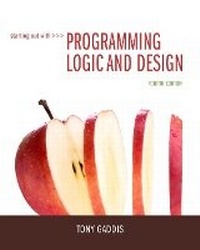
Starting Out with Programming Logic and Design
4th Edition
Will be published approx. on 23. July 2015
Book
Paperback/Softback
664 pages
978-0-13-398507-8 (ISBN)
Description
For introductory courses in Computer Programming.
The Fundamentals of Programming
When it comes to programming, understanding the founding concepts can greatly improve student engagement and future success. In its Fourth Edition, Starting Out with Programming Logic and Design is a language-independent introductory programming book, ideal for a precursor programming course or the first unit of an introductory programming course. The text covers fundamental topics such as data types, variables, input, output, control structures, modules, functions, arrays, files, object-oriented concepts, GUI development, and event-driven programming.
Designed for beginners, the text is clear and approachable, making the complex concepts accessible to every student. In this edition, Gaddis uses updated, contemporary examples to familiarize students with models and logical thought processes used in programming without further complicating them with language syntax. By using easy-to-understand pseudocode, flowcharts, and other tools, Gaddis illustrates how to design the logic of programs. Then, confident in their high-level understanding of computer programming, students are able to handle programming languages and syntax with greater ease and aptitude.
The Fundamentals of Programming
When it comes to programming, understanding the founding concepts can greatly improve student engagement and future success. In its Fourth Edition, Starting Out with Programming Logic and Design is a language-independent introductory programming book, ideal for a precursor programming course or the first unit of an introductory programming course. The text covers fundamental topics such as data types, variables, input, output, control structures, modules, functions, arrays, files, object-oriented concepts, GUI development, and event-driven programming.
Designed for beginners, the text is clear and approachable, making the complex concepts accessible to every student. In this edition, Gaddis uses updated, contemporary examples to familiarize students with models and logical thought processes used in programming without further complicating them with language syntax. By using easy-to-understand pseudocode, flowcharts, and other tools, Gaddis illustrates how to design the logic of programs. Then, confident in their high-level understanding of computer programming, students are able to handle programming languages and syntax with greater ease and aptitude.
More details
Other editions
New editions
Tony Gaddis
Starting Out with Programming Logic and Design
Book
02/2018
5th Edition
Pearson
€157.21
Shipment within 15-20 days
Previous edition
Tony Gaddis
Starting Out with Programming Logic and Design
Book
03/2012
3rd Edition
Pearson
€92.84
Article exhausted; check for reprint
Person
Tony Gaddis is the principal author of the Starting Out With . . . series of textbooks. Tony has twenty years of experience teaching computer science courses, primarily at Haywood Community College. He is a highly acclaimed instructor who was previously selected as the North Carolina Community College "Teacher of the Year" and has received the Teaching Excellence award from the National Institute for Staff and Organizational Development. The Starting Out With . . . series includes introductory books covering Programming Logic and Design, C++, Java, Microsoft (R) Visual Basic, C# (R), Python, and Alice, all published by Pearson.
Content
Preface
Acknowledgments
About the Author
Chapter 1 Introduction to Computers and Programming
Chapter 2 Input, Processing, and Output
Chapter 3 Modules
Chapter 4 Decision Structures and Boolean Logic
Chapter 5 Repetition Structures
Chapter 6 Functions
Chapter 7 Input Validation
Chapter 8 Arrays
Chapter 9 Sorting and Searching Arrays
Chapter 10 Files
Chapter 11 Menu-Driven Programs
Chapter 12 Text Processing
Chapter 13 Recursion
Chapter 14 Object-Oriented Programming
Chapter 15 GUI Applications and Event-Driven Programming
Appendix A ASCII/Unicode Characters
Appendix B Flowchart Symbols
Appendix C Pseudocode Reference
Appendix D Converting Decimal Numbers to Binary
Appendix E Answers to Checkpoint Questions
Index
Acknowledgments
About the Author
Chapter 1 Introduction to Computers and Programming
Chapter 2 Input, Processing, and Output
Chapter 3 Modules
Chapter 4 Decision Structures and Boolean Logic
Chapter 5 Repetition Structures
Chapter 6 Functions
Chapter 7 Input Validation
Chapter 8 Arrays
Chapter 9 Sorting and Searching Arrays
Chapter 10 Files
Chapter 11 Menu-Driven Programs
Chapter 12 Text Processing
Chapter 13 Recursion
Chapter 14 Object-Oriented Programming
Chapter 15 GUI Applications and Event-Driven Programming
Appendix A ASCII/Unicode Characters
Appendix B Flowchart Symbols
Appendix C Pseudocode Reference
Appendix D Converting Decimal Numbers to Binary
Appendix E Answers to Checkpoint Questions
Index