

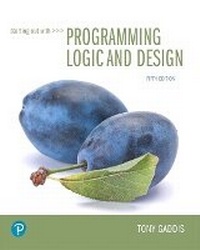
Starting Out with Programming Logic and Design
5th Edition
Published on 9. February 2018
Book
Paperback/Softback
832 pages
978-0-13-480115-5 (ISBN)
Description
For courses in problem solving and programming logic.
Making complex programming concepts accessible to every student
Starting Out with Programming Logic and Design is a language-independent introductory programming book, teaching students programming concepts and logic without assuming any previous programming experience.
Designed for beginners, the text is clear and approachable, making the complex concepts accessible to every student. In this new edition, Gaddis focuses on current languages providing code snippet examples and complete programs for each. The text uses updated, contemporary examples to familiarize students with models and logical thought processes used in programming without further complicating them with language syntax. By using easy-to-understand pseudocode, flowcharts, and other tools, Gaddis illustrates how to design the logic of programs.
The book is ideal for a programming logic course taught as a precursor to a language-specific introductory programming course, or for the first part of an introductory programming course.
Making complex programming concepts accessible to every student
Starting Out with Programming Logic and Design is a language-independent introductory programming book, teaching students programming concepts and logic without assuming any previous programming experience.
Designed for beginners, the text is clear and approachable, making the complex concepts accessible to every student. In this new edition, Gaddis focuses on current languages providing code snippet examples and complete programs for each. The text uses updated, contemporary examples to familiarize students with models and logical thought processes used in programming without further complicating them with language syntax. By using easy-to-understand pseudocode, flowcharts, and other tools, Gaddis illustrates how to design the logic of programs.
The book is ideal for a programming logic course taught as a precursor to a language-specific introductory programming course, or for the first part of an introductory programming course.
More details
Edition
5th edition
Language
English
Place of publication
United States
Publishing group
Pearson Education (US)
Target group
College/higher education
Dimensions
Height: 260 mm
Width: 202 mm
Thickness: 36 mm
Weight
1360 gr
ISBN-13
978-0-13-480115-5 (9780134801155)
Copyright in bibliographic data and cover images is held by Nielsen Book Services Limited or by the publishers or by their respective licensors: all rights reserved.
Schweitzer Classification
Other editions
Previous edition
Tony Gaddis
Starting Out with Programming Logic and Design
Book
07/2015
4th Edition
Pearson
€152.82
Article not available at the moment
Person
About our author Tony Gaddis is the principal author of the Starting Out With series of textbooks. He has nearly 2 decades of experience teaching computer science courses, primarily at Haywood Community College. Tony is a highly acclaimed instructor who was previously selected as the North Carolina Community College Teacher of the Year, and has received the Teaching Excellence award from the National Institute for Staff and Organizational Development. The Starting Out With series includes introductory textbooks covering Programming Logic and Design, Alice, C++, JavaTM, Microsoft (R) Visual Basic (R), Microsoft (R) Visual C#, Python and App Inventor, all published by Pearson.
Content
Introduction to Computers and Programming
Input, Processing, and Output
Modules
Decision Structures and Boolean Logic
Repetition Structures
Functions
Input Validation
Arrays
Sorting and Searching Arrays
Files
Menu-Driven Programs
Text Processing
Recursion
Object-Oriented Programming
GUI Applications and Event-Driven Programming
APPENDICES
ASCII/Unicode Characters
Flowchart Symbols
Pseudocode Reference
Converting Decimal Numbers to Binary
Answers to Checkpoint Questions
Input, Processing, and Output
Modules
Decision Structures and Boolean Logic
Repetition Structures
Functions
Input Validation
Arrays
Sorting and Searching Arrays
Files
Menu-Driven Programs
Text Processing
Recursion
Object-Oriented Programming
GUI Applications and Event-Driven Programming
APPENDICES
ASCII/Unicode Characters
Flowchart Symbols
Pseudocode Reference
Converting Decimal Numbers to Binary
Answers to Checkpoint Questions