

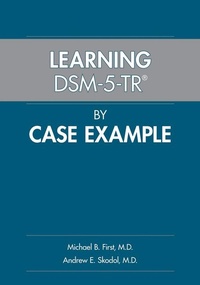
Learning DSM-5-TR (R) by Case Example
Will be published approx. on 28. February 2025
Book
Paperback/Softback
568 pages
978-1-61537-550-9 (ISBN)
Description
Engaging case studies drawn from the real-world practice of
a diverse group of experts bring DSM-5-TRto life in this exhaustive new
volume. Designed to familiarize undergraduate, graduate, and postgraduate
students in psychology, psychiatry, social work, counseling, and psychiatric
nursing with the diagnosis of psychopathology, this guide is equally useful
for experienced clinicians seeking to improve their understanding of the new
concepts and terminology in DSM-5-TR.
Organized according to the order
of the 19 diagnostic groupings as they appear in DSM-5-TR, this book
includes at least one case for each unique mental disorder listed in
DSM-5-TR. In each richly detailed chapter, readers will find:
* An
overview of the manifestation of the various disorders included in the
corresponding disorder class
* A table summarizing key characteristics
of each individual disorder
* Comprehensive sections on the individual
disorders that describe hallmark features, prevalence data, clinical course,
and commonly occurring disorders, among other topics
Multiple cases
are included for more than one-third of the DSM disorders to illustrate
heterogeneity in the presentation. For example, there are six different
cases of Bipolar I Disorder; these include cases with mood-congruent and
mood-incongruent psychotic features, with catatonia, with rapid cycling,
with development during treatment with an antidepressant, and with late-life
onset.
Distinctive to this edition are four new, cutting-edge cases
(illustrating Attenuated Psychosis Syndrome, Internet Gaming Disorder,
Olfactory Reference Disorder, and Compulsive Sexual Behavior Disorder) drawn
from the "Conditions for Further Study" chapter in DSM-5-TR and from the
current edition of the World Health Organization's International
Classification of Diseases, 11th revision.
The book concludes with an
alphabetical index of case names and a comprehensive index of diagnoses with
their related cases for ease of reference. Unmatched in its scope and
detail, Learning DSM-5-TR by Case Example is an essential resource
for all those looking to translate the latest diagnostic concepts and
criteria to real-world practice.
a diverse group of experts bring DSM-5-TRto life in this exhaustive new
volume. Designed to familiarize undergraduate, graduate, and postgraduate
students in psychology, psychiatry, social work, counseling, and psychiatric
nursing with the diagnosis of psychopathology, this guide is equally useful
for experienced clinicians seeking to improve their understanding of the new
concepts and terminology in DSM-5-TR.
Organized according to the order
of the 19 diagnostic groupings as they appear in DSM-5-TR, this book
includes at least one case for each unique mental disorder listed in
DSM-5-TR. In each richly detailed chapter, readers will find:
* An
overview of the manifestation of the various disorders included in the
corresponding disorder class
* A table summarizing key characteristics
of each individual disorder
* Comprehensive sections on the individual
disorders that describe hallmark features, prevalence data, clinical course,
and commonly occurring disorders, among other topics
Multiple cases
are included for more than one-third of the DSM disorders to illustrate
heterogeneity in the presentation. For example, there are six different
cases of Bipolar I Disorder; these include cases with mood-congruent and
mood-incongruent psychotic features, with catatonia, with rapid cycling,
with development during treatment with an antidepressant, and with late-life
onset.
Distinctive to this edition are four new, cutting-edge cases
(illustrating Attenuated Psychosis Syndrome, Internet Gaming Disorder,
Olfactory Reference Disorder, and Compulsive Sexual Behavior Disorder) drawn
from the "Conditions for Further Study" chapter in DSM-5-TR and from the
current edition of the World Health Organization's International
Classification of Diseases, 11th revision.
The book concludes with an
alphabetical index of case names and a comprehensive index of diagnoses with
their related cases for ease of reference. Unmatched in its scope and
detail, Learning DSM-5-TR by Case Example is an essential resource
for all those looking to translate the latest diagnostic concepts and
criteria to real-world practice.
More details
Language
English
Place of publication
VA
United States
Target group
Professional and scholarly
College/higher education
US School Grade: College Graduate Student and over
Product notice
Paperback (trade)
Illustrations
23 Tables, unspecified
Dimensions
Height: 252 mm
Width: 176 mm
Thickness: 24 mm
Weight
884 gr
ISBN-13
978-1-61537-550-9 (9781615375509)
Copyright in bibliographic data and cover images is held by Nielsen Book Services Limited or by the publishers or by their respective licensors: all rights reserved.
Schweitzer Classification
Other editions
Additional editions
Michael B. First | Andrew E. Skodol
Learning DSM-5-TR® by Case Example
E-Book
12/2024
American Psychiatric Association Publishing
€90.49
Available for download
Previous edition
Michael B. First | Andrew E. Skodol | Janet B. W. Williams
Learning DSM-5 (R) by Case Example
Book
12/2016
American Psychiatric Association Publishing
€88.09
Article exhausted; check for reprint
Persons
Michael B. First, M.D., is Professor of Clinical
Psychiatry at Columbia University Vagelos College of Physicians and
Surgeons, and Research Psychiatrist (retired), Division of Behavioral Health
and Policy Research, at New York State Psychiatric Institute, in New York,
New York.
Andrew E. Skodol, M.D., is Research Professor of
Psychiatry at University of Arizona College of Medicine in Tucson,
Arizona.
Psychiatry at Columbia University Vagelos College of Physicians and
Surgeons, and Research Psychiatrist (retired), Division of Behavioral Health
and Policy Research, at New York State Psychiatric Institute, in New York,
New York.
Andrew E. Skodol, M.D., is Research Professor of
Psychiatry at University of Arizona College of Medicine in Tucson,
Arizona.
Content
About the
Authors
Introduction
Acknowledgments
Chapter 1.
Neurodevelopmental Disorders
Chapter 2. Schizophrenia Spectrum and Other
Psychotic Disorders
Chapter 3. Bipolar and Related Disorders
Chapter
4. Depressive Disorders
Chapter 5. Anxiety Disorders
Chapter 6.
Obsessive-Compulsive and Related Disorders
Chapter 7. Trauma and
Stressor-Related Disorders
Chapter 8. Dissociative Disorders
Chapter
9. Somatic Symptom and Related Disorders
Chapter 10. Feeding and Eating
Disorders
Chapter 11. Elimination Disorders
Chapter 12. Sleep-Wake
Disorders
Chapter 13. Sexual Dysfunctions
Chapter 14. Gender
Dysphoria
Chapter 15. Disruptive, Impulse-Control, and Conduct
Disorders
Chapter 16. Substance-Related and Addictive
Disorders
Chapter 17. Neurocognitive Disorders
Chapter 18.
Personality Disorders
Chapter 19. Paraphilic Disorders
Chapter 20.
Conditions for Further Study
Alphabetical Index of Case
Names
Alphabetical Index of Diagnoses and Related Cases
Index
Authors
Introduction
Acknowledgments
Chapter 1.
Neurodevelopmental Disorders
Chapter 2. Schizophrenia Spectrum and Other
Psychotic Disorders
Chapter 3. Bipolar and Related Disorders
Chapter
4. Depressive Disorders
Chapter 5. Anxiety Disorders
Chapter 6.
Obsessive-Compulsive and Related Disorders
Chapter 7. Trauma and
Stressor-Related Disorders
Chapter 8. Dissociative Disorders
Chapter
9. Somatic Symptom and Related Disorders
Chapter 10. Feeding and Eating
Disorders
Chapter 11. Elimination Disorders
Chapter 12. Sleep-Wake
Disorders
Chapter 13. Sexual Dysfunctions
Chapter 14. Gender
Dysphoria
Chapter 15. Disruptive, Impulse-Control, and Conduct
Disorders
Chapter 16. Substance-Related and Addictive
Disorders
Chapter 17. Neurocognitive Disorders
Chapter 18.
Personality Disorders
Chapter 19. Paraphilic Disorders
Chapter 20.
Conditions for Further Study
Alphabetical Index of Case
Names
Alphabetical Index of Diagnoses and Related Cases
Index