

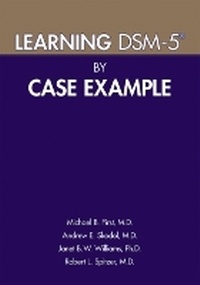
Learning DSM-5 (R) by Case Example
Published on 31. December 2016
Book
Paperback/Softback
487 pages
978-1-61537-016-0 (ISBN)
Description
With at least one case presentation for each of the mental
disorders catalogued in DSM-5-and multiple cases for nearly half of the
disorders-Learning DSM-5 by Case Example has been meticulously
designed to aid practitioners and students of all levels in psychology,
psychiatry, social work, counseling, and psychiatric nursing develop
internalized prototypes of DSM-5 disorders by first describing each disorder
in relatable terms and subsequently illustrating how these symptom
constellations manifest in real-life settings using clinical case
material.
The nearly 200 cases featured in this guide are drawn from
the clinical experience of well over 100 clinicians, many of whom are
well-known experts in particular areas of diagnosis and treatment. Sensitive
to the fact that one of the hallmarks of mental disorders is the wide range
of presentations that are encountered in a real-world setting, many of the
disorders described include multiple cases that vary in symptom
presentation, gender, age, clinical course, associated impairment in
psychosocial functioning, and developmental factors, thus giving readers an
appreciation for the heterogeneity typical of these disorders. Each case is
complemented by a discussion that elaborates the ways in which the case
conforms to the DSM-5 prototype or highlights those features of the case
that illustrate the heterogeneity.
With definitions of potentially
unfamiliar medical and psychiatric terms, Learning DSM-5 by Case
Example is an accessible resource for readers of all disciplines.
And because it guides the reader through the organizational structure of
DSM-5, it is also an ideal reference for courses on psychopathology or
abnormal psychology.
disorders catalogued in DSM-5-and multiple cases for nearly half of the
disorders-Learning DSM-5 by Case Example has been meticulously
designed to aid practitioners and students of all levels in psychology,
psychiatry, social work, counseling, and psychiatric nursing develop
internalized prototypes of DSM-5 disorders by first describing each disorder
in relatable terms and subsequently illustrating how these symptom
constellations manifest in real-life settings using clinical case
material.
The nearly 200 cases featured in this guide are drawn from
the clinical experience of well over 100 clinicians, many of whom are
well-known experts in particular areas of diagnosis and treatment. Sensitive
to the fact that one of the hallmarks of mental disorders is the wide range
of presentations that are encountered in a real-world setting, many of the
disorders described include multiple cases that vary in symptom
presentation, gender, age, clinical course, associated impairment in
psychosocial functioning, and developmental factors, thus giving readers an
appreciation for the heterogeneity typical of these disorders. Each case is
complemented by a discussion that elaborates the ways in which the case
conforms to the DSM-5 prototype or highlights those features of the case
that illustrate the heterogeneity.
With definitions of potentially
unfamiliar medical and psychiatric terms, Learning DSM-5 by Case
Example is an accessible resource for readers of all disciplines.
And because it guides the reader through the organizational structure of
DSM-5, it is also an ideal reference for courses on psychopathology or
abnormal psychology.
Reviews / Votes
Nothing brings a construct better to life than a vivid example, and this text explodes with wonderfully instructive illustrations of DSM-5 disorders. This text will provide outstanding supplemental reading for courses across the mental health professions." - Thomas A. Widiger, Ph.D., Department of Psychology, University of Kentucky"For the newcomer to mental disorder classification, and even for seasoned clinicians, DSM-5 can seem daunting in its complexity and depth. Fortunately, Drs. First, Skodol, Williams, and Spitzer have provided a marvelously rich compendium of case material that helps the detailed criteria on the pages of DSM-5 come alive." - Robert F. Krueger Ph.D., Hathaway Distinguished Professor, Distinguished McKnight University Professor, and Director of Clinical Training, Department of Psychology, University of Minnesota
"In this superb casebook, diagnostic categories jump off the page in the context of brief but vivid descriptions of real patients. Continuing and improving on the strong tradition of previous editions of this casebook, various case studies are provided illustrating the different ways in which patients might meet criteria for one DSM-5 disorder or another, and unlike previous editions, the case examples align very closely with each chapter in DSM-5. Everyone teaching or learning about psychopathology would benefit from this excellent resource." - David H. Barlow Ph.D., ABPP, Emeritus Professor of Psychology and Psychiatry, Boston University, Founder and Director Emeritus, Center for Anxiety and Related Disorders
"I cannot imagine how new students could get an understanding of our diagnostic system without this book. Truly a must read for teachers, students, and practitioners of medicine, nursing, psychology, social work, occupational and physical therapy, and others who interact with persons suffering from mental disorders." - A. John Rush, Professor Emeritus, Duke-National University of Singapore Graduate Medical School
More details
Language
English
Place of publication
VA
United States
Target group
Professional and scholarly
US School Grade: College Graduate Student and over
Product notice
Paperback (trade)
Illustrations
22 Tables, unspecified
Dimensions
Height: 254 mm
Width: 178 mm
Weight
757 gr
ISBN-13
978-1-61537-016-0 (9781615370160)
Copyright in bibliographic data and cover images is held by Nielsen Book Services Limited or by the publishers or by their respective licensors: all rights reserved.
Schweitzer Classification
Other editions
New editions
Michael B. First | Andrew E. Skodol
Learning DSM-5-TR (R) by Case Example
Book
02/2025
American Psychiatric Association Publishing
€88.50
Article not available at the moment
Persons
Michael B. First, M.D., is Professor of Clinical
Psychiatry at Columbia University College of Physicians and Surgeons, and
Research Psychiatrist, Division of Clinical Phenomenology, at New York State
Psychiatric Institute, in New York, New York.
Andrew E. Skodol,
M.D., is Research Professor of Psychiatry at University of Arizona
College of Medicine in Tucson, Arizona, and Adjunct Professor of Psychiatry
at Columbia University College of Physicians and Surgeons in New York, New
York.
Janet B. W. Williams, Ph.D., is Professor Emerita of
Clinical Psychiatric Social Work (in Psychiatry and Neurology) at Columbia
University College of Physicians and Surgeons, and Research Scientist and
Deputy Chief of the Biometrics Research Department (Retired) at New York
State Psychiatric Institute in New York, New York; she is also Senior Vice
President of Global Science at MedAvante, Inc., in Hamilton, New
Jersey.
Robert L. Spitzer, M.D., was Professor Emeritus of
Psychiatry at Columbia University College of Physicians and Surgeons, and
Research Scientist and Chief of the Biometrics Research Department (Retired)
at New York State Psychiatric Institute in New York, New York. Dr. Spitzer
passed away on December 25, 2015.
Psychiatry at Columbia University College of Physicians and Surgeons, and
Research Psychiatrist, Division of Clinical Phenomenology, at New York State
Psychiatric Institute, in New York, New York.
Andrew E. Skodol,
M.D., is Research Professor of Psychiatry at University of Arizona
College of Medicine in Tucson, Arizona, and Adjunct Professor of Psychiatry
at Columbia University College of Physicians and Surgeons in New York, New
York.
Janet B. W. Williams, Ph.D., is Professor Emerita of
Clinical Psychiatric Social Work (in Psychiatry and Neurology) at Columbia
University College of Physicians and Surgeons, and Research Scientist and
Deputy Chief of the Biometrics Research Department (Retired) at New York
State Psychiatric Institute in New York, New York; she is also Senior Vice
President of Global Science at MedAvante, Inc., in Hamilton, New
Jersey.
Robert L. Spitzer, M.D., was Professor Emeritus of
Psychiatry at Columbia University College of Physicians and Surgeons, and
Research Scientist and Chief of the Biometrics Research Department (Retired)
at New York State Psychiatric Institute in New York, New York. Dr. Spitzer
passed away on December 25, 2015.
Content
About the
Authors
Introduction
Acknowledgments
Chapter 1.
Neurodevelopmental Disorders
Chapter 2. Schizophrenia Spectrum and Other
Psychotic Disorders
Chapter 3. Bipolar and Related Disorders
Chapter
4. Depressive Disorders
Chapter 5. Anxiety Disorders
Chapter 6.
Obsessive-Compulsive and Related Disorders
Chapter 7. Trauma- and
Stressor-Related Disorders
Chapter 8. Dissociative Disorders
Chapter
9. Somatic Symptom and Related Disorders
Chapter 10. Feeding and Eating
Disorders
Chapter 11. Elimination Disorders
Chapter 12. Sleep-Wake
Disorders
Chapter 13. Sexual Dysfunctions
Chapter 14. Gender
Dysphoria
Chapter 15. Disruptive, Impulse-Control, and Conduct
Disorders
Chapter 16. Substance-Related and Addictive
Disorders
Chapter 17. Neurocognitive Disorders
Chapter 18.
Personality Disorders
Chapter 19. Paraphilic Disorders
Alphabetical
Index of Case Names
Alphabetical Index of Diagnoses and Related
Cases
Index
Authors
Introduction
Acknowledgments
Chapter 1.
Neurodevelopmental Disorders
Chapter 2. Schizophrenia Spectrum and Other
Psychotic Disorders
Chapter 3. Bipolar and Related Disorders
Chapter
4. Depressive Disorders
Chapter 5. Anxiety Disorders
Chapter 6.
Obsessive-Compulsive and Related Disorders
Chapter 7. Trauma- and
Stressor-Related Disorders
Chapter 8. Dissociative Disorders
Chapter
9. Somatic Symptom and Related Disorders
Chapter 10. Feeding and Eating
Disorders
Chapter 11. Elimination Disorders
Chapter 12. Sleep-Wake
Disorders
Chapter 13. Sexual Dysfunctions
Chapter 14. Gender
Dysphoria
Chapter 15. Disruptive, Impulse-Control, and Conduct
Disorders
Chapter 16. Substance-Related and Addictive
Disorders
Chapter 17. Neurocognitive Disorders
Chapter 18.
Personality Disorders
Chapter 19. Paraphilic Disorders
Alphabetical
Index of Case Names
Alphabetical Index of Diagnoses and Related
Cases
Index