

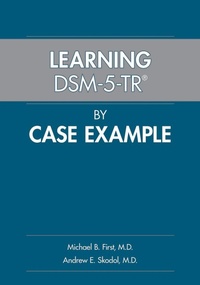
Learning DSM-5-TR® by Case Example
Description

Taking an innovative, case-based approach to DSM-5-TR, this new volume provides comprehensive, practical guidance to understanding the latest diagnostic criteria and applying them effectively to practice.
Organized according to the order of the 19 diagnostic groupings as they appear in DSM-5-TR, this manual features at least one case (and often multiple cases) for each unique mental disorder included in DSM-5-TR-drawn from the real-world practice of a diverse group of experts. Each chapter offers an overview of the manifestation of the various disorders in each disorder class; a table summarizing the key characteristics of individual disorders; and a rich discussion of the hallmark features, prevalence, clinical course, and commonly co-occurring conditions of each disorder, among other topics.
This edition also features four new, cutting-edge cases from the "Conditions for Further Study" chapter in DSM-5-TRand from ICD-11, including Attenuated Psychosis Syndrome and Internet Gaming Disorder, as well as Olfactory Reference Disorder and Compulsive Sexual Behavior Disorder, respectively.
Expansive in scope and meticulous in its level of detail, Learning DSM-5-TR by Case Example is as relevant for students and trainees learning about the diagnosis of psychopathology as it is for experienced clinicians seeking to improve their understanding of the new concepts and terminology in DSM-5-TR.
More details
Other editions
Additional editions
Persons
Michael B. First, M.D., is Professor of Clinical Psychiatry at Columbia University Vagelos College of Physicians and Surgeons, and Research Psychiatrist (retired), Division of Behavioral Health and Policy Research, at New York State Psychiatric Institute, in New York, New York.
Andrew E. Skodol, M.D., is Research Professor of Psychiatry at University of Arizona College of Medicine in Tucson, Arizona.
Content
About the AuthorsIntroductionAcknowledgmentsChapter 1. Neurodevelopmental DisordersChapter 2. Schizophrenia Spectrum and Other Psychotic DisordersChapter 3. Bipolar and Related DisordersChapter 4. Depressive DisordersChapter 5. Anxiety DisordersChapter 6. Obsessive-Compulsive and Related DisordersChapter 7. Trauma and Stressor-Related DisordersChapter 8. Dissociative DisordersChapter 9. Somatic Symptom and Related DisordersChapter 10. Feeding and Eating DisordersChapter 11. Elimination DisordersChapter 12. Sleep-Wake DisordersChapter 13. Sexual DysfunctionsChapter 14. Gender DysphoriaChapter 15. Disruptive, Impulse-Control, and Conduct DisordersChapter 16. Substance-Related and Addictive DisordersChapter 17. Neurocognitive DisordersChapter 18. Personality DisordersChapter 19. Paraphilic DisordersChapter 20. Conditions for Further StudyAlphabetical Index of Case NamesAlphabetical Index of Diagnoses and Related CasesIndex
