

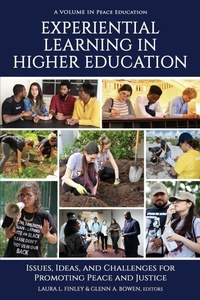
Experiential Learning in Higher Education
Issues, Ideas, and Challenges for Promoting Peace and Justice
Published on 25. May 2021
Book
Paperback/Softback
196 pages
978-1-64802-529-7 (ISBN)
Description
This edited volume focuses on best practices in experiential learning. Chapters address service-learning, community-based research, international efforts and other experiential methods, highlighting innovative approaches, successes, and issues of concern. Further, the book also demonstrates the interdisciplinary nature of experiential education, with authors hailing from psychology, sociology, education, social work, nursing, business and more. This timely and thorough volume will be useful to educators who are already involved in experiential education as well as those who are interested in the pedagogy and practice.
More details
Series
Language
English
Place of publication
United States
Publishing group
Emerald Publishing Inc
Target group
Professional and scholarly
Dimensions
Height: 234 mm
Width: 156 mm
Thickness: 11 mm
Weight
307 gr
ISBN-13
978-1-64802-529-7 (9781648025297)
Copyright in bibliographic data and cover images is held by Nielsen Book Services Limited or by the publishers or by their respective licensors: all rights reserved.
Schweitzer Classification
Other editions
Additional editions
Laura L. Finley | Glenn A. Bowen
Experiential Learning in Higher Education
Issues, Ideas, and Challenges for Promoting Peace and Justice
E-Book
05/2021
1st Edition
IAP - Information Age Publishing
€62.33
Available for download
Content
Foreword; Patrick M. Green.
Acknowledgments and Dedication.
Introduction: The Place and Purpose of Experiential Learning in Higher Education; Glenn A. Bowen.
Chapter 1. Community-Focused Experiential Learning: Creating Conditions for Fostering Social Responsibility; Glenn A. Bowen.
Chapter 2. Exploring a Critical Model of Faculty Engagement With Service-Learning Programs; Heidi Whitford.
Chapter 3. The Germination of an Engaged Scholar: From Tilling the Soil to Growing the Tree; Pamela D. Hall.
Chapter 4. Building a Campus-Community Coalition to Address Dating and Domestic Violence; Laura L. Finley.
Chapter 5. Acting Like a Prince, Dancing Like a Queen, Singing Like a Cop: Promoting Peace and Justice Through Community-Engaged Film and Theater in General Education Arts Courses for Adults; Celeste Landeros (with Samoya Gordon, Tanisha Durham, and Braxton McClams).
Chapter 6. Building Minds and Organizations Through Conversational Learning; Sheila M. McMahon and Dale E. Hartz.
Chapter 7. Global Service-Learning as an Avenue to Address Social Determinants of Health: Considerations for Undergraduate Nursing Education; Mureen L. Shaw and Glenn A. Bowen.
Chapter 8. Multilingualism in the Home, Workplace, and Community: Lessons From an Experiential Learning Project; Ligia A. Mihut.
Chapter 9. Community-Based Research as an Approach to Experiential Learning in Methodology of Research: A Case Study; Gerene K. Starratt.
Chapter 10. Developing Novice Researchers as Social Justice Advocates: Lessons Learned From the Trenches in Performing Community-Based Research Pedagogy; Ruth Ban, Clarence V. Walker, Jr., Liliam Dominguez Menendez, and Valerie G. M. Scott.
Chapter 11. Concluding Thoughts: The Promise and Practice of Experiential Learning; Laura L. Finley.
Appendices
A: Forms of Experiential Learning.
B: Principles of Good Practice for Experiential Learning Activities.
C: Experiential Learning Resources.
About the Editors and Authors.
Index.
Acknowledgments and Dedication.
Introduction: The Place and Purpose of Experiential Learning in Higher Education; Glenn A. Bowen.
Chapter 1. Community-Focused Experiential Learning: Creating Conditions for Fostering Social Responsibility; Glenn A. Bowen.
Chapter 2. Exploring a Critical Model of Faculty Engagement With Service-Learning Programs; Heidi Whitford.
Chapter 3. The Germination of an Engaged Scholar: From Tilling the Soil to Growing the Tree; Pamela D. Hall.
Chapter 4. Building a Campus-Community Coalition to Address Dating and Domestic Violence; Laura L. Finley.
Chapter 5. Acting Like a Prince, Dancing Like a Queen, Singing Like a Cop: Promoting Peace and Justice Through Community-Engaged Film and Theater in General Education Arts Courses for Adults; Celeste Landeros (with Samoya Gordon, Tanisha Durham, and Braxton McClams).
Chapter 6. Building Minds and Organizations Through Conversational Learning; Sheila M. McMahon and Dale E. Hartz.
Chapter 7. Global Service-Learning as an Avenue to Address Social Determinants of Health: Considerations for Undergraduate Nursing Education; Mureen L. Shaw and Glenn A. Bowen.
Chapter 8. Multilingualism in the Home, Workplace, and Community: Lessons From an Experiential Learning Project; Ligia A. Mihut.
Chapter 9. Community-Based Research as an Approach to Experiential Learning in Methodology of Research: A Case Study; Gerene K. Starratt.
Chapter 10. Developing Novice Researchers as Social Justice Advocates: Lessons Learned From the Trenches in Performing Community-Based Research Pedagogy; Ruth Ban, Clarence V. Walker, Jr., Liliam Dominguez Menendez, and Valerie G. M. Scott.
Chapter 11. Concluding Thoughts: The Promise and Practice of Experiential Learning; Laura L. Finley.
Appendices
A: Forms of Experiential Learning.
B: Principles of Good Practice for Experiential Learning Activities.
C: Experiential Learning Resources.
About the Editors and Authors.
Index.