

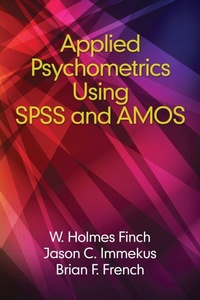
Applied Psychometrics using SPSS and AMOS
Published on 31. May 2016
Book
Paperback/Softback
288 pages
978-1-68123-526-4 (ISBN)
Description
The book will be designed primarily for graduate students (or advanced undergraduates) who are learning psychometrics, as well as professionals in the field who need a reference for use in their practice. We would assume that users have some basic knowledge of using SPSS to read data and conduct basic analyses (e.g., descriptive statistics, frequency distributions). In addition, the reader should be familiar with basic statistical concepts such as descriptive statistics (e.g., mean, median, variance, standard deviation), percentiles and the rudiments of hypothesis testing. They should also have a passing familiarity with issues in psychometrics such as reliability, validity and test/survey scoring. We will not assume any more than basic familiarity with these issues, and will devote a portion of each chapter (as well as the entire first chapter) to reviewing many of these basic ideas for those not familiar with them.
We envision the book as being useful either as a primary text for a course on applied measurement where SPSS is the main platform for instruction, or as a supplement to a more theoretical text. We also anticipate that readers working in government agencies responsible for testing and measurement issues at the local, state and national levels, and private testing, survey and market research companies, as well as faculty members needing a practical resource for psychometric practice will serve as a market for the book. In short, the readership would include graduate students, faculty members, data analysts and psychometricians responsible for analysis of survey response data, as well as educational and psychological assessments.
The goal of the book is to provide readers with the tools necessary for assessing the psychometric qualities of educational and psychological measures as well as surveys and questionnaires. Each chapter will cover an issue pertinent to psychometric and measurement practice, with an emphasis on application. Topics will be briefly discussed from a theoretical/technical perspective in order to provide the reader with the background necessary to correctly use and interpret the statistical analyses that will be presented subsequently. Readers will then be presented with examples illustrating a particular concept (e.g., reliability). These examples will include a discussion of the particular analysis, along with the SPSS code necessary to conduct them. The resulting output will then be discussed in detail, focusing on the interpretation of the results. Finally, examples of how these results might be written up will also be included in the text. It is hoped that this mixture of theory with examples of actual practice will serve the reader both as a pedagogical tool and as a reference work.
To our knowledge, no book outlining psychometric practice using commonly available software such as SPSS currently exists. Given that many practitioners in academia, government and private industry use SPSS for statistical analyses of testing data, we believe that our book will fill an important niche in the market. It will contain very practical information regarding how to conduct a wide variety of psychometric analyses, along with tips on interpretation of results and the appropriate format for reporting these results. We believe that it will prove useful to individuals in educational measurement, psychometrics, and survey and market research.
Our text will add to the literature by providing users with a single reference containing the major ideas in applied psychometrics with instructions and examples for conducting the analyses in SPSS. In addition, we will provide original macros for estimating a variety of statistics and conducting analyses common in educational and psychological measurement.
We envision the book as being useful either as a primary text for a course on applied measurement where SPSS is the main platform for instruction, or as a supplement to a more theoretical text. We also anticipate that readers working in government agencies responsible for testing and measurement issues at the local, state and national levels, and private testing, survey and market research companies, as well as faculty members needing a practical resource for psychometric practice will serve as a market for the book. In short, the readership would include graduate students, faculty members, data analysts and psychometricians responsible for analysis of survey response data, as well as educational and psychological assessments.
The goal of the book is to provide readers with the tools necessary for assessing the psychometric qualities of educational and psychological measures as well as surveys and questionnaires. Each chapter will cover an issue pertinent to psychometric and measurement practice, with an emphasis on application. Topics will be briefly discussed from a theoretical/technical perspective in order to provide the reader with the background necessary to correctly use and interpret the statistical analyses that will be presented subsequently. Readers will then be presented with examples illustrating a particular concept (e.g., reliability). These examples will include a discussion of the particular analysis, along with the SPSS code necessary to conduct them. The resulting output will then be discussed in detail, focusing on the interpretation of the results. Finally, examples of how these results might be written up will also be included in the text. It is hoped that this mixture of theory with examples of actual practice will serve the reader both as a pedagogical tool and as a reference work.
To our knowledge, no book outlining psychometric practice using commonly available software such as SPSS currently exists. Given that many practitioners in academia, government and private industry use SPSS for statistical analyses of testing data, we believe that our book will fill an important niche in the market. It will contain very practical information regarding how to conduct a wide variety of psychometric analyses, along with tips on interpretation of results and the appropriate format for reporting these results. We believe that it will prove useful to individuals in educational measurement, psychometrics, and survey and market research.
Our text will add to the literature by providing users with a single reference containing the major ideas in applied psychometrics with instructions and examples for conducting the analyses in SPSS. In addition, we will provide original macros for estimating a variety of statistics and conducting analyses common in educational and psychological measurement.
More details
Language
English
Place of publication
Charlotte
United States
Publishing group
Emerald Publishing Inc
Target group
College/higher education
Professional and scholarly
Dimensions
Height: 234 mm
Width: 156 mm
Thickness: 16 mm
Weight
442 gr
ISBN-13
978-1-68123-526-4 (9781681235264)
Copyright in bibliographic data and cover images is held by Nielsen Book Services Limited or by the publishers or by their respective licensors: all rights reserved.
Schweitzer Classification
Other editions
Additional editions
Holmes Finch
Applied Psychometrics using SPSS and AMOS
E-Book
01/2016
1st Edition
Information Age Publishing
from
€62.33
Available for download
Persons
Holmes Finch, Ball State University.Brian F. French, Washington State University.
Jason C. Immekus, University of Louisville.
Jason C. Immekus, University of Louisville.
Content
Preface.
Chapter 1. Introduction to Psychometric Concepts.
Chapter 2. Item Analysis.
Chapter 3. Reliability.
Chapter 4. Generalizability Theory.
Chapter 5. Validity.
Chapter 6. Issues in Scoring.
Chapter 7. Differential Item Functioning.
Chapter 8. Equating.
References.
Chapter 1. Introduction to Psychometric Concepts.
Chapter 2. Item Analysis.
Chapter 3. Reliability.
Chapter 4. Generalizability Theory.
Chapter 5. Validity.
Chapter 6. Issues in Scoring.
Chapter 7. Differential Item Functioning.
Chapter 8. Equating.
References.