

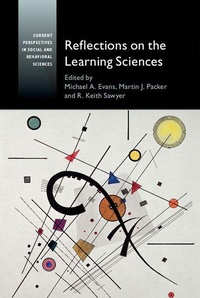
Reflections on the Learning Sciences
Published on 4. February 2016
Book
Hardback
308 pages
978-1-107-07015-8 (ISBN)
Description
This volume offers a historical and critical analysis of the emerging field of the learning sciences, which takes an interdisciplinary approach to understanding and improving how children and adults learn. It features a wide range of authors, including established scholars who founded and guided the learning sciences through the initial turbulence of forming a new line of academic inquiry, as well as newcomers who are continuing to shape the field. This diversity allows for a broad yet selective perspective on what the learning sciences are, why they came to be, and how contributors conduct their work. Reflections on the Learning Sciences serves both as a starting point for discussion among scholars familiar with the discipline and as an introduction for those interested in learning more. It will benefit graduate students and researchers in computer science, educational psychology, instructional technology, science, engineering, and mathematics.
More details
Series
Language
English
Place of publication
Cambridge
United Kingdom
Target group
Professional and scholarly
Illustrations
8 Tables, black and white; 18 Line drawings, black and white
Dimensions
Height: 235 mm
Width: 157 mm
Thickness: 21 mm
Weight
605 gr
ISBN-13
978-1-107-07015-8 (9781107070158)
Copyright in bibliographic data and cover images is held by Nielsen Book Services Limited or by the publishers or by their respective licensors: all rights reserved.
Schweitzer Classification
Other editions
Additional editions
Michael A. Evans | Martin J. Packer | R. Keith Sawyer
Reflections on the Learning Sciences
Book
10/2020
Cambridge University Press
€51.20
Shipment within 15-20 days
Michael A. Evans
Reflections on the Learning Sciences
E-Book
02/2016
Cambridge University Press
€24.49
Available for download
Michael A. Evans | Martin J. Packer | R. Keith Sawyer
Reflections on the Learning Sciences
E-Book
01/2016
Cambridge University Press
€103.99
Available for download
Persons
Michael A. Evans is Associate Professor in the Department of Teacher Education and Learning Sciences at North Carolina State University, where he is also a Senior Research Fellow at the Friday Institute for Educational Innovation. His numerous articles have appeared in journals such as the International Journal of Computer Supported Collaborative Learning, Educational Technology Research and Development and Computers in Education. Martin J. Packer is Associate Professor of Psychology at the University of the Andes in Bogota, Colombia. He is the author of The Structure of Moral Action, Changing Classes: School Reform and the New Economy, and The Science of Qualitative Research. He is also coeditor of Entering the Circle: Hermeneutic Investigation in Psychology (with Richard B. Addison) and Cultural and Critical Perspectives on Human Development (with Mark B. Tappan). He has published in American Psychologist and Educational Psychologist and was founding coeditor of the journal Qualitative Research in Psychology. R. Keith Sawyer is the Morgan Distinguished Professor in Educational Innovations at the University of North Carolina, Chapel Hill. He is the author or editor of fourteen books, including The Cambridge Handbook of the Learning Sciences, 2nd edition; Explaining Creativity: The Science of Human Innovation, 2nd edition; and Group Genius: The Creative Power of Collaboration.
Content
1. Introduction Michael A. Evans, Martin J. Packer and R. Keith Sawyer; Part I. Past: 2. Why learning sciences? Roger Schank; 3. The prehistory of the learning sciences Roy Pea; 4. Some early contributions to the situative perspective on learning and cognition James Greeno and Timothy Nokes-Malach; 5. The group as paradigmatic unit of analysis: the contested relationship of CSCL to the learning sciences Gerry Stahl; Part II. Present: 6. Reconstructing the influences on and focus of the learning sciences from the field's published conference proceedings Victor R. Lee, Min Yuan, Lei Ye and Mimi Recker; 7. Mapping the territory of the learning sciences Martin J. Packer and Cody Maddox; 8. Researcher-practitioner collaboration in educational design research: processes, roles, values, and expectations Susan McKenney; Part III. Future: 9. Growing the learning sciences: brand or big tent? Implications for graduate education Mitchell J. Nathan, Nikol Rummel and Kenneth E. Hay; 10. Education policy and the learning sciences: the case for a new alliance Mary Kay Stein, Kevin Crowley and Lauren Resnick; 11. Learning and development as transaction: offering a Deweyan perspective to extend the landscape of the learning sciences Michael A. Evans and Sandra Schneider; 12. Conclusion: a Foucauldian analysis of the learning sciences R. Keith Sawyer.