

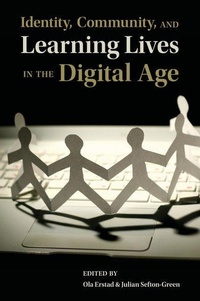
Identity, Community, and Learning Lives in the Digital Age
Transactions, Technologies, and Learner Identity
Published on 16. April 2015
Book
Paperback/Softback
254 pages
978-1-107-50727-2 (ISBN)
Description
Recent work on education, identity and community has expanded the intellectual boundaries of learning research. From home-based studies examining youth experiences with technology, to forms of entrepreneurial learning in informal settings, to communities of participation in the workplace, family, community, trade union and school, research has attempted to describe and theorize the meaning and nature of learning. Identity, Community, and Learning Lives in the Digital Age offers a systematic reflection on these studies, exploring how learning can be characterized across a range of 'whole-life' experiences. The volume brings together hitherto discrete and competing scholarly traditions: sociocultural analyses of learning, ethnographic literacy research, geo-spatial location studies, discourse analysis, comparative anthropological studies of education research and actor network theory. The contributions are united through a focus on the ways in which learning shapes lives in a digital age.
More details
Language
English
Place of publication
Cambridge
United Kingdom
Target group
Professional and scholarly
Product notice
Paperback (trade)
Illustrations
2 Tables, unspecified; 8 Halftones, unspecified; 3 Line drawings, unspecified
Dimensions
Height: 229 mm
Width: 152 mm
Thickness: 16 mm
Weight
418 gr
ISBN-13
978-1-107-50727-2 (9781107507272)
Copyright in bibliographic data and cover images is held by Nielsen Book Services Limited or by the publishers or by their respective licensors: all rights reserved.
Schweitzer Classification
Other editions
Additional editions
Ola Erstad | Julian Sefton-Green
Identity, Community, and Learning Lives in the Digital Age
Book
10/2012
Cambridge University Press
€140.60
Shipment within 15-20 days
Persons
Ola Erstad is a professor in the Department of Educational Research, University of Oslo. Professor Erstad works across the fields of media and educational research and has published widely on issues of technology and education. Julian Sefton-Green is an independent consultant and researcher. He is a principal research fellow at the London School of Economics and an honorary professor at the Hong Kong Institute of Education. He has published widely on media education, informal learning and creativity.
Content
Introduction: why learning lives? Julian Sefton-Green and Ola Erstad; Part I. Changing Approaches to Studying Learning: Identity, Policy and Social Change: 2. Tracing learning and identity across sites: tensions, connections and transformations in and between everyday and institutional practices Hans Christian Arnseth and Kenneth Silseth; 3. Procedural methodologies and digital forms of learning Kirsten Drotner; 4. Thinking about feeling: affect across literacies and lives Jay Lemke; 5. Learning lives in second modernity Lynne Chisholm; 6. Digital dis-connect? The 'digital learner' and the school Ola Erstad and Julian Sefton-Green; Part II. From Learning to Learners: Learning Lives as They are Lived: 7. Expanding the chronotypes of schooling for the promotion of students' agency Antti Rajala, Jaakko Hilppo, Lasse Lipponen and Kristiina Kumpulainen; 8. Discursive construction of learning lives for individuals and the collective Judith Green, Audra Skukauskaite and Maria Lucia Castanheira; 9. Social entrepreneurship: learning environments with exchange value Shirley Brice Heath; 10. The construction of parents as learners about pre-school children's development Helen Nixon; 11. Participant categorizations of gaming competence: Noob and Imba as learner identities Bjorn Sjoblom and Karin Aronsson; 12. Making a film-maker: four pathways across school, peer culture, and community Oystein Gilje; 13. Portrait of the artist as a younger adult: multimedia literacy and 'effective surprise' Mark Evan Nelson, Glynda A. Hull and Randy Young.