

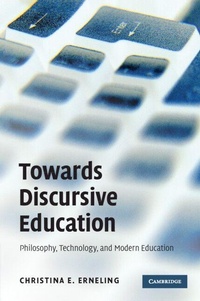
Towards Discursive Education
Philosophy, Technology, and Modern Education
Published on 16. September 2010
Book
Paperback/Softback
210 pages
978-0-521-14402-5 (ISBN)
Description
As technology continues to advance, the use of computers and the Internet in educational environments has immensely increased. But just how effective has their use been in enhancing children's learning? In this thought-provoking book, Christina E. Erneling conducts a thorough investigation of scholarly journal articles on how computers and the Internet affect learning. She critiques the influential pedagogical theories informing the use of computers in schools - in particular those of Jean Piaget and 'theory of mind' psychology. Erneling introduces and argues for a discursive approach to learning based on the philosophy of Ludwig Wittgenstein and the psychology of Lev Vygotsky. This book not only addresses an urgent pedagogical problem in depth, but also challenges dominant assumptions about learning in both developmental psychology and cognitive science.
Reviews / Votes
'In this important book Christina Erneling undermines one of the pervasive myths of our time - that there are culture independent mechanisms on the one hand and formal procedure on the other with which everything human is accomplished. Her target is the way this myth has led to the fatal neglect of the societal and linguistic contexts in which learning, like every other human activity, takes place. This book deserves the attention not only of those involved in schooling but of everyone with an interest in the development of mature human beings.' Rom Harre, Georgetown University, Washington DC and Centre for the Philosophy of the Natural and Social Sciences, London School of Economics 'In this book Erneling turns the tables on the common assumption that biology determines mind and dictates human development. Her Wittgensteinian perspective highlights the centrality of discourse, the meeting of minds, and social practices generally to human development and educational practices. While not denying the biological and individual psychological processes involved, she shows that imitation and participation in normative social practices are the governing mechanisms for the growth of mind.' David R. Olson, University of Toronto and author of Psychological Theory and Educational Reform: How School Remakes Mind and SocietyMore details
Language
English
Place of publication
Cambridge
United Kingdom
Target group
Professional and scholarly
Product notice
Paperback (trade)
Dimensions
Height: 229 mm
Width: 152 mm
Thickness: 12 mm
Weight
315 gr
ISBN-13
978-0-521-14402-5 (9780521144025)
Copyright in bibliographic data and cover images is held by Nielsen Book Services Limited or by the publishers or by their respective licensors: all rights reserved.
Schweitzer Classification
Other editions
Additional editions
Book
09/2010
Cambridge University Press
€57.30
Shipment within 15-20 days
E-Book
09/2010
1st Edition
Cambridge University Press
€29.49
Available for download
Person
Christina E. Erneling is Assistant Professor in the Department of Communication Studies at Lund University, Sweden. She is the author of Understanding Language Acquisition: The Framework of Learning (1993) and co-editor of two books on cognitive science: The Mind as a Scientific Object: Between Brain and Culture (2005) and The Future of the Cognitive Revolution (1997).
Content
Introduction; 1. The infantilisation of learning; 2. Educational technologies and pedagogy; 3. Piaget and natural learning; 4. Piaget's conception of the framework: from instincts to intentionality; 5. The infant as scientist; 6. The socio-cultural approach to learning; 7. Towards discursive education; Appendix.