

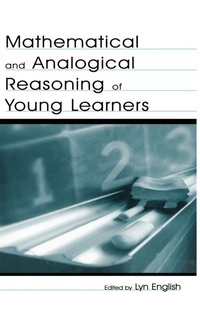
Mathematical and Analogical Reasoning of Young Learners
Published on 14. May 2004
Book
Hardback
236 pages
978-0-8058-4102-2 (ISBN)
Description
Mathematical and Analogical Reasoning of Young Learners provides foundational knowledge of the nature, development, and assessment of mathematical and analogical reasoning in young children. Reasoning is fundamental to understanding mathematics and is identified as one of the 10 key standards for school mathematics for the new millennium. The book draws on longitudinal and cross-cultural studies, conducted in the United States and Australia, of children's reasoning development as they progressed from preschool through the end of second grade.
The multifaceted analysis of young children's development of mathematical and analogical reasoning focuses on individual learners, their learning environments, and the interaction between the two. The multidisciplinary team of authors present multiple perspectives and multiple methodologies, and provide valuable information on organizing and sustaining interdisciplinary and cross-cultural inquiry. Key issues addressed include:
*the relationship between mathematical and analogical reasoning;
*how changes in children's reasoning relate to the implicit instruction they receive in their classrooms;
*analyses of the participating teachers' knowledge, beliefs, and practices with respect to mathematical and analogical reasoning of young learners; and
*ways in which we might promote development of mathematical and analogical reasoning in young children.
This volume is highly relevant for mathematics educators, researchers in mathematics education, educational psychologists, early childhood teachers, and others interested in mathematical development of young children, in particular, the development of their reasoning processes.
The multifaceted analysis of young children's development of mathematical and analogical reasoning focuses on individual learners, their learning environments, and the interaction between the two. The multidisciplinary team of authors present multiple perspectives and multiple methodologies, and provide valuable information on organizing and sustaining interdisciplinary and cross-cultural inquiry. Key issues addressed include:
*the relationship between mathematical and analogical reasoning;
*how changes in children's reasoning relate to the implicit instruction they receive in their classrooms;
*analyses of the participating teachers' knowledge, beliefs, and practices with respect to mathematical and analogical reasoning of young learners; and
*ways in which we might promote development of mathematical and analogical reasoning in young children.
This volume is highly relevant for mathematics educators, researchers in mathematics education, educational psychologists, early childhood teachers, and others interested in mathematical development of young children, in particular, the development of their reasoning processes.
Reviews / Votes
"This book is a very useful resource not only for mathematics education researchers, cognitive psychologists and teacher educators but would also benefit classroom teachers of young children. Understanding the development of children's reasoning processes would help teachers tailor instruction that facilitates and nurtures the natural 'mathematical' tendencies of young children....recommended very highly."-The Montana Mathematics Enthusiast
"This book fills a niche in the current literature. It takes us back to the very roots of learning by investigating foundational questions on the nature of, the evolution of, and the complexity of reasoning in young children. The book's attempt to create a research base on children's analogical reasoning and its relationship to mathematical reasoning is a giant step in the right direction. It is certainly an eye-opener for anybody interested in complexities of the teaching and learning of mathematics."
-ZDM - International Reviews on Mathematical Education
More details
Series
Language
English
Place of publication
New York
United States
Publishing group
Taylor & Francis Inc
Target group
College/higher education
Professional and scholarly
Dimensions
Height: 235 mm
Width: 157 mm
Thickness: 17 mm
Weight
501 gr
ISBN-13
978-0-8058-4102-2 (9780805841022)
Copyright in bibliographic data and cover images is held by Nielsen Book Services Limited or by the publishers or by their respective licensors: all rights reserved.
Schweitzer Classification
Other editions
Additional editions
Lyn D. English
Mathematical and Analogical Reasoning of Young Learners
E-Book
07/2004
1st Edition
Routledge
€55.59
Available for download
Lyn D. English
Mathematical and Analogical Reasoning of Young Learners
E-Book
07/2004
1st Edition
Routledge
€52.99
Available for download
Lyn D. English
Mathematical and Analogical Reasoning of Young Learners
E-Book
07/2004
1st Edition
Routledge
€52.99
Available for download
Lyn D. English
Mathematical and Analogical Reasoning of Young Learners
Book
05/2004
Routledge
€60.20
Shipment within 10-20 days
Person
Lyn D. English
Content
Contents: Preface. L.D. English, Mathematical and Analogical Reasoning in Early Childhood. P.A. Alexander, M. Buehl, Seeing the Possibilities: Constructing and Validating Measures of Mathematical and Analogical Reasoning for Young Children. M.M. Buehl, P.A. Alexander, Longitudinal and Cross-Cultural Trends in Young Children's Analogical and Mathematical Reasoning Abilities. S. Chiu, M.O. Tron, Classroom Discourse and the Development of Mathematical and Analogical Reasoning. D. Deal, S. Hardy, Portraying Mathematical and Analogical Reasoning in the Young: Three Case Studies. C.S. White, D. Deal, C.B. Deniz, Teachers' Knowledge, Beliefs, and Practices and Mathematical and Analogical Reasoning. C.S. White, D. Deal, Case Studies of Teacher Beliefs, Knowledge, and Practices. U. Goswami, Commentary: Analogical Reasoning and Mathematical Development. G. Hatano, T. Sakakibara, Commentary: Toward a Cognitive-Sociocultural Psychology of Mathematical and Analogical Development. L.D. English, Promoting the Development of Young Children's Mathematical and Analogical Reasoning.