

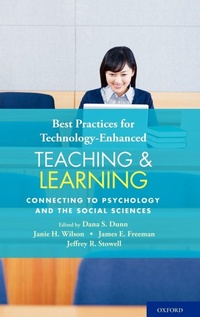
Best Practices for Technology-Enhanced Teaching and Learning
Connecting to Psychology and the Social Sciences
1st Edition
Published on 17. February 2011
Book
Hardback
352 pages
978-0-19-973318-7 (ISBN)
Description
The use of technology and teaching techniques derived from technology is currently a bourgeoning topic in higher education. Teachers at all levels and types of institutions want to know how these new technologies will affect what happens in and outside of the classroom. Many teachers have already embraced some of these technologies but remain uncertain about their educational efficacy. Other teachers have waited because they are reluctant to try tools or techniques that remain unproven or, as is often the case, lack institutional support. This book is designed to help both groups, so that those with technological expertise can extend their knowledge, while technological novices can "ramp up" at their own pace and for their own purposes.
Best Practices for Technology-Enhanced Teaching and Learning brings together expert teacher-scholars who apply and assess technology's impact on traditional, hybrid or blended, or completely on-line courses, relying on technology as a teaching tool for classroom management and interaction (e.g., Blackboard, PowerPoint, student response or "clicker systems," multimedia tools), as well as student-based uses of technology largely independent of instructors (e.g., social networking on popular sites including Facebook and MySpace). Each chapter will address how technological improvements can be connected to assessment initiatives, as is now routinely advocated in psychology and social science education. The book features current scholarship and pedagogy involving innovative technology that impacts on student learning in psychology and related disciplines, focusing also on student reactions to these novel technologies, and proper assessments of how well they promote learning. This text will serve as the standard reference on emerging technologies for undergraduate instructors.
Best Practices for Technology-Enhanced Teaching and Learning brings together expert teacher-scholars who apply and assess technology's impact on traditional, hybrid or blended, or completely on-line courses, relying on technology as a teaching tool for classroom management and interaction (e.g., Blackboard, PowerPoint, student response or "clicker systems," multimedia tools), as well as student-based uses of technology largely independent of instructors (e.g., social networking on popular sites including Facebook and MySpace). Each chapter will address how technological improvements can be connected to assessment initiatives, as is now routinely advocated in psychology and social science education. The book features current scholarship and pedagogy involving innovative technology that impacts on student learning in psychology and related disciplines, focusing also on student reactions to these novel technologies, and proper assessments of how well they promote learning. This text will serve as the standard reference on emerging technologies for undergraduate instructors.
Reviews / Votes
Many readers will likely find their virtual toolbox much more robust after reviewing the text. * PsycCRITIQUES *More details
Language
English
Place of publication
New York
United States
Target group
Professional and scholarly
Undergraduate instructors, especially in psychology and social science.
Dimensions
Height: 240 mm
Width: 161 mm
Thickness: 24 mm
Weight
696 gr
ISBN-13
978-0-19-973318-7 (9780199733187)
Copyright in bibliographic data and cover images is held by Nielsen Book Services Limited or by the publishers or by their respective licensors: all rights reserved.
Schweitzer Classification
Other editions
Additional editions
Dana S. Dunn | Janie H. Wilson | James Freeman
Best Practices for Technology-Enhanced Teaching and Learning
Connecting to Psychology and the Social Sciences
E-Book
02/2011
1st Edition
OUP eBook
€61.99
Available for download
Dana S. Dunn | Janie H. Wilson | James Freeman
Best Practices for Technology-Enhanced Teaching and Learning: Connecting to Psychology and the Social Sciences
E-Book
01/2011
1st Edition
Oxford University Press
€54.00
Available for download
Persons
Dana S. Dunn is currently professor of psychology and director of the Learning in Common Curriculum at Moravian College in Bethlehem, PA. He is the author or editor of 12 books and over 100 articles, chapters, and book reviews. Dr. Dunn frequently speaks on assessment matters, issues facing higher education, and psychological topics at professional conferences, and he served as President of the Society for the Teaching of Psychology in 2010. Dana Dunn is winner of the 2013 Charles L. Brewer Award for Distinguished Teaching of Psychology from the American Psychological Foundation (of the APA). Janie H. Wilson is a professor at Georgia Southern University, where she has been teaching for over 15 years.
Dr. Wilson's research on teaching focuses on the importance of building rapport with students. She conducts studies on student evaluations of rapport as related to students' attitudes, motivation, and grades. Recent and current projects include building rapport through touch such as a handshake, electronic communication such as email, and numerous immediacy behaviors as well as examining the importance of the first day of class.
Dr. Wilson currently serves as the Program Director in the Society for the Teaching of Psychology. James E. Freeman has been teaching for over 34 years and is currently a professor of psychology and director of Undergraduate Studies at the University of Virginia. Dr. Freeman's specialty area is research methods and statistics. He has also served in various capacities for the Society for the Teaching of Psychology and committees for the American Psychological Association. Jeffrey R. Stowell is an associate professor at Eastern Illinois University. His research interests are in test anxiety, and how technology can enhance student learning. Dr. Stowell currently serves as the Internet Editor for the Society for the Teaching of Psychology.
Dr. Wilson's research on teaching focuses on the importance of building rapport with students. She conducts studies on student evaluations of rapport as related to students' attitudes, motivation, and grades. Recent and current projects include building rapport through touch such as a handshake, electronic communication such as email, and numerous immediacy behaviors as well as examining the importance of the first day of class.
Dr. Wilson currently serves as the Program Director in the Society for the Teaching of Psychology. James E. Freeman has been teaching for over 34 years and is currently a professor of psychology and director of Undergraduate Studies at the University of Virginia. Dr. Freeman's specialty area is research methods and statistics. He has also served in various capacities for the Society for the Teaching of Psychology and committees for the American Psychological Association. Jeffrey R. Stowell is an associate professor at Eastern Illinois University. His research interests are in test anxiety, and how technology can enhance student learning. Dr. Stowell currently serves as the Internet Editor for the Society for the Teaching of Psychology.
Content
Chapter 1 - Getting Connected: An Overview of Best Practices for Using Technology to Improve Teaching and Learning in Psychology - Dana S. Dunn, Janie H. Wilson, James Freeman, and Jeffrey R. StowellTeaching with Technology: Issues and IdeasChapter 2 - Approach or Avoidance? Understanding Technology's Place In and Outside of the Classroom - Dana S. Dunn, Janie H. Wilson, & James FreemanChapter 3 - A Walk Down Random Access Memory Lane: Implications for Teaching with Technology - Bernard C. BeinsChapter 4 - Developing an Online Curriculum in Psychology: Practical Advice from a Departmental Initiative - Jeffrey L. Helms, Pam Marek, and Christopher K. Randall, Daniel T. Rogers, Lauren A. Taglialatela, and Adrienne A. WilliamsonChapter 5 - Faculty-Student Communication: Beyond Face to Face - Monica Reis-Bergan, Suzanne C. Baker, Kevin J. Apple, & Tracy E. ZinnChapter 6 - Practical PowerPoint: Promising Principles for Developing Individual Practice - David B. DanielTechnology: Applications In and Outside the ClassroomChapter 7 - Comprehensive Hybrid Course Development - Charles M. Harris & Ulas KaplanChapter 8 -Academic Advising with a Developmentally Organized Web Site- Drew ApplebyChapter 9 - Enhancing Student Engagement and Learning Using "Clicker"-based Interactive Classroom Demonstrations - Gary M. Muir and Anne M. ClearyChapter 10 - The What? How? and Which? of Course Management Systems - Michelle A. DrouinChapter 11 - Interact! Teaching Using an Interactive Whiteboard - Matthew B. Sacks and Ben JonesChapter 12 - Motivating Student Engagement with MySpace and Web-Enhanced Research Labs - Kim A. Case and Beth HentgesChapter 13 - A Practical Guide to Using YouTube in the Classroom - Mandy ClevelandChapter 14 - I Didn't Know I Could Do That: Using Web-Based Tools to Enhance Learning - Jorge Perez and Kevin HuryszChapter 15 - Think Fast: Using Web-Based Reaction Time Technology to Promote Teaching about Racial Bias and Diversity - Kathryn A. Morris, Leslie Ashburn-Nardo, and Robert J. PadgettTechnology: New Opportunities for TeachingChapter 16 - Online Tools to Promote Student Collaboration - Kevin J. Apple, Monica Reis-Bergan, Andrea H. Adams, and Grover SaundersChapter 17 - To the Internet and Beyond: Surveying the Active Learning Universe - Beth Kirsner, Clayton L. Teem II, and Laura B. UnderwoodChapter 18 - Online Quizzes: Improving Reading Compliance and Student Learning - Lonnie Yandell and William N. BaileyChapter 19 - Going Virtual: Virtual Worlds as Educational Tools - Suzanne C. Baker and Monica Reis-BerganChapter 20 - Emerging Technologies to Improve Teaching and Learning in a Digital World - Jeffrey R. StowellAuthor IndexSubject Index