

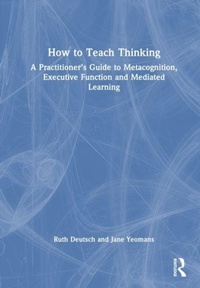
How to Teach Thinking
A Practitioner's Guide to Metacognition, Executive Function and Mediated Learning
1st Edition
Will be published approx. on 29. October 2026
Book
Hardback
180 pages
978-1-041-10498-8 (ISBN)
Description
How to Teach Thinking develops a range of tools for bringing together two essential components of effective learning: knowledge (what we know) and cognitive skills (how we learn). Mediation is the way in which these cognitive skills can be taught and promoted, ensuring successful learning for everyone and particularly for those with additional learning needs. This book blends theory and practice to embed thinking skills both in everyday classroom practice and for daily life activities
The book is divided into two parts, the first of which offers an exploration of the conceptual foundations of cognitive skills, including executive functioning and metacognition, which can be applied to a range of problem-solving activities. The second part develops the infusion model of teaching, an inclusive approach which incorporates thinking skills within the day-to-day curriculum. A user- friendly framework is set out with step-by-step guidance for mediating cognitive thinking skills, together with a wealth of resources and strategies to support the process, including practical scripts.
With case examples to bring theory to life, How to Teach Thinking is an essential resource for SENCOs, TAs, mainstream and specialist teachers, and educational psychologists, to enhance their practice. It will also be of use to speech and language therapists to incorporate a cognitive approach to enrich the development of reasoning skills.
The book is divided into two parts, the first of which offers an exploration of the conceptual foundations of cognitive skills, including executive functioning and metacognition, which can be applied to a range of problem-solving activities. The second part develops the infusion model of teaching, an inclusive approach which incorporates thinking skills within the day-to-day curriculum. A user- friendly framework is set out with step-by-step guidance for mediating cognitive thinking skills, together with a wealth of resources and strategies to support the process, including practical scripts.
With case examples to bring theory to life, How to Teach Thinking is an essential resource for SENCOs, TAs, mainstream and specialist teachers, and educational psychologists, to enhance their practice. It will also be of use to speech and language therapists to incorporate a cognitive approach to enrich the development of reasoning skills.
More details
Language
English
Place of publication
London
United Kingdom
Publishing group
Taylor & Francis Ltd
Target group
Professional and scholarly
Professional Practice & Development
Illustrations
16 s/w Zeichnungen, 31 s/w Tabellen, 16 s/w Abbildungen
31 Tables, black and white; 16 Line drawings, black and white; 16 Illustrations, black and white
Dimensions
Height: 246 mm
Width: 174 mm
ISBN-13
978-1-041-10498-8 (9781041104988)
Copyright in bibliographic data and cover images is held by Nielsen Book Services Limited or by the publishers or by their respective licensors: all rights reserved.
Schweitzer Classification
Other editions
Additional editions

Ruth M. Deutsch | Jane Yeomans
How to Teach Thinking
A Practitioner's Guide to Metacognition, Executive Function and Mediated Learning
Book
approx. 10/2026
1st Edition
Routledge
€31.50
Not yet published
Ruth M. Deutsch | Jane Yeomans
How to Teach Thinking
A Practitioner's Guide to Metacognition, Executive Function and Mediated Learning
E-Book
approx. 10/2026
Routledge
€32.99
Not yet available
Ruth M. Deutsch | Jane Yeomans
How to Teach Thinking
A Practitioner's Guide to Metacognition, Executive Function and Mediated Learning
E-Book
approx. 10/2026
Routledge
€32.99
Not yet available
Persons
Ruth M. Deutsch is a Chartered Educational Psychologist. She consults to organisations and schools, also teaching on doctoral programmes for EPs and on CPD courses internationally. Ruth is the author of research articles and of the Cognitive Abilities Profile. She works with learners of all ages, specialising in cognitive assessment and development.
Jane Yeomans is an independent Educational Psychologist. She is an accredited practitioner for Feuerstein's Learning Propensity Assessment Device, Instrumental Enrichment and for the Bright Start programme. Jane has taught and tutored on doctoral programmes for EPs. She has authored many papers for peer reviewed journals and is the co-author of three books about aspects of educational psychology.
Jane Yeomans is an independent Educational Psychologist. She is an accredited practitioner for Feuerstein's Learning Propensity Assessment Device, Instrumental Enrichment and for the Bright Start programme. Jane has taught and tutored on doctoral programmes for EPs. She has authored many papers for peer reviewed journals and is the co-author of three books about aspects of educational psychology.
Content
Acknowledgements
Introduction
PART ONE: THEORETICAL FOUNDATIONS
Chapter One: What is Thinking?
Chapter Two: Theoretical Foundations: East, West and Somewhere in Between
Chapter Three: A Framework for Mediated Learning
PART TWO: PRACTICAL APPLICATIONS
Chapter Four: The Learner
Chapter Five: The Task
Chapter Six: The Mediator
Chapter Seven: Teaching for Transfer
Chapter Eight: Putting It All Together: Delivering Metacognitive Teaching and Mediated Learning
Appendix One: Further Information
Resources - Online Only
Index
Introduction
PART ONE: THEORETICAL FOUNDATIONS
Chapter One: What is Thinking?
Chapter Two: Theoretical Foundations: East, West and Somewhere in Between
Chapter Three: A Framework for Mediated Learning
PART TWO: PRACTICAL APPLICATIONS
Chapter Four: The Learner
Chapter Five: The Task
Chapter Six: The Mediator
Chapter Seven: Teaching for Transfer
Chapter Eight: Putting It All Together: Delivering Metacognitive Teaching and Mediated Learning
Appendix One: Further Information
Resources - Online Only
Index