

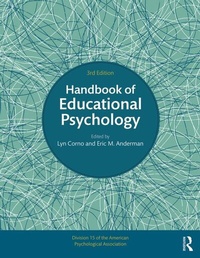
Handbook of Educational Psychology
3rd Edition
Published on 6. July 2015
Book
Paperback/Softback
482 pages
978-0-415-89482-1 (ISBN)
Description
The third edition of the Handbook of Educational Psychology is sponsored by Division 15 of the American Psychological Association. In this volume, thirty chapters address new developments in theory and research methods while honoring the legacy of the field's past. A diverse group of recognized scholars within and outside the U.S. provide integrative reviews and critical syntheses of developments in the substantive areas of psychological inquiry in education, functional processes for learning, learner readiness and development, building knowledge and subject matter expertise, and the learning and task environment. New chapters in this edition cover topics such as learning sciences research, latent variable models, data analytics, neuropsychology, relations between emotion, motivation, and volition (EMOVO), scientific literacy, sociocultural perspectives on learning, dialogic instruction, and networked learning. Expanded treatment has been given to relevant individual differences, underlying processes, and new research on subject matter acquisition.
The Handbook of Educational Psychology, Third Edition, provides an indispensable reference volume for scholars in education and the learning sciences, broadly conceived, as well as for teacher educators, practicing teachers, policy makers and the academic libraries serving these audiences. It is also appropriate for graduate level courses in educational psychology, human learning and motivation, the learning sciences, and psychological research methods in education and psychology.
The Handbook of Educational Psychology, Third Edition, provides an indispensable reference volume for scholars in education and the learning sciences, broadly conceived, as well as for teacher educators, practicing teachers, policy makers and the academic libraries serving these audiences. It is also appropriate for graduate level courses in educational psychology, human learning and motivation, the learning sciences, and psychological research methods in education and psychology.
More details
Edition
3rd edition
Language
English
Place of publication
London
United Kingdom
Publishing group
Taylor & Francis Ltd
Target group
College/higher education
Professional and scholarly
Postgraduate and Professional
Illustrations
20 s/w Abbildungen, 10 s/w Tabellen
10 Tables, black and white; 20 Illustrations, black and white
Dimensions
Height: 280 mm
Width: 210 mm
Weight
1160 gr
ISBN-13
978-0-415-89482-1 (9780415894821)
Copyright in bibliographic data and cover images is held by Nielsen Book Services Limited or by the publishers or by their respective licensors: all rights reserved.
Schweitzer Classification
Other editions
New editions
Paul A. Schutz | Krista R. Muis
Handbook of Educational Psychology
Book
09/2023
4th Edition
Routledge
€145.20
Shipment within 10-20 days
Additional editions
Lyn Corno | Eric M. Anderman
Handbook of Educational Psychology
Book
07/2015
3rd Edition
Routledge
€371.40
Article exhausted; check for reprint
Previous edition
Patricia A. Alexander | Philip H. Winne
Handbook of Educational Psychology
Book
05/2006
2nd Edition
Lawrence Erlbaum Associates Inc
€117.79
Article exhausted; check for reprint
Persons
Lyn Corno is former Professor of Education and Psychology (retired) at Teachers College, Columbia University, USA, and co-Editor of Teachers College Record and the National Society for the Study of Education Yearbooks.
Eric M. Anderman is Professor of Educational Psychology and Chair of the Department of Educational Studies at The Ohio State University, USA.
Eric M. Anderman is Professor of Educational Psychology and Chair of the Department of Educational Studies at The Ohio State University, USA.
Content
Part I. Psychological Inquiry in Education. 1. Philosophical Perspectives on Mind, Nature, and Educational Psychology. Eric Bredo, University of Toronto, Canada. 2. Modes of Inquiry in Educational Psychology and Learning Sciences Research. William R. Penuel, University of Colorado at Boulder; Kenneth A. Frank, Michigan State University. 3. The Work of Educational Psychologists in a Digitally Networked World. Punya Mishra, Matthew J. Koehler, Christine Greenhow, Michigan State University. 4. The Prospects and Limitations of Latent Variable Models in Educational Psychology. Benjamin Nagengast, Ulrich Trautwein, University of Tuebingen, Germany. Part II. Functional Processes for Learning. 5. Learning as Coordination: Cognitive Psychology and Education. Daniel L. Schwartz, Stanford University; Robert Goldstone, Indiana University. 6. Emotions and Emotion Regulation in Academic Settings. Monique Boekaerts, Leiden University, The Netherlands; Reinhard Pekrun, University of Munich, Germany. 7. Motivation. Lisa Linnenbrink-Garcia, Michigan State University; Erika A. Patall, University of Texas, Austin. 8. Volition. Gabriele Oettingen, New York University; Jana Schrage, University of Hamburg, Germanny; Peter M. Gollwitzer, New York University. Part III. Learner Readiness and Development. 9. Human Cognitive Abilities: Their Organization, Development, and Use. Patrick C. Kyllonen, Educational Testing Service. 10. Cognition and Cognitive Disabilities. H. Lee Swanson, University of California, Riverside. 11. Personal Capability Beliefs. Ellen L. Usher, University of Kentucky. 12. Motivation Interventions in Education: Bridging Theory, Research, and Practice. Chris S. Hulleman, University of Virginia; Kenn E. Barron, James Madison University. 13. Beyond the Shadow: The Role of Personality and Temperament in Learning. Arthur E. Poropat, Griffith University, Australia. 14. Cultural, Racial/Ethnic, and Linguistic Diversity and Identity. Na'ilah Suad Nasir, University of California, Berkeley; Stephanie J. Rowley, University of Michigan; William Perez, Claremont Graduate University. 15. Language Development. Alison L. Bailey, University of California, Los Angeles; Anna Osipova, California State University, Los Angeles; Kimberly Reynolds Kelly, California State University, Long Beach. 16. Character Education, Moral Education, and Moral-Character Education. Cary J. Roseth, Michigan State University. Part IV. Building Knowledge and Subject Matter Expertise. 17. Literacy for Schooling: Two-Tiered Scaffolding for Learning and Teaching. Ian A. G. Wilkinson, The Ohio State University; Janet S. Gaffney, University of Auckland, New Zealand. 18. Warm Change about Hot Topics: The Role of Motivation and Emotion in Attitude and Conceptual Change about Controversial Science Topics. Gale M. Sinatra, University of Southern California; Viviane Seyranian, California State Polytechnic University, Pomona. 19. Toward an Educational Psychology of Mathematics Education. John R. Star, Harvard University; Bethany Rittle-Johnson, Vanderbilt University. 20. Functional Scientific Literacy: Seeing the Science within the Words and Across the Web. Iris Tabak, Ben-Gurion University of the Negev, Israel. 21. Studying Historical Understanding. Chauncey Monte-Sano, University of Michigan; Abby Reisman, University of Pennsylvania. 22. Civic Education. Mario Carretero, Autonoma University of Madrid, Spain; Helen Haste, Harvard University; Angela Bermudez, Deusto University, Bilbao, Spain. Part V. The Learning and Task Environment. 23. Sociocultural Perspectives on Literacy and Learning. David O'Brien, University of Minnesota; Theresa Rogers, University of British Columbia, Canada. 24. Learning Environments In and Out of School. Brigid Barron, Stanford University; Philip Bell, University of Washington. 25. Networked Learning. Gary Natriello, Teachers College, Columbia University. 26. Collaborative Learning. Cindy E. Hmelo-Silver, Indiana University; Clark A. Chinn, Rutgers University. 27. Black and Hispanic Students: Cultural Differences within the Context of Education. Donna Y. Ford, Vanderbilt University. 28. Dialogic Instruction: A New Frontier. Sherice Clarke, Lauren Resnick, University of Pittsburgh; Carolyn Rose, Carnegie Mellon University. 29. Assessment Illuminating Pathways to Learning. Ellen B. Mandinach, Andrea Lash, WestEd. 30. Being a Teacher: Efficacy, Emotions, and Interpersonal Relationships in the Classroom. Lynley H. Anderman, The Ohio State University; Robert Klassen, University of York, United Kingdom. Afterwords. I. Perspectives on the Past, Present, and Future of Educational Psychology. Frank Farley, Temple University; Patricia Alexander, University of Maryland; Eva L. Baker, University of California, Los Angeles; David C. Berliner, Arizona State University; Robert C. Calfee, Stanford University; Erik DeCorte, University of Leuven, Belgium; James G. Greeno, University of Pittsburgh; Anita Woolfolk Hoy, The Ohio State University; Richard Mayer, University of California, Santa Barbara. II. On Impact Beyond the Field. Eric M. Anderman, The Ohio State University; Lyn Corno, Teachers College, Columbia University.