

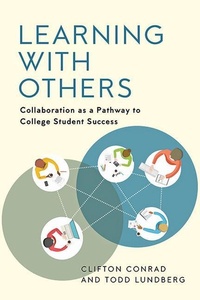
Learning with Others
Collaboration as a Pathway to College Student Success
Published on 10. May 2022
Book
Hardback
240 pages
978-1-4214-4351-5 (ISBN)
Description
How can colleges and universities engage students in ways that prepare them to solve problems in our rapidly changing world?
Most American colleges and universities assimilate students into highly competitive undergraduate experiences. By placing achievement for personal and material gain as the bedrock of a college education, these institutions fail to educate students to become collaborative learners: people who are committed and prepared to join with others in developing promising solutions to problems that they share with others.
Drawing on a three-year study of student persistence and learning at Minority-Serving Institutions, Clifton Conrad and Todd Lundberg argue that student success in college should be redefined by focusing on the importance of collaborative learning over individual achievement. Engaging students in shared, real-world problem-solving, Conrad and Lundberg assert, will encourage them to embrace interdependence and to value and draw on diverse perspectives. Learning with Others presents a set of core practices to empower students to enter, nourish, and sustain collaborative learning and outlines how to blend the roles and responsibilities of faculty, staff, and students; how to adopt best practices for receiving and giving feedback on problem-solving; and how to anchor a curriculum in shared problem-solving.
Bringing together lessons learned from more than 300 interviews, along with notes from 14 campus visits, 3 national convenings, and examples from across our nation's colleges and universities, Conrad and Lundberg explore ways in which successful antiracist networks of problem-solvers are learning to contribute to the flourishing of their communities on campus and far beyond. Outlining strategies for identifying and dismantling barriers to participation, Learning with Others will pique interest among faculty, students, and administrators in higher education and a wide range of external stakeholders-from families and communities to policymakers and funders.
Most American colleges and universities assimilate students into highly competitive undergraduate experiences. By placing achievement for personal and material gain as the bedrock of a college education, these institutions fail to educate students to become collaborative learners: people who are committed and prepared to join with others in developing promising solutions to problems that they share with others.
Drawing on a three-year study of student persistence and learning at Minority-Serving Institutions, Clifton Conrad and Todd Lundberg argue that student success in college should be redefined by focusing on the importance of collaborative learning over individual achievement. Engaging students in shared, real-world problem-solving, Conrad and Lundberg assert, will encourage them to embrace interdependence and to value and draw on diverse perspectives. Learning with Others presents a set of core practices to empower students to enter, nourish, and sustain collaborative learning and outlines how to blend the roles and responsibilities of faculty, staff, and students; how to adopt best practices for receiving and giving feedback on problem-solving; and how to anchor a curriculum in shared problem-solving.
Bringing together lessons learned from more than 300 interviews, along with notes from 14 campus visits, 3 national convenings, and examples from across our nation's colleges and universities, Conrad and Lundberg explore ways in which successful antiracist networks of problem-solvers are learning to contribute to the flourishing of their communities on campus and far beyond. Outlining strategies for identifying and dismantling barriers to participation, Learning with Others will pique interest among faculty, students, and administrators in higher education and a wide range of external stakeholders-from families and communities to policymakers and funders.
More details
Language
English
Place of publication
Baltimore, MD
United States
Target group
Professional and scholarly
Product notice
sewn/stitched
Cloth over boards
Illustrations
1 s/w Abbildung
1 Illustrations, black and white
Dimensions
Height: 218 mm
Width: 142 mm
Thickness: 28 mm
Weight
386 gr
ISBN-13
978-1-4214-4351-5 (9781421443515)
DOI
10.1353/book.100173
Copyright in bibliographic data and cover images is held by Nielsen Book Services Limited or by the publishers or by their respective licensors: all rights reserved.
Schweitzer Classification
Other editions
Additional editions
Clifton Conrad | Todd Lundberg
Learning with Others
Collaboration as a Pathway to College Student Success
E-Book
05/2022
Johns Hopkins University Press
€28.99
Available for download
Persons
Clifton Conrad is the Vilas Distinguished Achievement Professor and a professor of higher education at the University of Wisconsin-Madison. He is the coauthor of Cultivating Inquiry-Driven Learners. Todd Lundberg, formerly Dean for Student Learning at Cascadia College, is an associate director within the Center for Teaching, Learning & Mentoring at the University of Wisconsin-Madison.
Content
Acknowledgments
Introduction. Undergraduate Education for Twenty-First-Century America
Chapter One. Unsettling Individual Learning as the Cornerstone of a College Education
Chapter Two: A Twenty-First-Century Imperative: Placing Collaborative Learning at the Forefront of Student Success
Chapter Three: Situating Collaborative Learning at the Center of the Undergraduate Experience
Chapter Four: Blending Roles and Responsibilities of Faculty, Staff, and Students
Chapter Five: Receiving and Giving Feedback
Chapter Six: Anchoring the Curriculum in Shared Problem-Solving
Afterword: Beyond Predominantly White Undergraduate Education
References
Index
Introduction. Undergraduate Education for Twenty-First-Century America
Chapter One. Unsettling Individual Learning as the Cornerstone of a College Education
Chapter Two: A Twenty-First-Century Imperative: Placing Collaborative Learning at the Forefront of Student Success
Chapter Three: Situating Collaborative Learning at the Center of the Undergraduate Experience
Chapter Four: Blending Roles and Responsibilities of Faculty, Staff, and Students
Chapter Five: Receiving and Giving Feedback
Chapter Six: Anchoring the Curriculum in Shared Problem-Solving
Afterword: Beyond Predominantly White Undergraduate Education
References
Index