

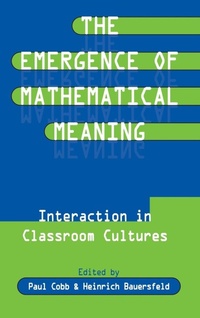
The Emergence of Mathematical Meaning
interaction in Classroom Cultures
Published on 1. May 1995
Book
Hardback
318 pages
978-0-8058-1728-7 (ISBN)
Description
This book grew out of a five-year collaboration between groups of American and German mathematics educators. The central issue addressed accounting for the messiness and complexity of mathematics learning and teaching as it occurs in classroom situations. The individual chapters are based on the view that psychological and sociological perspectives each tell half of a good story. To unify these concepts requires a combined approach that takes individual students' mathematical activity seriously while simultaneously seeing their activity as necessarily socially situated. Throughout their collaboration, the chapter authors shared a single set of video recordings and transcripts made in an American elementary classroom where instruction was generally compatible with recent reform recommendations. As a consequence, the book is much more than a compendium of loosely related papers.
The combined approach taken by the authors draws on interactionism and ethnomethodology. Thus, it constitutes an alternative to Vygotskian and Soviet activity theory approaches. The specific topics discussed in individual chapters include small group collaboration and learning, the teacher's practice and growth, and language, discourse, and argumentation in the mathematics classroom. This collaborative effort is valuable to educators and psychologists interested in situated cognition and the relation between sociocultural processes and individual psychological processes.
The combined approach taken by the authors draws on interactionism and ethnomethodology. Thus, it constitutes an alternative to Vygotskian and Soviet activity theory approaches. The specific topics discussed in individual chapters include small group collaboration and learning, the teacher's practice and growth, and language, discourse, and argumentation in the mathematics classroom. This collaborative effort is valuable to educators and psychologists interested in situated cognition and the relation between sociocultural processes and individual psychological processes.
Reviews / Votes
"The book has a novel and highly rewarding structure that capitalises on the power of multiple perspectives....The book as a whole makes a unique and profound contribution to the theory of mathematics education."-British Journal of Educational Psychology
More details
Series
Language
English
Place of publication
New York
United States
Publishing group
Taylor & Francis Inc
Target group
Professional and scholarly
Dimensions
Height: 235 mm
Width: 157 mm
Thickness: 22 mm
Weight
616 gr
ISBN-13
978-0-8058-1728-7 (9780805817287)
Copyright in bibliographic data and cover images is held by Nielsen Book Services Limited or by the publishers or by their respective licensors: all rights reserved.
Schweitzer Classification
Other editions
Additional editions
Paul Cobb | Heinrich Bauersfeld
The Emergence of Mathematical Meaning
interaction in Classroom Cultures
E-Book
12/2012
1st Edition
Routledge
€251.99
Available for download
Paul Cobb | Heinrich Bauersfeld
The Emergence of Mathematical Meaning
interaction in Classroom Cultures
E-Book
12/2012
1st Edition
Routledge
€251.99
Available for download
Paul Cobb | Heinrich Bauersfeld
The Emergence of Mathematical Meaning
interaction in Classroom Cultures
Book
05/1995
Lawrence Erlbaum Associates Inc
€50.94
Article exhausted; check different version
Persons
Paul Cobb, Heinrich Bauersfeld
Content
Contents: Preface. P. Cobb, H. Bauersfeld, Introduction: The Coordination of Psychological and Sociological Perspectives in Mathematics Education. P. Cobb, E. Yackel, T. Wood, The Teaching Experiment Classroom. P. Cobb, Mathematical Learning and Small-Group Interaction: Four Case Studies. E. Yackel, Children's Talk in Inquiry Mathematics Classrooms. J. Voigt, Thematic Patterns of Interaction and Sociomathematical Norms. T. Wood, An Emerging Practice of Teaching. G. Krummheuer, The Ethnography of Argumentation. H. Bauersfeld, "Language Games" in the Mathematics Classroom: Their Function and Their Effects.