

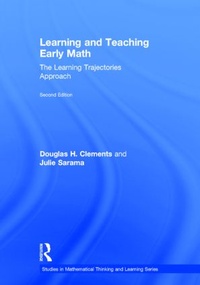
Learning and Teaching Early Math
The Learning Trajectories Approach
2nd Edition
Published on 21. April 2014
Book
Hardback
394 pages
978-0-415-82851-2 (ISBN)
Description
In this important book for pre- and in-service teachers, early math experts Douglas Clements and Julie Sarama show how "learning trajectories" help diagnose a child's level of mathematical understanding and provide guidance for teaching. By focusing on the inherent delight and curiosity behind young children's mathematical reasoning, learning trajectories ultimately make teaching more joyous. They help teachers understand the varying levels of knowledge exhibited by individual students, which in turn allows them to better meet the learning needs of all children. Using straightforward, no-nonsense language, this book summarizes the current research about how children learn mathematics, and how to build on what children already know to realize more effective teaching.
This second edition of Learning and Teaching Early Math remains the definitive, research-based resource to help teachers understand the learning trajectories of early mathematics and become quintessential professionals.
Updates to the new edition include:
* Explicit connections between Learning Trajectories and the new Common Core State Standards.
* New coverage of patterns and patterning.
* Incorporation of hundreds of recent research studies.
This second edition of Learning and Teaching Early Math remains the definitive, research-based resource to help teachers understand the learning trajectories of early mathematics and become quintessential professionals.
Updates to the new edition include:
* Explicit connections between Learning Trajectories and the new Common Core State Standards.
* New coverage of patterns and patterning.
* Incorporation of hundreds of recent research studies.
Reviews / Votes
"The book's strengths are many. The in-depth coverage of the mathematical concepts and the related research are invaluable. But notably the greatest strength, in my view, is the inclusion of the developmental trajectories. I think these are an invaluable reference for anyone teaching mathematics to young children, and I encourage my students to all hold onto this text for reference when teaching."-Barbrina Ertle, Department of Education, Adelphi UniversityPraise for the 1st Edition:
"What math is most important for young learners? What concepts and skills are foundational for their reaching the next level of math understanding? And how can teachers help children grasp each new idea and remain enthusiastic about math? These are the key questions in this incredibly valuable book from Douglas Clements and Julie Sarama. For each topic area, they clearly describe the developmental path, or 'learning trajectory,' along which children move to develop mathematical concepts and skills. And they offer evidence-based guidelines and instructional activities in an engaging, straightforward way that reflects their deep respect for, and understanding of, what teachers do." -Carol Copple, Former Director, Publications and Initiatives in Educational Practice, National Association for the Education of Young Children
"One of the book's greatest strengths is the focus on 'Developmental Trajectories', which are a little like 'schemas'. Learning or developmental progressions that children follow as they are learning something - for example, from rolling, crawling, walking, skipping and jumping, to running and moving with increased speed and dexterity." - Martine Horvath, eye magazine
"Armed with learning trajectories, it is easy to assess any student's thinking via pedagogical documentation, locate the student on a trajectory, determine the next step in the child's learning, provide feedback that fosters it and program relevant instructional tasks." - Edward Schroeter, ETFO VOICE
More details
Series
Edition
2nd edition
Language
English
Place of publication
London
United Kingdom
Publishing group
Taylor & Francis Ltd
Target group
Professional and scholarly
Academic and Professional Practice & Development
Illustrations
22 s/w Tabellen
22 Tables, black and white
Dimensions
Height: 254 mm
Width: 178 mm
Weight
890 gr
ISBN-13
978-0-415-82851-2 (9780415828512)
Copyright in bibliographic data and cover images is held by Nielsen Book Services Limited or by the publishers or by their respective licensors: all rights reserved.
Schweitzer Classification
Other editions
New editions
Douglas H. Clements | Julie Sarama
Learning and Teaching Early Math
The Learning Trajectories Approach
Book
12/2020
3rd Edition
Routledge
€191.89
Shipment within 15-20 days
Additional editions
Douglas H. Clements | Julie Sarama
Learning and Teaching Early Math
The Learning Trajectories Approach
Book
04/2014
2nd Edition
Routledge
€85.60
Article exhausted; check for reprint
Previous edition
Douglas H. Clements | Julie Sarama
Learning and Teaching Early Math
The Learning Trajectories Approach
Book
03/2009
1st Edition
Routledge
€76.94
Article exhausted; check for reprint
Persons
Douglas H. Clements is the Kennedy Endowed Chair in Early Childhood Learning, Executive Director of the Marsico Institute of Early Learning and Literacy, and Professor at the University of Denver, USA.
Julie Sarama is the Kennedy Endowed Chair in Innovative Learning Technologies and Professor at the University of Denver, USA.
Julie Sarama is the Kennedy Endowed Chair in Innovative Learning Technologies and Professor at the University of Denver, USA.
Content
1. Young Children and Mathematics Learning
2. Quantity, Number, and Subitizing
3. Verbal and Object Counting
4. Comparing, Ordering, and Estimating
5. Arithmetic: Early Addition and Subtraction and Counting Strategies
6. Arithmetic: Composition of Number, Place Value, and Multidigit Addition and Subtraction
7. Spatial Thinking
8. shape
9. Composition and Decomposition of Shapes
10. Geometric Measurement: Length
11. Geometric Measurement: Area, Volume, and Angle
12. Other Content Domains
13. Mathematical Processs and Practices
14. Cognition, Affect, and Equity
15. Early Childhood Mathematics Education: Contexts and Curricula
16. Instructional Practices and Pedagogical Issues
2. Quantity, Number, and Subitizing
3. Verbal and Object Counting
4. Comparing, Ordering, and Estimating
5. Arithmetic: Early Addition and Subtraction and Counting Strategies
6. Arithmetic: Composition of Number, Place Value, and Multidigit Addition and Subtraction
7. Spatial Thinking
8. shape
9. Composition and Decomposition of Shapes
10. Geometric Measurement: Length
11. Geometric Measurement: Area, Volume, and Angle
12. Other Content Domains
13. Mathematical Processs and Practices
14. Cognition, Affect, and Equity
15. Early Childhood Mathematics Education: Contexts and Curricula
16. Instructional Practices and Pedagogical Issues