

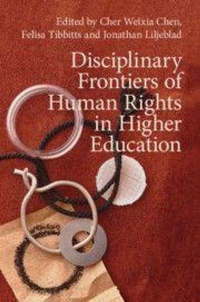
Disciplinary Frontiers of Human Rights in Higher Education
Will be published approx. on 31. July 2026
Book
Paperback/Softback
360 pages
978-1-009-60085-9 (ISBN)
Description
This groundbreaking book explores the expanding and impactful relationship between human rights and academia, illustrating historical and emerging practices for integrating human rights within scholarship and teaching in a range of disciplines and professional studies. By providing examples of meaningful applications across 13 academic fields, chapters examine the varied ways that higher education engages with human rights ontologically, theoretically, conceptually, and in practice. Collectively, it also demonstrates that human rights remain essential for addressing 21st-century challenges, emphasizing the role of faculty and students in advancing this work. Offering a framework for designing and studying the infusion of human rights within and across disciplines, this work includes a broad range of discussion questions to enrich learner engagement, critical thinking, and practical application. It is a vital resource for instructors, departments, and multidisciplinary centers, as well as anyone engaged in human rights, social justice, peace, and global citizenship education.
More details
Other editions
Additional editions
Cher Weixia Chen | Felisa Tibbitts | Jonathan Liljeblad
Disciplinary Frontiers of Human Rights in Higher Education
Book
approx. 07/2026
Cambridge University Press
€123.50
Not yet published
Content
Acknowledgements; List of contributors; 1. Introduction: disciplines and human rights Cher Weixia Chen, Felisa Tibbits and Jonathan Liljeblad; Part I. Human Rights, Humanities and Social Sciences: 2. Human rights, art history, and aesthetic experience: theory and practice José Falconi, Michael Orwicz and Robin Greeley; 3. Human rights and journalism and media: the absence, presence, and misrepresentation of human rights issues in the media-sphere Maria Armoudian and Anne Goldson; 4. Human rights and literature: the environmental justice novel Pramod Nayar; 5. Human rights and political science: recognizing cultural imperialism in theory and enforcement Alison Dundes Renteln; 6. Human rights and psychology: protection, prevention, redress and rehabilitation Nora Sveaass; 7. Human rights and sociology: social movement theory Karie Jo Peralta; 8. Human rights and theology: shaping moral imaginations through theological education Whittney Barth; Part II. Human Rights and Professional Studies: 9. Human rights and architecture: recognizing professional responsibilities in the curriculum Graeme Bristol; 10. Human rights and biomedical engineering: context, ethics and access Muhammad Hamid Zaman; 11. Human rights and education: fruitful interactions Ana María Rodino; 12. Human rights and law: the evolution of legal education Jonathan Liljeblad; 13. Human rights and library science: libraries transforming communities Roxanne Missingham; 14. Human rights and public health: principles and priorities Bradley P. Stoner and Alison D. Renteln; 15. Conclusion: reflections, challenges, and pathways for human rights scholarship and education Cher Weixia Chen, Felisa Tibbits and Jonathan Liljeblad; Index.