

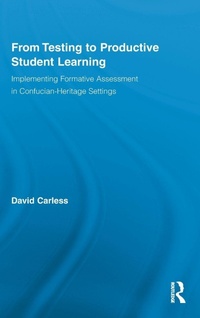
From Testing to Productive Student Learning
Implementing Formative Assessment in Confucian-Heritage Settings
1st Edition
Published on 7. December 2010
Book
Hardback
280 pages
978-0-415-88082-4 (ISBN)
Description
Research evidence indicates that formative assessment is one of the most effective ways of enhancing student learning. It is, however, difficult to implement successfully, principally because what is tested through summative assessment has such a powerful influence on teacher and student actions. This book scrutinizes the relationship between testing and learning from alternative perspectives to the dominant literature from the major Anglophone countries. It develops the notion of contextually grounded formative assessment practices by analyzing data from schools in the Confucian-heritage setting of Hong Kong. It explores questions such as:
* Under what circumstances do tests support or hinder student learning?
* How can teachers effectively prepare students for tests and appropriately follow up after tests?
* What are the key socio-cultural influences impacting on testing and student learning in the classroom?
* How do teachers change in their orientation towards assessment and what support do they require?
This text is a valuable resource for education students, professionals and researchers, policy-makers and curriculum developers.
* Under what circumstances do tests support or hinder student learning?
* How can teachers effectively prepare students for tests and appropriately follow up after tests?
* What are the key socio-cultural influences impacting on testing and student learning in the classroom?
* How do teachers change in their orientation towards assessment and what support do they require?
This text is a valuable resource for education students, professionals and researchers, policy-makers and curriculum developers.
Reviews / Votes
"This book is well organized and clear so a reader can follow right along - and wants to do so."-Teachers College Record"Taken as a whole, the book helps researchers and those working with teachers to work realistically and pragmatically in the socio-cultural contexts they are subjected to but also help to shape. It also illuminates the need to encourage teachers to ask critical questions about the nature of learning and engagement that formative and summative assessment encourages, and discourages, and the forms of skill and knowledge that assessment opens access to or denies." -Assessment in Education: Principles, Policy & Practice
More details
Series
Language
English
Place of publication
London
United Kingdom
Publishing group
Taylor & Francis Ltd
Target group
College/higher education
Illustrations
6 s/w Abbildungen, 6 s/w Zeichnungen, 7 s/w Tabellen
7 Tables, black and white; 6 Line drawings, black and white; 6 Illustrations, black and white
Dimensions
Height: 235 mm
Width: 157 mm
Thickness: 20 mm
Weight
560 gr
ISBN-13
978-0-415-88082-4 (9780415880824)
Copyright in bibliographic data and cover images is held by Nielsen Book Services Limited or by the publishers or by their respective licensors: all rights reserved.
Schweitzer Classification
Other editions
Additional editions
David Carless
From Testing to Productive Student Learning
Implementing Formative Assessment in Confucian-Heritage Settings
Book
09/2012
1st Edition
Routledge
€82.50
Shipment within 15-20 days
David Carless
From Testing to Productive Student Learning
Implementing Formative Assessment in Confucian-Heritage Settings
E-Book
03/2012
1st Edition
Routledge
€76.49
Available for download
David Carless
From Testing to Productive Student Learning
Implementing Formative Assessment in Confucian-Heritage Settings
E-Book
03/2012
1st Edition
Routledge
€76.49
Available for download
Person
David Carless is Associate Professor of Education at the University of Hong Kong.
Content
1. Potentials and Pitfalls in Assessment 2. Summative and Formative Assessment: Building Productive Relationships 3. Testing and Assessment: Selection, Learning and Social Control 4. Education and Assessment in Hong Kong 5. 'Restricted' and 'Extended' Formative Assessment: Towards Contextually Grounded Models 6. Test Follow-Up as a Formative Assessment Strategy 7. Peer Learning and Assessment 8. Teacher Change and Formative Assessment 9. Conclusions and Implications: Ways Forward for Formative Assessment Appendices