

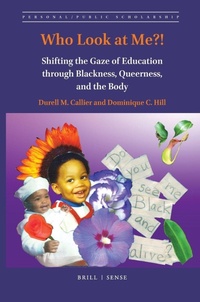
Who Look at Me?!
Shifting the Gaze of Education through Blackness, Queerness, and the Body
Published on 17. January 2019
Book
Paperback/Softback
156 pages
978-90-04-39222-9 (ISBN)
Description
Who Look at Me?!: Shifting the Gaze of Education through Blackness, Queerness, and the Body explores how we, as a society, see Blackness and in particular Black youth. Drawing on a range of sources, the authors argue that the ability to operationalize the sentiment that #BlackLivesMatter, requires seeing Blackness wholly, as queer, and as a site of subversive knowledge production. Continuing the work of June Jordan and Langston Hughes, and based on their work as a Black queer artist collective known as Hill L. Waters, Who Look at Me?! provides alternative tools for reading about and engaging with the lived experiences of Black youth and educational research for and about Black youth. In this way, the book presents not only the possibilities of envisioning teaching and research practices but presents examples that embrace, celebrate, and make room for the fullness of Black and queer bodies and experiences. This work will appeal to those interested in emancipatory methodological and educational practices as well as interdisciplinary conversations related to sociocultural constructions of race and sexuality, politics of Blackness, and race in education.
Reviews / Votes
"Who Look at Me?! is a book not only to shift the field, but our humanity. To see Black queer bodies wholeness and complexities at the same time. This book is a love poem of research addressed to the most vulnerable." - Bettina L. Love, Associate Professor, University of Georgia, Department of Educational Theory & Practice"This text shudders with not only the brilliance of these young authors, but also the seismic times in which it has been forged. Do yourself a favor and go buy this book now. Better yet, buy two and give one to a colleague or friend who needs it." - Anne M. Harris, Associate Professor, Australian Research Council Future Fellow and RMIT University, Principal Research Fellow, School of Education and Digital Ethnography Research Centre
More details
Series
Language
English
Place of publication
Leiden
Netherlands
Target group
Professional and scholarly
Product notice
Paperback (trade)
Unsewn / adhesive bound
Dimensions
Height: 234 mm
Width: 155 mm
Thickness: 13 mm
Weight
227 gr
ISBN-13
978-90-04-39222-9 (9789004392229)
Copyright in bibliographic data and cover images is held by Nielsen Book Services Limited or by the publishers or by their respective licensors: all rights reserved.
Schweitzer Classification
Other editions
Additional editions
Durell M. Callier | Dominique C. Hill
Who Look at Me?!
Shifting the Gaze of Education through Blackness, Queerness, and the Body
Book
01/2019
Brill
€139.50
Shipment within 10-20 days
Persons
Durell M. Callier, Ph.D., is an assistant professor of cultural and critical youth studies in the Department of Educational Leadership at Miami University.
Dominique C. Hill, Ph.D., is the 2017 recipient of the Illinois Distinguished Qualitative Dissertation Award in experimental design and a visiting assistant professor of Black Studies at Amherst College.
Dominique C. Hill, Ph.D., is the 2017 recipient of the Illinois Distinguished Qualitative Dissertation Award in experimental design and a visiting assistant professor of Black Studies at Amherst College.
Content
Acknowledgements
Prologue
Why Auto/Ethnography Education and Performance Now: Who Look at me, Now: Reflections on Being Seen
?Framing Shifting the Gaze
?The Origins of Shifting the Gaze in Our Work
?Shifting the Educational Gaze Now: Insisting on Pedagogies of Freedom, Creativity, and Praxis
?Tools to Engender Gaze Shifting
?Autoethnography and Education
?A Note to Our Read(er)s
?Organization of the Book
?Reflection Questions & Interactive Exercise
Chapter 1: When You See Me: Notes on Terrible Educations
?Reflections
?Naming & Unlearning: Pedagogies of Resistance
?I Am, We Are, Before That: Letters to the Future
?Reflection Questions
Chapter 2: Reflections on Bodies on Display: Exploring the Radical Potential of the Black, Queer Body
?Dimensions of Body
?Bodies on Display: Pleasure
?Learning through the Body: What Being on Display Taught Us
?Deep Creation Happens with/in the Feminine: A Lesson
?Reorienting the Gaze: Notes on Pleasure and Blended Scripting
?Conclusion
?Reflection Questions & Interactive Exercise
Chapter 3: Looking Again: Collective Visions, Collective Sight/Seeing
?SOLHOT Lesson I: "Just because...Don't Mean..."
?SOLHOT Lesson II: Save Yourself First: Recollecting Dirty Work and Wreckless Theatrics
?Conclusion
?Reflection Questions
Chapter 4: Answering the Call: Manifesting the Spirit of Auto/Ethnography
?The Contribution of Auto/Ethnography to Qualitative Research
?Manifesting & Autoethnography: Charting New Directions in the Field
?Reflection Questions & Interactive Exercise
Chapter 5: When We Look at Each Other: An Auto/Ethnography of Togetherness
?Searching for Collectivity in Auto/Ethnography
?More than Collaboration, We Love Each Other: Coming to Collective Auto/Ethnography
?Reflection Questions
Conclusion Shifting Sociocultural Gazes: Toward Seeing Blackness Anew
?Black Scenes/Seen Black
?Reflection Questions & Interactive Exercise
Epilogue
?Dear Uncle Jimmy
References
About the Authors
Index
Prologue
Why Auto/Ethnography Education and Performance Now: Who Look at me, Now: Reflections on Being Seen
?Framing Shifting the Gaze
?The Origins of Shifting the Gaze in Our Work
?Shifting the Educational Gaze Now: Insisting on Pedagogies of Freedom, Creativity, and Praxis
?Tools to Engender Gaze Shifting
?Autoethnography and Education
?A Note to Our Read(er)s
?Organization of the Book
?Reflection Questions & Interactive Exercise
Chapter 1: When You See Me: Notes on Terrible Educations
?Reflections
?Naming & Unlearning: Pedagogies of Resistance
?I Am, We Are, Before That: Letters to the Future
?Reflection Questions
Chapter 2: Reflections on Bodies on Display: Exploring the Radical Potential of the Black, Queer Body
?Dimensions of Body
?Bodies on Display: Pleasure
?Learning through the Body: What Being on Display Taught Us
?Deep Creation Happens with/in the Feminine: A Lesson
?Reorienting the Gaze: Notes on Pleasure and Blended Scripting
?Conclusion
?Reflection Questions & Interactive Exercise
Chapter 3: Looking Again: Collective Visions, Collective Sight/Seeing
?SOLHOT Lesson I: "Just because...Don't Mean..."
?SOLHOT Lesson II: Save Yourself First: Recollecting Dirty Work and Wreckless Theatrics
?Conclusion
?Reflection Questions
Chapter 4: Answering the Call: Manifesting the Spirit of Auto/Ethnography
?The Contribution of Auto/Ethnography to Qualitative Research
?Manifesting & Autoethnography: Charting New Directions in the Field
?Reflection Questions & Interactive Exercise
Chapter 5: When We Look at Each Other: An Auto/Ethnography of Togetherness
?Searching for Collectivity in Auto/Ethnography
?More than Collaboration, We Love Each Other: Coming to Collective Auto/Ethnography
?Reflection Questions
Conclusion Shifting Sociocultural Gazes: Toward Seeing Blackness Anew
?Black Scenes/Seen Black
?Reflection Questions & Interactive Exercise
Epilogue
?Dear Uncle Jimmy
References
About the Authors
Index