

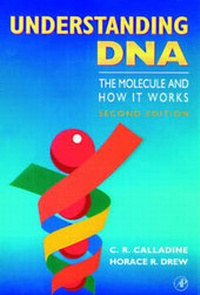
Understanding DNA
The Molecule and How it Works
2nd Edition
Published on 15. April 1997
Book
Paperback/Softback
384 pages
978-0-12-155088-2 (ISBN)
Description
The Second Edition of Understanding DNA has been entirely revised and updated, and expanded by more than 50 per cent to cover new advances. The book explains step-by-step how DNA forms specific structures, the nature of these structures, and how they fundamentally affect the biological processes of transcription and replication. The functional properties of any molecule are directly related to and affected by its structure; this is especially true for DNA, the molecule that carries the code for all life on earth. Written in a clear, concise, and at times lively fashion, Understanding DNA is essential reading for all molecular biology, biochemistry, and genetics students, for newcomers to the field from such areas as physics or chemistry, and for even the most seasoned researchers who really want to understand DNA.
Reviews / Votes
"@from:Reviews of the first edition Stylish... beautifully crafted, with a logical step-by-step approach to the subject. A book from which the advanced undergraduate will benefit, and which will also generate a refreshing perspective for experts. --NATURE Authoritative and lucid. --SIR AARON KLUG Throughout the book, there is something of a playful spirit at work... [which] make[s] subtle physical effects... intuitively comprehensible. We see DNA structures so often that it is often taken for granted that the molecule should not be anything but an aesthetically appealing, spiralling helix. But why should it assume such a nice structure? The book offers an absolutely delightful answer to this and other similarly mischievous questions. Understanding DNA is a great book that will surely prove to be a valuable teaching tool. --THE BIOCHEMIST Among the strengths [of the book] are the clarity of the explanations of some quite difficult concepts and the novel way in which certain ideas are treated, perhaps causing the reader to think again about certain aspects of DNA structure. I enjoyed reading this book and would encourage colleagues working in the general area of DNA research to read it. --HEREDITY A systematic and comprehensive analysis of the structure of DNA from a wonderfully fresh perspective. The book is a systematic effort to understand this fascinating molecule from the inside out, building from the first, and simplest, principles... I recommend it very highly. --TRENDS IN GENETICS The text would be a useful companion for a course using more traditional biology or molecular biology coverage. And, of course, it would be well suited for those wishing to introduce themselves to the topic of DNA for the first time. --Roger W. Melvold, Northwestern University Medical School, DOODY REVIEW.More details
Edition
2nd Revised edition
Language
English
Place of publication
San Diego
United States
Publishing group
Elsevier Science Publishing Co Inc
Target group
College/higher education
Professional and scholarly
Edition type
Revised edition
Illustrations
122 b&w illustrations, 6 colour illustrations, index
Dimensions
Height: 229 mm
Width: 152 mm
Weight
590 gr
ISBN-13
978-0-12-155088-2 (9780121550882)
Copyright in bibliographic data and cover images is held by Nielsen Book Services Limited or by the publishers or by their respective licensors: all rights reserved.
Schweitzer Classification
Other editions
New editions
Book
03/2004
3rd Edition
Academic Press
€76.00
Shipment within 15-20 days
Additional editions
E-Book
05/2014
3rd Edition
Academic Press
€28.95
Available for download
Previous edition

Book
12/1992
Academic Press
€18.57
Article exhausted; check for reprint
Persons
Chris Calladine is Professor of Structural Mechanics at the University of Cambridge. In addition to researching aspects of structural engineering, he has applied the methods of structural mechanics to the study of flagella and DNA.
Content
An Introduction to Molecular Biology for Non-Scientists. Why a Helix? Different Kinds of Double Helix. Twisting and Curving. Curving in Three Dimensions. DNA Supercoiling. The Assembly of DNA into Chromosomes. Specific DNA-Protein Interactions. Methods Used to Study the Structure of DNA. DNA in Disease, Diagnostics, and Medicine. Appendices: Notes on the Derivation of Some Technical Terms; The Chemical Theory of Base-Stacking Interactions in DNA; Answers to Selected Exercises.