

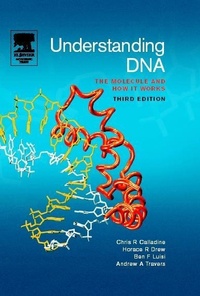
Understanding DNA
The Molecule and How it Works
3rd Edition
Published on 13. March 2004
Book
Hardback
352 pages
978-0-12-155089-9 (ISBN)
Description
The functional properties of any molecule are directly related to, and affected by, its structure. This is especially true for DNA, the molecular that carries the code for all life on earth.
The third edition of Understanding DNA has been entirely revised and updated, and expanded to cover new advances in our understanding. It explains, step by step, how DNA forms specific structures, the nature of these structures and how they fundamentally affect the biological processes of transcription and replication.
Written in a clear, concise and lively fashion, Understanding DNA is essential reading for all molecular biology, biochemistry and genetics students, to newcomers to the field from other areas such as chemistry or physics, and even for seasoned researchers, who really want to understand DNA.
The third edition of Understanding DNA has been entirely revised and updated, and expanded to cover new advances in our understanding. It explains, step by step, how DNA forms specific structures, the nature of these structures and how they fundamentally affect the biological processes of transcription and replication.
Written in a clear, concise and lively fashion, Understanding DNA is essential reading for all molecular biology, biochemistry and genetics students, to newcomers to the field from other areas such as chemistry or physics, and even for seasoned researchers, who really want to understand DNA.
Reviews / Votes
Praise for previous editions:"Stylish...beautifully crafted, with a logical step-by-step approach to the subject. A book from which the advanced undergraduate will benefit and which will also generate a refreshing perspective for experts" --NATURE
"Understanding DNA is a great book that will surely prove to be a valuable teaching tool." --THE BIOCHEMIST
"A systematic and comprehensive analysis of the structure of DNA from a wonderfully fresh perspective." --TRENDS IN GENETICS
More details
Edition
3rd edition
Language
English
Place of publication
San Diego
United States
Publishing group
Elsevier Science Publishing Co Inc
Target group
Professional and scholarly
Advanced undergraduate and graduate students in molecular biology, biochemistry, and biophysics. Also of interest to researchers in related areas seeking a background to molecular biology.
Product notice
sewn/stitched
Cloth over boards
Dimensions
Height: 250 mm
Width: 178 mm
Thickness: 21 mm
Weight
857 gr
ISBN-13
978-0-12-155089-9 (9780121550899)
Copyright in bibliographic data and cover images is held by Nielsen Book Services Limited or by the publishers or by their respective licensors: all rights reserved.
Schweitzer Classification
Other editions
Additional editions
E-Book
03/2004
3rd Edition
Academic Press
€59.95
Available for download
Previous edition

Book
04/1997
2nd Edition
Academic Press
€45.79
Article exhausted; check for reprint
Persons
Chris Calladine is Professor of Structural Mechanics at the University of Cambridge. In addition to researching aspects of structural engineering, he has applied the methods of structural mechanics to the study of flagella and DNA. Horace Drew solved several of the first DNA crystal X-ray structures with Richard Dickerson at Caltech, and subsequently spent five years researching DNA and chromosome structures with Aaron Klug at the MRC Laboratory of Molecular Biology in Cambridge, UK He now lives in Australia and is a Principle Research Scientist at the CSIRO Division of Biomolecular Engineering in Sydney. Ben Luisi works in the Department of Biochemistry at the University of Cambridge, where he has an appointment as professor of structural biology. He and his colleagues study the structure and mechanism of efflux pumps and the riboregulatory machinery that help to control the expression of the pumps and other complex systems in bacteria.
Content
An Introduction to Molecular Biology for Non-Scientists
Why a Helix?
Different Kinds of Double Helix
Twisting and Curving
Curving in Three Dimensions
DNA Supercoiling
The Assembly of DNA intor Chromosomes
Specific DNA-Protein Interactions
Methods Used to Study the Structure of DNA
DNA in Disease, Diagnostics and Medicine
Cytosine Methylation and DNA Epigenetics
Appendix
1: Notes on the Derivation of Some Technical Terms
2: The Chemical Theory of Base-stacking Interactions in DNA
3: How to modify Gene Expression by means of Anti-sense Oligonucleotides, Ribozymes or si-RNA
Why a Helix?
Different Kinds of Double Helix
Twisting and Curving
Curving in Three Dimensions
DNA Supercoiling
The Assembly of DNA intor Chromosomes
Specific DNA-Protein Interactions
Methods Used to Study the Structure of DNA
DNA in Disease, Diagnostics and Medicine
Cytosine Methylation and DNA Epigenetics
Appendix
1: Notes on the Derivation of Some Technical Terms
2: The Chemical Theory of Base-stacking Interactions in DNA
3: How to modify Gene Expression by means of Anti-sense Oligonucleotides, Ribozymes or si-RNA