

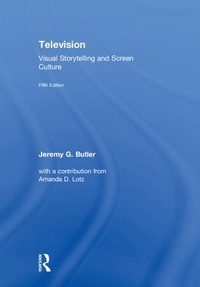
Television
Visual Storytelling and Screen Culture
5th Edition
Published on 26. February 2018
Book
Hardback
422 pages
978-1-138-74400-4 (ISBN)
Description
For over two decades, Television has served as the foremost guide to television studies, offering readers an in-depth understanding of how television programs and commercials are made and how they function as producers of meaning. Author Jeremy G. Butler shows the ways in which camera style, lighting, set design, editing, and sound combine to produce meanings that viewers take away from their television experience.
Highlights of the fifth edition include:
An entirely new chapter by Amanda D. Lotz on television in the contemporary digital media environment.
Discussions integrated throughout on the latest developments in screen culture during the on-demand era-including the impact of binge-watching and the proliferation of screens (smartphones, tablets, computer monitors, etc.).
Updates on the effects of new digital technologies on TV style.
Highlights of the fifth edition include:
An entirely new chapter by Amanda D. Lotz on television in the contemporary digital media environment.
Discussions integrated throughout on the latest developments in screen culture during the on-demand era-including the impact of binge-watching and the proliferation of screens (smartphones, tablets, computer monitors, etc.).
Updates on the effects of new digital technologies on TV style.
Reviews / Votes
"In recent years, TV has radically changed and, simultaneously, tapped into genres and technical formulas pioneered decades ago. Butler's magisterial book-including a terrific new chapter by Amanda Lotz-enables us to make sense of it all. There is, quite simply, no more comprehensive resource for the student of television." -Heather Hendershot, Massachusetts Institute of Technology"Instructors of undergraduate television studies courses know that Butler's Television is a smart, accessible, and indispensable teaching tool, whether our objects of study are The Beverly Hillbillies or Breaking Bad, Monday Night Football or Meet the Press. This exciting new edition incorporates up-to-date critical perspectives on the latest developments in a medium that keeps expanding across multiple modes of delivery, ways of watching, and forms of communication." -Mary Desjardins, Dartmouth College
"Given television's pervasive presence in our personal and political lives today, it's vital to understand how TV works as an expressive form, a business, and a cultural force. Jeremy Butler's updated Television proves more indispensable than ever before in exploring these facets of the medium." -Christine Becker, University of Notre Dame
"Television remains the best book out there for introducing students to the art, industry, and culture of television as we actually experience it. An essential guide to the stories television tells, yesterday and today." -Michele Hilmes, University of Wisconsin, Madison
More details
Edition
5th edition
Language
English
Place of publication
London
United Kingdom
Publishing group
Taylor & Francis Ltd
Target group
College/higher education
Illustrations
300 s/w Photographien bzw. Rasterbilder, 12 s/w Tabellen
12 Tables, black and white; 300 Halftones, black and white
Dimensions
Height: 254 mm
Width: 178 mm
Weight
1300 gr
ISBN-13
978-1-138-74400-4 (9781138744004)
Copyright in bibliographic data and cover images is held by Nielsen Book Services Limited or by the publishers or by their respective licensors: all rights reserved.
Schweitzer Classification
Other editions
Additional editions
Book
02/2018
5th Edition
Routledge
€123.47
Shipment within 10-20 days
E-Book
02/2018
5th Edition
Routledge
€109.99
Available for download
E-Book
02/2018
5th Edition
Routledge
€109.99
Available for download
Previous edition
Book
12/2011
4th Edition
Routledge
€289.69
Article exhausted; check for reprint
Person
Jeremy G. Butler is Professor of Journalism and Creative Media at the University of Alabama. He has taught television, film, and new media courses since 1980 and is active in online educational resources for television and film studies.
Content
PART I TELEVISION STRUCTURES AND SYSTEMS
1. Television Structures and Systems: Ebb and Flow in the Network Era
2. Television Structures and Systems: Ebb and Flow in the Postnetwork Era - Amanda Lotz
3. Narrative Structure: Television Stories
4. Building Narrative: Character, Actor, Star
5. Beyond and Beside Narrative Structure
6. The Television Commercial
PART II TELEVISION STYLE: IMAGE AND SOUND
7. An Introduction to Television Style: Modes of Production
8. Style and Setting: Mise-en-Scene
9. Style and the Camera: Videography and Cinematography
10. Style and Editing
11. Style and Sound
PART III TELEVISION STUDIES
12. An Introduction to Television Studies
13. Textual Analysis
14. Discourse and Identity
1. Television Structures and Systems: Ebb and Flow in the Network Era
2. Television Structures and Systems: Ebb and Flow in the Postnetwork Era - Amanda Lotz
3. Narrative Structure: Television Stories
4. Building Narrative: Character, Actor, Star
5. Beyond and Beside Narrative Structure
6. The Television Commercial
PART II TELEVISION STYLE: IMAGE AND SOUND
7. An Introduction to Television Style: Modes of Production
8. Style and Setting: Mise-en-Scene
9. Style and the Camera: Videography and Cinematography
10. Style and Editing
11. Style and Sound
PART III TELEVISION STUDIES
12. An Introduction to Television Studies
13. Textual Analysis
14. Discourse and Identity