

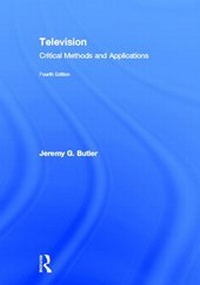
Television
Critical Methods and Applications
4th Edition
Published on 16. December 2011
Book
Hardback
494 pages
978-0-415-88327-6 (ISBN)
Description
For nearly two decades, Television: Critical Methods and Applications has served as the foremost guide to television studies. Designed for the television studies course in communication and media studies curricula, Television explains in depth how television programs and commercials are made and how they function as producers of meaning. Author Jeremy G. Butler shows the ways in which camera style, lighting, set design, editing, and sound combine to produce meanings that viewers take away from their television experience. He supplies students with a whole toolbox of implements to disassemble television and read between the lines, teaching them to incorporate critical thinking into their own television viewing. The fourth edition builds upon the pedagogy of previous editions to best accommodate current modes of understanding and teaching television.
Highlights of the fourth edition include:
New chapter and part organization to reflect the current approach to teaching television-with greatly expanded methods and theories chapters.
An entirely new chapter on modes of production and their impact on what you see on the screen.
Discussions integrated throughout on the latest developments in television's on-going convergence with other media, such as material on transmedia storytelling and YouTube's impact on video distribution.
Over three hundred printed illustrations, including new and better quality frame grabs of recent television shows and commercials.
A companion website featuring color frame grabs, a glossary, flash cards, and editing and sound exercises for students, as well as PowerPoint presentations, sample syllabi and other materials for instructors. Links to online videos that support examples in the text are also provided.
With its distinctive approach to examining television, Television is appropriate for courses in television studies, media criticism, and general critical studies.
Highlights of the fourth edition include:
New chapter and part organization to reflect the current approach to teaching television-with greatly expanded methods and theories chapters.
An entirely new chapter on modes of production and their impact on what you see on the screen.
Discussions integrated throughout on the latest developments in television's on-going convergence with other media, such as material on transmedia storytelling and YouTube's impact on video distribution.
Over three hundred printed illustrations, including new and better quality frame grabs of recent television shows and commercials.
A companion website featuring color frame grabs, a glossary, flash cards, and editing and sound exercises for students, as well as PowerPoint presentations, sample syllabi and other materials for instructors. Links to online videos that support examples in the text are also provided.
With its distinctive approach to examining television, Television is appropriate for courses in television studies, media criticism, and general critical studies.
Reviews / Votes
"This is, quite simply, the best book out there for teaching introductory TV courses. The text is well-conceived and engaging, and Butler does a superb job of illustrating the formal and aesthetic structures of television in a clear and readable manner."--Tara McPherson, Associate Professor, School of Cinematic Arts, University of Southern California
"Written with clarity and wit, Television surveys a range of ways of analyzing a medium which young people, although they consume it voraciously, seldom scrutinize. It can help make students more sensitive and critical consumers of the major mass medium of our time."
--David Bordwell, Jacques Ledoux Professor of Film Studies, Department of Communication Arts, University of Wisconsin-Madison
"Television is a terrific book with wide student appeal. Butler explains critically sophisticated ideas in clear, accessible language, with concrete examples that bring those ideas to life. The book's substance, structure and 'user-friendly' design make it the best all-around book for teaching students how to think about television."
--Kathleen Rowe Karlyn, Professor, University of Oregon
More details
Edition
4th New edition
Language
English
Place of publication
London
United Kingdom
Publishing group
Taylor & Francis Ltd
Target group
College/higher education
Edition type
New edition
Illustrations
11 s/w Tabellen, 300 s/w Photographien bzw. Rasterbilder
Following last edn with some amends; 300 Halftones, black and white; 11 Tables, black and white
Dimensions
Height: 254 mm
Width: 178 mm
Weight
1021 gr
ISBN-13
978-0-415-88327-6 (9780415883276)
Copyright in bibliographic data and cover images is held by Nielsen Book Services Limited or by the publishers or by their respective licensors: all rights reserved.
Schweitzer Classification
Other editions
New editions
Book
02/2018
5th Edition
Routledge
€230.59
Shipment within 10-20 days
Additional editions
Book
12/2011
4th Edition
Routledge
€97.98
Article exhausted; check for reprint
Person
Jeremy G. Butler is Professor of Telecommunication and Film at the University of Alabama. He has taught television, film, and new media courses since 1980 and is active in online educational resources for television and film studies.
Content
Part I: Television Structures and Systems
An Introduction to Television Structures and Systems: Ebb and Flow in the Postnetwork Era
Narrative Structure: Television Stories
Building Narrative: Character, Actor, Star
Beyond and Beside Narrative Structure
The Television Commercial
Part II: Television Style: Image and Sound
An Introduction to Television Style: Modes of Production
Style and Setting: Mise-en-Scene
Style and the Camera: Videography and Cinematography
Style and Editing
Style and Sound
Part III: Television Studies
An Introduction to Television Studies
Textual Analysis
Discourse and Identity
An Introduction to Television Structures and Systems: Ebb and Flow in the Postnetwork Era
Narrative Structure: Television Stories
Building Narrative: Character, Actor, Star
Beyond and Beside Narrative Structure
The Television Commercial
Part II: Television Style: Image and Sound
An Introduction to Television Style: Modes of Production
Style and Setting: Mise-en-Scene
Style and the Camera: Videography and Cinematography
Style and Editing
Style and Sound
Part III: Television Studies
An Introduction to Television Studies
Textual Analysis
Discourse and Identity