

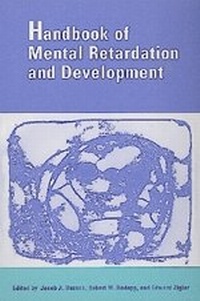
Handbook of Mental Retardation and Development
Published on 28. February 1998
Book
Hardback
782 pages
978-0-521-44123-0 (ISBN)
Description
This book reviews theoretical and empirical work in the developmental approach to mental retardation. Armed with methods derived from the study of typically developing children, developmentalists have recently learned about the mentally retarded child's own development in a variety of areas. These areas now encompass many aspects of cognition, language, social and adaptive functioning, as well as of maladaptive behavior and psychopathology. In addition to a focus on individuals with mental retardation themselves, familial and other 'ecological' factors have entered developmental approaches to mental retardation. Comprised of 26 chapters on various aspects of development, this handbook provides a comprehensive guide to understanding mental retardation and development.
Reviews / Votes
"There are also excellent review chapters on neuropsychology and genetics and helpful contributions related to family issues, such as the impact on families generally and on siblings and mother-child interactions more specifically." Patricia Howlin, Contemporary Psychology APA ReviewMore details
Language
English
Place of publication
Cambridge
United Kingdom
Target group
Professional and scholarly
Illustrations
12 Tables, unspecified; 8 Line drawings, unspecified
Dimensions
Height: 237 mm
Width: 160 mm
Thickness: 47 mm
Weight
1235 gr
ISBN-13
978-0-521-44123-0 (9780521441230)
Copyright in bibliographic data and cover images is held by Nielsen Book Services Limited or by the publishers or by their respective licensors: all rights reserved.
Schweitzer Classification
Persons
Content
Part I. Issues in the Developmental Approach to Mental Retardation: 1. Developmental approaches to mental retardation Robert M. Hodapp, Jacob A. Burack, and Edward Zigler; 2. The organization and the environment: implications for understanding mental retardation Frances Degan Horowitz and Calliope Haritos; 3. Genetic perspectives on mental retardation Emily Simonoff, Patrick Bolton and Michael Rutter; 4. Towards a neuropsychology of mental retardation Bruce F. Pennington and Loisa Bennetto; 5. Resolving the developmental-difference debate: an evaluation of the triarchic and systems theory models Dianne Bennett-Gates and Edward Zigler; Part II.Cognitive and Linguistic Development: 6. Sensorimotor development and developmental disabilities Carl J. Dunst; 7. Early communication skill acquisition and developmental disorders Peter Mundy and Stephen Sheinkopf; 8. Early language development in children with mental retardation Helen Tager-Flusberg and Kate Sullivan; 9. Emergence of symbolic play: perspectives from typical and atypical development Marjorie Beeghly; 10. Language in mental retardation: associations with and dissociations from general cognition Ann E. Fowler; 11. Modularity in developmental cognitive neuropsychology: evidence from autism and Gilles de la Tourette Syndrome Simon Baron-Cohen; 12. Understanding the development of attention in persons with mental retardation: challenging the myths Grace Iarocci and Jacob A. Burack; 13. The development of strategy use and metacognitive processing in mental retardation: some sources of difficulty James M. Bebko and Helen Luhaorg; Part III. Social and Emotional Development: 14. Social and emotional development in children with mental retardation Connie Kasari and Nirit Bauminger; 15. Outerdirections in individuals with and without mental retardation: a review Jane Bybee and Edward Zigler; 16. Development of the self-concept in children with mental retardation: organismic and contextual factors David W. Evans; 17. Adaptation through the life span Andrea G. Zetlin and Gale M. Morrison; 18. Life course perspectives in mental retardation research: the case of family caregiving Marty Wyngaarden Krauss and Marsha Mailick Seltzer; 19. Development of adaptive behavior in persons with mental retardation Katherine A. Loveland and Belgin Tunali-Kotoski; 20. Maladaptive behavior and dual diagnosis in persons with genetic syndromes Elisabeth M. Dykens; 21. A developmental approach to psychopathology in people with mild mental retardation Marion Glick; Part IV. Environmental Issues: 22. The environment of the child with mental retardation: risk, vulnerabilty and resilience Charles W. Greenbaum and Judith G. Auerbach; 23. Maternal reactions to children with mental retardation Johanna Shapiro, Jan Blacher and Steven R. Lopez; 24. Mother-child interactions and the development of children with mental retardation Kofi Marfo, Cynthia F. Dedrick and Nancy Barbour; 25. Research on siblings of children with mental retardation: contributions of developmental theory and etiology Zolinda Stoneman; 26. Mental retardation: The impact upon the family Patricia Minnes.