

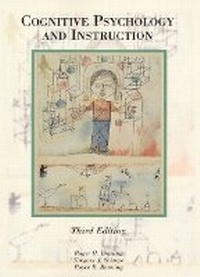
Cognitive Psychology and Instruction
3rd Edition
Published on 19. August 1998
Book
Paperback/Softback
433 pages
978-0-13-716606-0 (ISBN)
Description
This text is rooted in a solid base of current cognitive psychology and motivational research and carefully examines how they apply to teaching and learning. It is an appropriate core text for upper-undergraduate or graduate-level courses in cognition/ instruction in education and applied psychology. This edition reflects new developments in the field using a four-part structure which: 1) covers the basic principles of cognitive psychology, 2) examines school-based applications of a cognitive approach, 3) reflects the emphasis on the importance of beliefs in cognition, and 4) describes new approaches to problem solving, critical thinking, and reflective thought.
More details
Edition
3rd edition
Language
English
Place of publication
United States
Publishing group
Pearson Education (US)
Target group
Professional and scholarly
Dimensions
Height: 235 mm
Width: 190 mm
Thickness: 18 mm
Weight
707 gr
ISBN-13
978-0-13-716606-0 (9780137166060)
Copyright in bibliographic data and cover images is held by Nielsen Book Services Limited or by the publishers or by their respective licensors: all rights reserved.
Schweitzer Classification
Other editions
New editions

Roger H. Bruning | gregory J. Schraw | Monica M. Norby
Cognitive Psychology and Instruction
Book
08/2003
4th Edition
Pearson
€66.84
Article exhausted; check for reprint
Previous edition

Roger Bruning | etc. | Greg Schraw
Cognitive Psychology and Instruction
Book
02/1995
2nd Edition
Macmillan USA
€52.13
Article exhausted; check different version
Content
1. Introduction to Cognitive Psychology.
I. INFORMATION PROCESSING THEORY.
2. Sensory, Short-Term, and Working Memory.
3. Long-Term Memory: Structures and Models.
4. Encoding Processes.
5. Retrieval Processes.
II. BELIEFS AND COGNITION.
6. Beliefs about Self.
7. Beliefs about Intelligence and Knowledge.
III. FOSTERING COGNITIVE GROWTH.
8. Problem Solving and Critical Thinking.
9. Building Knowledge and Reflective Thought.
IV. COGNITION IN THE CLASSROOM.
10. Learning to Read.
11. Reading to Learn.
12. Writing.
13. Cognitive Approaches to Mathematics.
14. Cognitive Approaches to Science.
References.
Glossary.
Name Index.
Subject Index.
I. INFORMATION PROCESSING THEORY.
2. Sensory, Short-Term, and Working Memory.
3. Long-Term Memory: Structures and Models.
4. Encoding Processes.
5. Retrieval Processes.
II. BELIEFS AND COGNITION.
6. Beliefs about Self.
7. Beliefs about Intelligence and Knowledge.
III. FOSTERING COGNITIVE GROWTH.
8. Problem Solving and Critical Thinking.
9. Building Knowledge and Reflective Thought.
IV. COGNITION IN THE CLASSROOM.
10. Learning to Read.
11. Reading to Learn.
12. Writing.
13. Cognitive Approaches to Mathematics.
14. Cognitive Approaches to Science.
References.
Glossary.
Name Index.
Subject Index.