

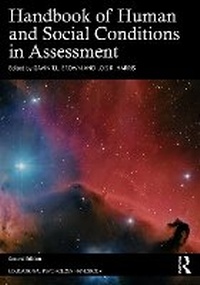
Handbook of Human and Social Conditions in Assessment
2nd Edition
Will be published approx. on 11. November 2026
Book
Paperback/Softback
516 pages
978-1-032-72956-5 (ISBN)
Description
The Handbook of Human and Social Conditions in Assessment is the first book to explore assessment issues and opportunities occurring due to the real world of human, cultural, historical, and societal influences upon assessment practices, policies, and statistical modeling. This book engages with numerous forms of assessment, from classroom-level formative assessment practices to national accountability and international comparative testing practices, all of which are significantly influenced by social and cultural conditions. Across four sections, assessment foundations and practice are examined in relation to teachers, students, classroom conditions, and cultural factors.
A unique contribution to the field of educational psychology, this revised and expanded second edition extends its coverage into studies of diversity. Original and synthesized research on individual differences (gifted and talented, physical and intellectual disabilities, gender identities) and populations (cultures, language, religion, region, socio-economic status, educational level) offer a path into assessment beyond what has been established through the field's historic reliance on "WEIRD" samples. In addition, each chapter will examine evidence or theories that offer counterarguments or contradictions to its perspectives to ensure that diversity of thought is well-represented.
Taken together, the chapters in this volume will provide educators, scholars, test developers, and policymakers with an understanding of the human and social complexities that shape assessment at all levels of learning.
A unique contribution to the field of educational psychology, this revised and expanded second edition extends its coverage into studies of diversity. Original and synthesized research on individual differences (gifted and talented, physical and intellectual disabilities, gender identities) and populations (cultures, language, religion, region, socio-economic status, educational level) offer a path into assessment beyond what has been established through the field's historic reliance on "WEIRD" samples. In addition, each chapter will examine evidence or theories that offer counterarguments or contradictions to its perspectives to ensure that diversity of thought is well-represented.
Taken together, the chapters in this volume will provide educators, scholars, test developers, and policymakers with an understanding of the human and social complexities that shape assessment at all levels of learning.
More details
Series
Edition
2nd edition
Language
English
Place of publication
London
United Kingdom
Publishing group
Taylor & Francis Ltd
Target group
College/higher education
Postgraduate
Illustrations
16 s/w Zeichnungen, 19 s/w Tabellen, 22 s/w Abbildungen, 6 s/w Photographien bzw. Rasterbilder
19 Tables, black and white; 16 Line drawings, black and white; 6 Halftones, black and white; 22 Illustrations, black and white
Dimensions
Height: 254 mm
Width: 178 mm
ISBN-13
978-1-032-72956-5 (9781032729565)
Copyright in bibliographic data and cover images is held by Nielsen Book Services Limited or by the publishers or by their respective licensors: all rights reserved.
Schweitzer Classification
Other editions
Additional editions
Gavin T. L. Brown | Lois R. Harris
Handbook of Human and Social Conditions in Assessment
Book
approx. 11/2026
2nd Edition
Routledge
€303.50
Not yet published
Previous edition
Gavin T. L. Brown | Lois R. Harris
Handbook of Human and Social Conditions in Assessment
Book
07/2016
1st Edition
Routledge
€175.30
Shipment within 10-20 days
Persons
Gavin T. L. Brown is Professor and Director of the Quantitative Data Analysis and Research Unit in the Faculty of Education and Social Work at the University of Auckland, New Zealand.
Lois R. Harris is Research Fellow in the School of Education and the Arts and Co-Leader of the Centre for Research in Equity & Advancement of Teaching & Education at Central Queensland University, Australia.
Lois R. Harris is Research Fellow in the School of Education and the Arts and Co-Leader of the Centre for Research in Equity & Advancement of Teaching & Education at Central Queensland University, Australia.
Content
Introduction - Harris & Brown
Section I: Teacher role in assessment (7 chapters)
Chapter 1: Teacher knowledge & beliefs about assessment. Sarah Bonner
Chapter 2: Assessment within ITE: Learning to become an assessor. New author needed
Chapter 3: Teachers using assessment data: Uses and misuses. Mei Kuin Lai & Schildkamp
Chapter 4: Personalisation, customisation, & differentiation: Challenges and efficacy. Moon
Chapter 5: Teachers and classroom assessment practices that support learning. Cowie
Section II: Students in assessment (8 chapters)
Chapter 6: Student assessment emotions. Vogl & Pekrun
Chapter 7: Student identity and assessment. Lois Harris and colleagues
Chapter 8: Student participation in assessment: Self & peer assessment. Panadero & Andrade
Chapter 9: Student responses to feedback. Lipnevich and colleagues
Chapter 10: Student integrity & dishonesty. Stephens & Murdock
Chapter 11: Student effort. Wise & Smith
Chapter 12: Self-regulation in assessment. Dinsmore
Chapter 13: Student experiences of digital assessments: Gorin
Chapter 14: Assessment of collaborative learning. Strijbos
Section III: Contextual conditions for assessment (6 chapters)
Chapter 15: Assessment reports: Leading assessment policy in schools. April Zenisky
Chapter 16: Protecting students: Considering issues of fairness and privacy. Tierney & Koch
Chapter 17: High consequence school accountability processes: Nichols & Harris
Chapter 18: Public and parental perceptions of results, grades, and assessments. Buckendahl, or Guskey or McMillan
Chapter 19 International large scale assessment programs. Teltemann
Chapter 20: EduBusiness' role in assessment: Is it really so bad? Lingard
Section IV: Assessing diverse learners (7 chapters)
Chapter 21: The cultural basis of educational assessment. Kennedy
Chapter 22: Assessment in the Global South: colonised, decolonised, or localised. Bryan Maddox
Chapter 23: Assessing special needs students. Karvonen & Kingston
Chapter 24: Assessing for IQ and specific abilities. Author needed
Chapter 25: Assessing in multi-cultural societies with marginalised minorities Author needed
Chapter 26: Assessing socio-emotional learning. Roisin Corcoran
Chapter 27: Assessing Indigenous or First Nations learners. Liz McKinley (Melbourne), Peter Keegan (Auckland)
Chapter 28: Future of assessment as a social and human enterprise - Brown & Harris
Section I: Teacher role in assessment (7 chapters)
Chapter 1: Teacher knowledge & beliefs about assessment. Sarah Bonner
Chapter 2: Assessment within ITE: Learning to become an assessor. New author needed
Chapter 3: Teachers using assessment data: Uses and misuses. Mei Kuin Lai & Schildkamp
Chapter 4: Personalisation, customisation, & differentiation: Challenges and efficacy. Moon
Chapter 5: Teachers and classroom assessment practices that support learning. Cowie
Section II: Students in assessment (8 chapters)
Chapter 6: Student assessment emotions. Vogl & Pekrun
Chapter 7: Student identity and assessment. Lois Harris and colleagues
Chapter 8: Student participation in assessment: Self & peer assessment. Panadero & Andrade
Chapter 9: Student responses to feedback. Lipnevich and colleagues
Chapter 10: Student integrity & dishonesty. Stephens & Murdock
Chapter 11: Student effort. Wise & Smith
Chapter 12: Self-regulation in assessment. Dinsmore
Chapter 13: Student experiences of digital assessments: Gorin
Chapter 14: Assessment of collaborative learning. Strijbos
Section III: Contextual conditions for assessment (6 chapters)
Chapter 15: Assessment reports: Leading assessment policy in schools. April Zenisky
Chapter 16: Protecting students: Considering issues of fairness and privacy. Tierney & Koch
Chapter 17: High consequence school accountability processes: Nichols & Harris
Chapter 18: Public and parental perceptions of results, grades, and assessments. Buckendahl, or Guskey or McMillan
Chapter 19 International large scale assessment programs. Teltemann
Chapter 20: EduBusiness' role in assessment: Is it really so bad? Lingard
Section IV: Assessing diverse learners (7 chapters)
Chapter 21: The cultural basis of educational assessment. Kennedy
Chapter 22: Assessment in the Global South: colonised, decolonised, or localised. Bryan Maddox
Chapter 23: Assessing special needs students. Karvonen & Kingston
Chapter 24: Assessing for IQ and specific abilities. Author needed
Chapter 25: Assessing in multi-cultural societies with marginalised minorities Author needed
Chapter 26: Assessing socio-emotional learning. Roisin Corcoran
Chapter 27: Assessing Indigenous or First Nations learners. Liz McKinley (Melbourne), Peter Keegan (Auckland)
Chapter 28: Future of assessment as a social and human enterprise - Brown & Harris