

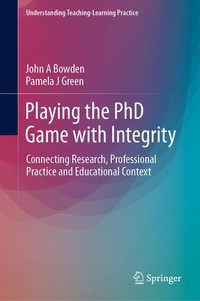
Playing the PhD Game with Integrity
Description
This book focuses on integrity throughout the PhD journey and beyond, and is organised around two main themes: (1) integrity in relation to the capabilities developed by doctoral candidates for professional practice; and (2) integrity and coherence at the PhD system level. The working methods of key participants such as PhD candidates, supervisors, university managers, government agencies and politicians are central to achieving integrity goals within PhD programmes. In this context, a number of constructs are developed that inform the practice-based elements of the book in relation to conducting doctoral research, research supervision, academic writing, and research training support systems; in particular, these include our Moral Compass Framework for professional integrity, notions of collective morality, decision-making when faced with 'wicked' problems, connected moral capability and our double-helix model of capability development, negotiated sense in contrast with common sense, completion mindsets and contexts, mindfulness, liminality, and mutual catalysis in joint authorship.
While the data the book employs stems from practice-led research within the Australian doctoral system, the conclusions drawn are of global relevance. Throughout the book, wherever appropriate, comparisons are made between the Australian context and other contexts, such as the doctoral systems of the United Kingdom, Europe and the United States.
More details
Other editions
Additional editions
Persons
Pam Green is an Adjunct Professor at RMIT University. For more than a decade, she was the Director of Graduate Studies at SUT. She was also responsible for the creation, from 2004 onwards, of the research student programme and supervisor training at SUT (Melbourne and Sarawak). Currently she is an educational consultant, offering research training for universities, and supervising doctoral candidates. Pam is co-founder of the Australian Qualitative Research Association. Her areas of expertise include doctoral education, research supervision, language / literacy education, qualitative research, transition and leadership.