

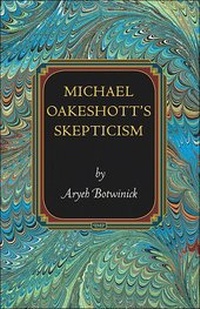
Michael Oakeshott's Skepticism
Published on 21. November 2010
Book
Hardback
272 pages
978-0-691-14717-8 (ISBN)
Description
The English philosopher Michael Oakeshott (1901-1990) is known as a conservative who rejected philosophically ambitious rationalism and the grand political ideologies of the twentieth century on the grounds that no human ideas have ultimately reliable foundations. Instead, he embraced tradition and habit as the guides to moral and political life. In this book, Aryeh Botwinick presents an original account of Oakeshott's skepticism about foundations, an account that newly reveals the unity of his thought. Botwinick argues that, despite Oakeshott's pragmatic conservatism, his rejection of all-embracing intellectual projects made him a friend to liberal individualism and an ally of what would become postmodern antifoundationalism. Oakeshott's skepticism even extended paradoxically to skepticism about skepticism itself and is better described as a 'generalized agnosticism'. Properly conceived and translated, this agnosticism ultimately evolves into mysticism, which becomes a bridge linking philosophy and religion.
Botwinick explains and develops this strategy of interpretation and then shows how it illuminates and unifies the diverse strands of Oakeshott's thought in the philosophy of religion, metaphysics, epistemology, political theory, philosophy of personal identity, philosophy of law, and philosophy of history.
Botwinick explains and develops this strategy of interpretation and then shows how it illuminates and unifies the diverse strands of Oakeshott's thought in the philosophy of religion, metaphysics, epistemology, political theory, philosophy of personal identity, philosophy of law, and philosophy of history.
Reviews / Votes
"During a time when the fragility of things is so palpable, Aryeh Botwinick's re-engagement with the work of Michael Oakeshott is invaluable. He shows us how Oakeshott's skepticism turns sharply back upon itself, how he draws us toward a tacit dimension that is itself both real and fragile, and how, once human anger against the complexity of skepticism is overcome, this stance can provide a live medium from which a generous ethic emerges. Botwinick reads Oakeshott in relation to Hobbes, Wittgenstein, Levinas, and Heidegger, as he also periodically reads Oakeshott against himself. A timely and illuminating study."-William E. Connolly, author of A World of Becoming "The literature on Oakeshott tends to emphasize the independence of his thought and the problem of how to classify him, a problem that Aryeh Botwinick neatly sidesteps by taking an entirely different line. Oakeshott turns out to be in agreement or dialogue with a range of other thinkers, including Nietzsche and Arendt. This is a fresh and rewarding approach that provides a new perspective on Oakeshott's thought and its significance."-Oliver Leaman, University of KentuckyMore details
Series
Language
English
Place of publication
New Jersey
United States
Target group
College/higher education
Professional and scholarly
Product notice
Trade binding
Dimensions
Height: 203 mm
Width: 127 mm
Weight
425 gr
ISBN-13
978-0-691-14717-8 (9780691147178)
Copyright in bibliographic data and cover images is held by Nielsen Book Services Limited or by the publishers or by their respective licensors: all rights reserved.
Schweitzer Classification
Other editions
Additional editions
Aryeh Botwinick
Michael Oakeshott's Skepticism
E-Book
11/2010
1st Edition
Princeton University Press
€49.49
Available for download
Person
Aryeh Botwinick is professor of political science at Temple University. He is the author of "Skepticism, Belief, and the Modern"; "Postmodernism and Democratic Theory"; and "Skepticism and Political Participation".
Content
Preface and Acknowledgments xi Chapter 1: Introduction: Epistemological Backdrop 1 Chapter 2: Metaphysics 29 Chapter 3: Philosophy of Religion and Philosophy of Science 49 Chapter 4: Political Theory 117 Chapter 5: Philosophy of Conversation and Philosophy of Personal Identity 132 Chapter 6: Philosophy of Law and Philosophy of History 194 Notes 223 Index 241