

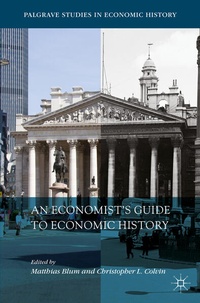
An Economist's Guide to Economic History
Description
Reviews / Votes
"Every economist who appreciates the importance of economic history should read this book as they will learn so much from the wealth of the material it covers. More importantly, all the other economists, those who do not yet know why economic history matters to them, should read it too. Whatever the subject - financial crises, innovation, trade wars, competition policy, and many others - understanding the historical perspective is essential to sound economic analysis and must be part of what students of economics are taught." (Diane Coyle, Bennett Professor of Public Policy, University of Cambridge, UK)"Economists have much to gain from studying economic history seriously. This excellent volume explains why, elaborates what this entails, and demonstrates the potential for synergies between economics and economic history. The result is a compelling manifesto." (Nicholas Crafts, Professor of Economic History, University of Warwick, UK)
"The list of contributors to this project is truly impressive, as is the breadth of the topics covered. The result is a terrific teaching resource that will give students a good sense of the many ways in which economic history can help economics come alive." (Kevin H. O'Rourke, Chichele Professor of Economic History, University of Oxford, UK)
More details
Other editions
Additional editions
Persons
Content
Chapter 1: Introduction, or Why We Started This Project.- Part I: Purpose, Philosophy and Pedagogy of Economic History.- Chapter 2: Economics and History.- Chapter 3: Economics, Economic History and Historical Data .- Chapter 4: Economic Theory and Economic History.- Chapter 5: Economic History and the Policymaker.- Chapter 6: Economic History, the History of Economic Thought and Economic Policy.- Chapter 7: Teaching Economics with Economic History.- Part II: Questions and Themes in Economic History.- Chapter 8: Money and Central Banking.- Chapter 9: Globalisation and Trade.- Chapter 10: Migration and Labour Markets.- Chapter 11: Financial Institutions and Markets.- Chapter 12: Bubbles and Crises.- Chapter 13: Sovereign Debt and State Financing.- Chapter 14: Health and Development.- Chapter 15: Education and Human Capital.- Chapter 16: Famine and Disease.- Chapter 17: Women and Children.- Chapter 18: Slavery and Discrimination.- Chapter 19: Crime and Violence.- Chapter 20: Business Ownership and Organisation.- Chapter 21: Competition and Collusion.- Chapter 22: Human Resources and Incentive Contracts.- Chapter 23: Global Divergence and Economic Change.- Chapter 24: Industrial Revolution and British Exceptionalism.- Chapter 25: Innovation and Technological Change.- Chapter 26: Culture and Religion.- Chapter 27: Agriculture and Rural Development.- Chapter 28: Environment and Natural Resources.- Part III: Eras, Regions and Contexts in Economic History.- Chapter 29: Economic Prehistory.- Chapter 30: The World Wars.- Chapter 31: Western Europe.- Chapter 32: Central and Eastern Europe.- Chapter 33: Sub-Saharan Africa.- Chapter 34: South Asia.- Chapter 35: East Asia.- Chapter 36: Australasia.- Chapter 37: North America.- Chapter 38: Latin America.- Part IV: Methods and Techniques in Economic History.- Chapter 39: Impact and Communication.- Chapter 40: Publishing Economic History.- Chapter 41: Archival Evidence.- Chapter 42: Case Studies.- Chapter 43: Analytic Narratives.- Chapter 44: Measurement and Metrics.- Chapter 45: Econometric Identification.- Chapter 46: Historical National Accounting.- Chapter 47: Productivity, Innovation and Social Savings.- Chapter 49: Frontier Analysis.- Chapter 49: Geospatial Information Systems.- Chapter 50: Network Analysis.