

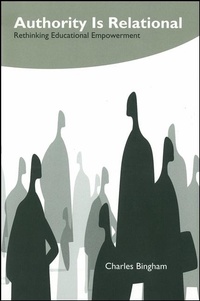
Authority Is Relational
Rethinking Educational Empowerment
Published on 29. May 2008
Book
Hardback
180 pages
978-0-7914-7403-7 (ISBN)
Description
A must read for anyone who wants to think in depth about contemporary classrooms.
Written in an accessible and personal style, this innovative study of authority in education examines scenarios of authority in ways that problematize, augment, and redefine prevalent ideas of how it works. Usually seen as a thing that people have, the author suggests that authority should be understood instead as a relation that happens between people, which gets enacted in circuits where each participant has a role to play; those circuits can include teachers, students, the books they read, as well as former teachers and former students. Drawing on ideas from psychoanalysis, hermeneutics, philosophy of language, and the work of Jacques Derrida and Paulo Freire, the book offers a useful new understanding of authority in education.
Written in an accessible and personal style, this innovative study of authority in education examines scenarios of authority in ways that problematize, augment, and redefine prevalent ideas of how it works. Usually seen as a thing that people have, the author suggests that authority should be understood instead as a relation that happens between people, which gets enacted in circuits where each participant has a role to play; those circuits can include teachers, students, the books they read, as well as former teachers and former students. Drawing on ideas from psychoanalysis, hermeneutics, philosophy of language, and the work of Jacques Derrida and Paulo Freire, the book offers a useful new understanding of authority in education.
Reviews / Votes
"The book is written with great clarity and in a personal style making it accessible to undergraduate students, without sacrificing a nuanced analysis that will be appreciated by graduate students, curriculum theorists, and philosophers of education." - CHOICE"Charles Bingham debunks the notion that teaching and learning are straightforward practices that can be improved by doing something 'other' or 'more,' an important contribution in the midst of dominant discourses that would have education be about the 'test/improve, test/improve' Sisyphean cycle. He turns our attention to the messy operation of human interaction, encouraging us to enrich our notions of authority and relation, which in turn enriches our notions of learning at the level of both schools and universities. This is one philosophical text that, refreshingly, does not shy away from examining classroom applications." - Kate Evans, author of Negotiating the Self: Identity, Sexuality, and Emotion in Learning to Teach
More details
Language
English
Place of publication
Albany, NY
United States
Target group
College/higher education
US School Grade: College Graduate Student and over
Product notice
sewn/stitched
Cloth over boards
With dust jacket
Dimensions
Height: 235 mm
Width: 155 mm
Thickness: 17 mm
Weight
399 gr
ISBN-13
978-0-7914-7403-7 (9780791474037)
Copyright in bibliographic data and cover images is held by Nielsen Book Services Limited or by the publishers or by their respective licensors: all rights reserved.
Schweitzer Classification
Other editions
Additional editions
E-Book
01/2009
1st Edition
State University of New York Press
€34.99
Available for download
Person
Charles Bingham is Assistant Professor in the Faculty of Education at Simon Fraser University and coeditor (with Alexander M. Sidorkin) of No Education Without Relation and author of Schools of Recognition: Identity Politics and Classroom Practices.
Content
Acknowledgments
Introduction: Authority Is Relational
1. Texts and the Authority Relation
2. The Literary Relation of Authority
3. Relating to Authority Figures Who Are Not There
4. When Faced with Authority
5. Questioning Authority
6. Paulo Freire and Relational Authority
Notes
References
Index
Introduction: Authority Is Relational
1. Texts and the Authority Relation
2. The Literary Relation of Authority
3. Relating to Authority Figures Who Are Not There
4. When Faced with Authority
5. Questioning Authority
6. Paulo Freire and Relational Authority
Notes
References
Index