

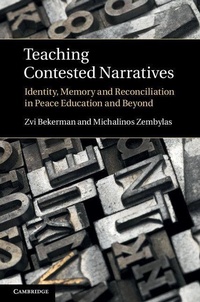
Teaching Contested Narratives
Identity, Memory and Reconciliation in Peace Education and Beyond
Published on 1. December 2011
Book
Hardback
272 pages
978-0-521-76689-0 (ISBN)
Description
In troubled societies narratives about the past tend to be partial and explain a conflict from narrow perspectives that justify the national self and condemn, exclude and devalue the 'enemy' and their narrative. Through a detailed analysis, Teaching Contested Narratives reveals the works of identity, historical narratives and memory as these are enacted in classroom dialogues, canonical texts and school ceremonies. Presenting ethnographic data from local contexts in Cyprus and Israel, and demonstrating the relevance to educational settings in countries which suffer from conflicts all over the world, the authors explore the challenges of teaching narratives about the past in such societies, discuss how historical trauma and suffering are dealt with in the context of teaching, and highlight the potential of pedagogical interventions for reconciliation. The book shows how the notions of identity, memory and reconciliation can perpetuate or challenge attachments to essentialized ideas about peace and conflict.
Reviews / Votes
'This is a critically important analysis of assumptions in peace education, based on a rich corpus of research in Israeli and Cypriot classrooms. The analysis challenges assumptions about our understanding of identity, memory and reconciliation, and challenges us to help children envisage and realise alternative futures.' Tony Gallagher, Professor of Education and Pro Vice Chancellor, Queen's University, Belfast '... a most compelling ethnographic comparative study of education that deals with issues of conflicting memories, identities and historical narratives in divided societies. It raises serious questions that challenge the prevailing psychologically oriented and Western-based epistemologies of peace education. Being written for both professionals and practitioners, it is a must read for anybody in the field of reconciliation, peace education and forgiveness.' Gabi Salomon, Professor Emeritus and Head of the Center for Research on Peace Education, Haifa University, IsraelMore details
Language
English
Place of publication
Cambridge
United Kingdom
Target group
Professional and scholarly
Dimensions
Height: 235 mm
Width: 157 mm
Thickness: 19 mm
Weight
549 gr
ISBN-13
978-0-521-76689-0 (9780521766890)
Copyright in bibliographic data and cover images is held by Nielsen Book Services Limited or by the publishers or by their respective licensors: all rights reserved.
Schweitzer Classification
Other editions
Additional editions
Zvi Bekerman | Michalinos Zembylas
Teaching Contested Narratives
Identity, Memory and Reconciliation in Peace Education and Beyond
Book
01/2014
Cambridge University Press
€55.60
Shipment within 15-20 days
Zvi Bekerman | Michalinos Zembylas
Teaching Contested Narratives
Identity, Memory and Reconciliation in Peace Education and Beyond
E-Book
03/2012
1st Edition
Cambridge University Press
€38.49
Available for download
Zvi Bekerman
Teaching Contested Narratives
Identity, Memory and Reconciliation in Peace Education and Beyond
E-Book
12/2011
Cambridge University Press
€31.99
Available for download
Persons
Michalinos Zembylas is Assistant Professor of Education at the Open University of Cyprus. His research interests are in the areas of educational philosophy and curriculum theory and his work focuses on exploring the role of emotion and affect in curriculum and pedagogy. He is particularly interested in how affective politics intersect with issues of social justice pedagogies, intercultural and peace education, and citizenship education. Zvi Bekerman, Ph.D. teaches anthropology of education at the School of Education and the Melton Center, Hebrew University of Jerusalem. From 2003 to 2007 he was a Research Fellow at the Truman Institute for the Advancement of Peace, Hebrew University. His main interests are in the study of cultural, ethnic and national identity, including identity processes and negotiation during intercultural encounters and in formal/informal learning contexts.
Content
Part I. Introduction and Theoretical Underpinnings: 1. Introduction; 2. Problematizing peace education romanticism; 3. On conflict, identity and more; Part II. Living and Teaching Contested Narratives: 4. Victims and perpetrators: how teachers live with contested narratives; 5. (Im)possible openings; 6. The everyday challenges of teaching children from conflicting groups; 7. The emotional complexities of teaching contested narratives; Part III. Mourning, Forgiveness and Reconciliation: Problems and Possible Solutions: 8. The nationalization of mourning in troubled societies; 9. The work of mourning in schools: ambivalent emotions and the risks of seeking mutual respect and understanding; 10. Forgiveness as a possible path towards reconciliation; Part IV. Conclusions: Implications for Peace Education: 11. Becoming critical design experts in schools; 12. Memory and forgetting: a pedagogy of dangerous memories; 13. De-essentializing identity; 14. Designing different paths for reconciliation pedagogies.