

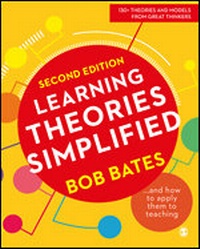
Learning Theories Simplified
...and how to apply them to teaching
2nd Edition
Published on 29. January 2019
Book
Hardback
384 pages
978-1-5264-5937-4 (ISBN)
Description
Are you struggling to get your head around John Dewey's educational pragmatism? What exactly is Jean Piaget saying about cognitive development? Maybe you're running out of time and patience making sense of Carol Dweck's mindsets? Have you reached breaking point reading Daniel T. Willingham on educational neuroscience?
Written for busy teachers, trainers, managers and students, this 'dip-in, dip-out' guide makes theories of learning accessible and practical. It explores 130 classic and contemporary learning theorists in an easy-to-use, bite-sized format with clear relevant illustrations on how each theory will benefit teaching and learning.
Each model or theory is explained in less than 350 words, followed by a 'how to use it' section.
What's new to this edition:
A new early childhood theorists section
A new communication theories section
Additional 'on trend' theorists throughout
New 'critical view' features added to each entry.
Written for busy teachers, trainers, managers and students, this 'dip-in, dip-out' guide makes theories of learning accessible and practical. It explores 130 classic and contemporary learning theorists in an easy-to-use, bite-sized format with clear relevant illustrations on how each theory will benefit teaching and learning.
Each model or theory is explained in less than 350 words, followed by a 'how to use it' section.
What's new to this edition:
A new early childhood theorists section
A new communication theories section
Additional 'on trend' theorists throughout
New 'critical view' features added to each entry.
Reviews / Votes
Bob's extensive knowledge of putting educational theory into practice shines through in this book. He gives clear explanations of each theory, often relating them to his own teaching experiences. He uses realistic examples to help the reader engage with the theory, with useful tips to put each into practice. I recommend this book to practitioners in the further education sector as well as in schools.Ann Gravells
www.anngravells.com -- Ann Gravells
More details
Edition
2nd Revised edition
Language
English
Place of publication
London
United Kingdom
Target group
College/higher education
Professional and scholarly
Edition type
Revised edition
Dimensions
Height: 232 mm
Width: 186 mm
Weight
846 gr
ISBN-13
978-1-5264-5937-4 (9781526459374)
Copyright in bibliographic data and cover images is held by Nielsen Book Services Limited or by the publishers or by their respective licensors: all rights reserved.
Schweitzer Classification
Other editions
New editions
Book
07/2023
3rd Edition
SAGE Publications Ltd
€101.60
Shipment within 3-4 weeks
Additional editions
E-Book
01/2019
2nd Edition
SAGE Publications Ltd
€39.99
Available for download
E-Book
01/2019
2nd Edition
SAGE Publications Ltd
€39.99
Available for download
Previous edition
Book
10/2015
1st Edition
SAGE Publications Ltd
€102.94
Article exhausted; check for reprint
Person
Bob Bates was a Senior Executive in the Civil Service for twenty years. During this time, he also worked as a staff trainer and coach and mentor to people with disabilities. He then set up his own Management & Training Consultancy (The Arundel Group), which celebrates its 25th anniversary next year. His work as a management consultant covered a number of local and central government projects as well as working as a trainer with major UK private sector companies.
In the late 1990s Bob started a lecturing career, during which time he gained two Masters Degrees in Management and Education and a PhD in Education. He has taught over 1000 teachers and trainers on graduate and post-graduate programmes at two universities. He currently manages and teaches on City & Guild Teaching Award, Certificate and Diploma courses in a Community College
The first edition of Learning Theories Simplified was Bob's third book. His first book, The Little Book of BIG Management Theories, written with Jim McGrath, was on W.H, Smiths' non-fiction best sellers list for nearly a year, is being translated into fifteen languages, including Japanese and Arabic, and was chosen by the Chartered Management Institute as the CMI's Practical Management Book of the Year for 2014. His second book, The Little Book of BIG Coaching Theories, published in February 2015, was also a best seller and has been translated into German and Thai. His fourth book, A Quick Guide to Special Needs and Disabilities, was published by SAGE in 2016 and his fifth book, Leadership Theories Simplified, was published by SAGE in 2017.
Bob shares his time these days between writing, working voluntarily for a charity that promotes health and education in the Gambia, researching into offender learning and homelessness and teaching Adult Education Teachers.
Bob can be contacted through his web site bobbates.co.uk (here you get an option to pick Research or Bad Bob Bates - please choose the former) or email saddlers9899@aol.com
In the late 1990s Bob started a lecturing career, during which time he gained two Masters Degrees in Management and Education and a PhD in Education. He has taught over 1000 teachers and trainers on graduate and post-graduate programmes at two universities. He currently manages and teaches on City & Guild Teaching Award, Certificate and Diploma courses in a Community College
The first edition of Learning Theories Simplified was Bob's third book. His first book, The Little Book of BIG Management Theories, written with Jim McGrath, was on W.H, Smiths' non-fiction best sellers list for nearly a year, is being translated into fifteen languages, including Japanese and Arabic, and was chosen by the Chartered Management Institute as the CMI's Practical Management Book of the Year for 2014. His second book, The Little Book of BIG Coaching Theories, published in February 2015, was also a best seller and has been translated into German and Thai. His fourth book, A Quick Guide to Special Needs and Disabilities, was published by SAGE in 2016 and his fifth book, Leadership Theories Simplified, was published by SAGE in 2017.
Bob shares his time these days between writing, working voluntarily for a charity that promotes health and education in the Gambia, researching into offender learning and homelessness and teaching Adult Education Teachers.
Bob can be contacted through his web site bobbates.co.uk (here you get an option to pick Research or Bad Bob Bates - please choose the former) or email saddlers9899@aol.com
Content
Part 1: Classical Learning Theories
Section 1.1: Educational Philosophy
Section 1.2: Behaviourism
Section 1.3: Cognitivism
Section 1.4: Humanism
Section 1.5: Neurolism
Part 2: Contemporary Thinking on Teaching and Learning
Section 2.1: Professionalism
Section 2.2: Learning Styles
Section 2.3: Motivation
Section 2.4: Behaviour Management
Section 2.5: Coaching and Mentoring
Section 2.6: Teamworking
Part 3: An Introduction to Early Childhood and Developmental Strategies
Section 3.1: Children and Society
Section 3.2: Emotional Growth
Section 3.3: Classroom Strategies
Section 3.4: Working with Children with Additional Needs
Section 3.5: Different School Approaches
Part 4: Planning, Delivering and Assessing Learning
Section 4.1: Curriculum Planning
Section 4.2: Lesson Planning
Section 4.3: Delivering Learning
Section 4.4: Assessment and Feedback
Section 4.5: Evaluating Teaching and Learning
Section 1.1: Educational Philosophy
Section 1.2: Behaviourism
Section 1.3: Cognitivism
Section 1.4: Humanism
Section 1.5: Neurolism
Part 2: Contemporary Thinking on Teaching and Learning
Section 2.1: Professionalism
Section 2.2: Learning Styles
Section 2.3: Motivation
Section 2.4: Behaviour Management
Section 2.5: Coaching and Mentoring
Section 2.6: Teamworking
Part 3: An Introduction to Early Childhood and Developmental Strategies
Section 3.1: Children and Society
Section 3.2: Emotional Growth
Section 3.3: Classroom Strategies
Section 3.4: Working with Children with Additional Needs
Section 3.5: Different School Approaches
Part 4: Planning, Delivering and Assessing Learning
Section 4.1: Curriculum Planning
Section 4.2: Lesson Planning
Section 4.3: Delivering Learning
Section 4.4: Assessment and Feedback
Section 4.5: Evaluating Teaching and Learning