

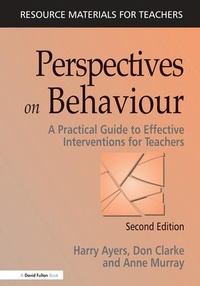
Perspectives on Behaviour
A Practical Guide to Effective Interventions for Teachers
2nd Edition
Published on 18. August 2016
Book
Hardback
128 pages
978-1-138-13279-5 (ISBN)
Description
This book is a practical guide to the following eight perspectives on behaviour:
biological -
focusing on biological and biochemical processes in accounting for behaviour;
behavioural
(or behaviourist) - focusing on overt, observable and measurable behaviours and their reinforcement in accounting for behaviour;
cognitive
(or cognitive-behavioural) - focusing on cognitive processes (beliefs, attitudes, expectations and attributions) in accounting for behaviour; combines both the cognitive and the behavioural perspective;
social learning
- focusing on observational learning, perceived self-efficacy and expectancies in accounting for behaviour;
psychodynamic
- focusing on unconscious conflicts in early childhood as accounting for current behaviour;
humanistic
- focusing on low self-esteem and problems in coping with and exploring feelings in accounting for behaviour;
ecosystemic
- focusing on positive and negative interactions between teachers and students within the school and those that externally affect the school; these interactions are seen as accounting for behaviour;
ecological
- focusing on the influence of systems and the environment in accounting for behaviour.The aim of the book is to enable the reader to develop a structured approach to emotional and behavioural problems by drawing on one or more of the above perspectives.
biological -
focusing on biological and biochemical processes in accounting for behaviour;
behavioural
(or behaviourist) - focusing on overt, observable and measurable behaviours and their reinforcement in accounting for behaviour;
cognitive
(or cognitive-behavioural) - focusing on cognitive processes (beliefs, attitudes, expectations and attributions) in accounting for behaviour; combines both the cognitive and the behavioural perspective;
social learning
- focusing on observational learning, perceived self-efficacy and expectancies in accounting for behaviour;
psychodynamic
- focusing on unconscious conflicts in early childhood as accounting for current behaviour;
humanistic
- focusing on low self-esteem and problems in coping with and exploring feelings in accounting for behaviour;
ecosystemic
- focusing on positive and negative interactions between teachers and students within the school and those that externally affect the school; these interactions are seen as accounting for behaviour;
ecological
- focusing on the influence of systems and the environment in accounting for behaviour.The aim of the book is to enable the reader to develop a structured approach to emotional and behavioural problems by drawing on one or more of the above perspectives.
More details
Edition
2nd edition
Language
English
Place of publication
London
United Kingdom
Publishing group
Taylor & Francis Ltd
Target group
Professional and scholarly
Academic and Professional Practice & Development
Dimensions
Height: 297 mm
Width: 210 mm
Weight
400 gr
ISBN-13
978-1-138-13279-5 (9781138132795)
Copyright in bibliographic data and cover images is held by Nielsen Book Services Limited or by the publishers or by their respective licensors: all rights reserved.
Schweitzer Classification
Other editions
Additional editions
Harry Ayers | Don Clarke | Anne Murray
Perspectives on Behaviour
A Practical Guide to Effective Interventions for Teachers
E-Book
08/2015
2nd Edition
David Fulton Publishers Ltd
€49.99
Available for download
Harry Ayers | Don Clarke | Anne Murray
Perspectives on Behaviour
A Practical Guide to Effective Interventions for Teachers
E-Book
08/2015
2nd Edition
David Fulton Publishers Ltd
€49.99
Available for download
Harry Ayers | Don Clarke | Anne Murray
Perspectives on Behaviour
A Practical Guide to Effective Interventions for Teachers
Book
05/2000
2nd Edition
David Fulton Publishers Ltd
€55.40
Shipment within 3-4 weeks
Persons
Harry Ayers, Don Clarke, Anne Murray
Content
Chapter 1 The biological perspective; Chapter 2 The behavioural perspective; Chapter 3 The cognitive-behavioural perspective; Chapter 4 The social learning perspective; Chapter 5 The psychodynamic perspective; Chapter 6 The humanistic perspective; Chapter 7 The ecosystemic perspective; Chapter 8 The ecological perspective;