

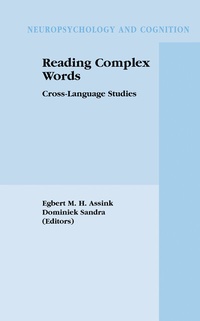
Reading Complex Words
Cross-Language Studies
Published on 31. March 2003
Book
Hardback
XXII, 339 pages
978-0-306-47707-2 (ISBN)
Description
In a series of fourteen chapters this book brings together current research findings on the involvement of word-internal structure for the purpose of word reading (especially morphological structure). Contributors include many leading experts in this research domain. The central theme of reading complex words is approached from several angles, such that the chapters span a wide variety of topics where this issue is important. The experiments reported in the book involve:
- different populations : children, expert readers, illiterates;
- different languages: Chinese, Dutch, English, French, Hebrew, Italian, Turkish, Serbian;
- different processing levels where morphology may play a role: sublexical, supralexical;
- different variables which may determine morphological effects: morphological type, semantic transparency, branching relations among morphemes.
Reviews / Votes
"Overall, the book is quite comprehensive and adds substantive information to the pool of data regarding sublexical processes and reading."(Jaumeiko J.C. Brown, Ph.D.)
More details
Series
Edition
2003 ed.
Language
English
Place of publication
New York
United States
Publishing group
Springer Science+Business Media
Target group
Professional and scholarly
Research
Illustrations
36 s/w Abbildungen
XXII, 339 p. 36 illus.
Dimensions
Height: 241 mm
Width: 160 mm
Thickness: 26 mm
Weight
709 gr
ISBN-13
978-0-306-47707-2 (9780306477072)
DOI
10.1007/978-1-4757-3720-2
Schweitzer Classification
Other editions
Additional editions
E-Book
06/2013
Springer
€149.79
Available for download
Book
12/2010
Springer
€160.49
Shipment within 15-20 days
Content
1. Linking morphological knowledge to English decoding ability: Large effects of little suffixes.- 2. The effects of morphological structure on children's reading of derived words in English.- 3. Morphological and phonological analysis by beginning readers: Evidence from Serbian and Turkish.- 4. Recognizing morphologically complex words in Turkish.- 5. Word decomposition in Hebrew as a Semitic language.- 6. Morphological representation as a correlation between form and meaning.- 7. A supralexical model for French derivational morphology.- 8. Parsing and semantic opacity.- 9. Effects of sublexical frequency and meaning in prefixed words.- 10. Morphological parsing and morphological structure.- 11. Morpheme-based lexical reading: Evidence from pseudoword naming.- 12. Word reading processes in adult learners.- 13. Reading aloud polysyllabic words.- 14. Homophonous regular verb forms with a morphographic spelling: Spelling errors as a window on the mental lexicon and working memory.