

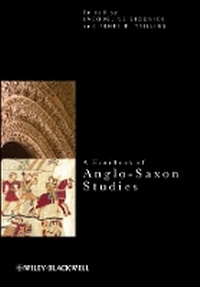
A Handbook of Anglo-Saxon Studies
Published on 5. September 2012
Software
Other digital
336 pages
978-1-118-32882-8 (ISBN)
Description
Reflecting the profound impact of critical theory on the study of the humanities, this collection of original essays examines the texts and artifacts of the Anglo-Saxon period through key theoretical terms such as 'ethnicity' and 'gender'. Explores the interplay between critical theory and Anglo-Saxon studies Theoretical framework will appeal to specialist scholars as well as those new to the field Includes an afterword on the value of the dialogue between Anglo-Saxon studies and critical theory
More details
Language
English
Place of publication
New York
United States
Target group
Professional and scholarly
Dimensions
Height: 250 mm
Width: 150 mm
Thickness: 15 mm
Weight
666 gr
ISBN-13
978-1-118-32882-8 (9781118328828)
Copyright in bibliographic data and cover images is held by Nielsen Book Services Limited or by the publishers or by their respective licensors: all rights reserved.
Schweitzer Classification
Other editions
Additional editions
Jacqueline Stodnick | Renée Trilling
A Handbook of Anglo-Saxon Studies
E-Book
08/2012
Wiley-Blackwell
€112.99
Available for download
Jacqueline Stodnick | Renée Trilling
A Handbook of Anglo-Saxon Studies
E-Book
08/2012
Wiley-Blackwell
€112.99
Available for download
Person
Jacqueline Stodnick is Associate Professor of English at the University of Texas at Arlington, USA, where she teaches the history of the English language, Old English, and the history of British literature. She has published articles on lists, the Anglo-Saxon Chronicle, and hagiography, focusing in particular on English cultural identity. Her current work explores Anglo-Saxon notions of the body. Renee R. Trilling is Associate Professor of English at the University of Illinois, USA. She is the author of The Aesthetics of Nostalgia: Historical Representation in Old English Verse (2009), as well as articles on Beowulf, Wulfstan the Homilist, and Anglo-Saxon historiography. Her current work draws on recent trends in neuroscience and related fields to explore the role of materiality in Anglo-Saxon notions of subjectivity.
Content
List of Figures vii Notes on Contributors ix Acknowledgments xiii Introduction 1 Jacqueline Stodnick and Rene'e R. Trilling 1 Borders 9 Elaine Treharne 2 Disability 23 Christina Lee 3 Gender 39 Stacy S. Klein 4 Hegemony 55 Robin Norris 5 Historicism 69 Scott Thompson Smith 6 Law and Justice 85 Andrew Rabin 7 Literacy 99 R. M. Liuzza 8 Masculinity 115 D. M. Hadley 9 Media 133 Martin K. Foys 10 Postcolonial 149 Catherine E. Karkov 11 Race and Ethnicity 165 Stephen Harris 12 Sex and Sexuality 181 Carol Braun Pasternack 13 Space and Place 197 Andrew Scheil 14 Time 215 Kathleen Davis 15 Violence 235 Mary Louise Fellows 16 Visual Culture 251 Benjamin C. Withers 17 Women 265 Helene Scheck and Virginia Blanton 18 Writing 281 E. J. Christie Index 295