

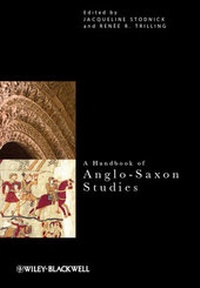
A Handbook of Anglo-Saxon Studies
Description

Reviews / Votes
"The essays are written in a consistently clear andinformative manner that will engage students and scholarsalike. Summing Up. Highly recommended. Upper-division undergraduates through faculty." (Choice, 1 September 2013) "Neither Modern Critical Theory nor Anglo-Saxon Studies ispast its 'best before' date. The contributions to thisbook combine authoritative knowledge of many aspects of Anglo-Saxonculture with a diversity of interpretative perspectives. Meticulousanalysis of the material within a framework of concentrated,reflective approaches continues to generate stimulating newinsights and appreciation."--John Hines, CardiffUniversityMore details
Other editions
Additional editions
Persons
Content
Chapter 1
Borders
Elaine Treharne
To write about borders in Early England already indicates the creation of a metanarrative of confinement – an essay neatly limited by its topic. However, “borders” in Anglo-Saxon England and into the twelfth century are as complex and messy as any of our modern boundaries. “Borders” can refer to geographically, politically, and religiously defined areas, landmarks both natural and man-made, individual nations, races, regions, languages, demarcations of land ownership, entire chronological periods, the limits of knowledge and cultural influences, the defining of texts and genres, the acceptability and policing of the orthodox, and the censuring and punishment of the heterodox. “Borders” also intimate distance and distinction, or throw into sharp relief proximity and similarity – a blurring of boundaries. Thus, what appears to be a relatively straightforward term is immensely tricky, and particularly so within the bounded length of an essay like this. Here, then, Early English terminology for “borders” will be discussed, with a particular and recurring emphasis on mearcian (“to mark,” “to mark out”) and its various compounds and derivatives; and the way land was mapped and divided up will be briefly investigated through Anglo-Saxon charters. Most time will be spent on the in-between, though, in an effort to understand how the Anglo-Saxons might have conceived of the land between borders, those spaces which one might think of in postcolonial terms as “liminal,” on the threshold of that which is on the other side, but which one might also think of as being neither one thing nor the other; or, indeed, paradoxically, looking both ways simultaneously. Since borders or boundaries invoke all these complexities, I shall be treating literal boundaries and border regions within a range of Old English works, to allow multiple readings to emerge while resisting oversimplistic definition or predetermined categorization.
Border Theory has as its champions scholars whose focus is principally modern, and often centered on contemporary America and its borders with Hispanic Central America. Gloria Anzaldua's seminal work, Borderlands/La Frontera, first published in 1987, describes the United States–Mexico border as a site “where the Third World grates against the first and bleeds. And before a scab forms it hemorrhages again, the lifeblood of two worlds merging to form a third country – a border culture” (25). This “border culture,” a space of the in-between, is akin to the hybridity of postcolonial theory, where the hybrid is created as a destabilizing identity emerging from the contested space between colonizer and colonized. Some scholars imagine an assimilative impulse evolving from the hybrid; this implies that hybridity equates to syncretism or fusion, but this is to oversimplify the complex, processual, and separate state-of-being created in the contested space. In relation to the border, this is a space that cleaves, and thus emerges as “in-between” and mediating adjacent boundaries.1 Ironically, of course, the present essay concerns itself with a period labeled the “medieval,” the “middle ages,” an often derogatory term that implies transition from one (good) thing to another; the “middle” is the “dark,” the empty, the lacuna delimited by the edges of the defined. This fallacy of the boundary (whether chronological, political, or linguistic) is highlighted by Iain Chambers's sensitive work on the Mediterranean, in which he describes the border as “not a thing, but rather, the materialization of authority,” reminding us that “the seeming solidity of the lands, languages, and lineages that border and extend outward from [the Mediterranean's] shores ... become an accessory to its fluid centrality” (6, 27). It is this “fluid centrality,” the “in-betweenness,” that might prove most productive for the purposes of this examination of borders in the Anglo-Saxon world.
Translating Meaning
It is always best to begin with clarifying the labels that we use, themselves indicative of the way in which language potentially closes off interpretation, especially when we are required to translate an ancient form of a language into its modern approximation. For the Anglo-Saxons, the word “border” itself did not exist, since it is a French loan (though its semantic range might have been influenced by Old English bord); neither did the words “frontier,” “limit,” “territory,” and “genre” exist in English prior to the fifteenth century and later. The Anglo-Saxons used instead a multitude of words to express the concept of the boundary or demarcation of land or nation. One such term is bord – itself a polysemic word – meaning “boundary,” particularly when used with prepositions innan and utan denoting place (“within” and “outside” of boundaries). The most famous use of this concept of a boundary denoting a geographic and political unit is found in the late ninth-century work, King Alfred's Preface to Gregory's Pastoral Care, one of the best known and most widely taught texts from the period (Treharne 14–15). In his lament on the state of education in England following the Viking incursions throughout the ninth century, Alfred looks back to a time when there were far greater numbers of learned men and successful leaders in the country. He comments on how previous kings in Anglo-Saxon England
ægðer ge hiora sibbe ge hiora siodu ge hiora onweald innanbordes gehioldon, ond eac ut hiora eðel rymdon; ond hu him ða speow ægðer ge mid wige ge mid wisdome; ond eac ða godcundan hadas, hu giorne hie wæron ægðer ge ymb lare ge ymb liornunga, ge ymb ealle ða ðiowotdomas ðe hie Gode don scoldon; ond hu man utanbordes wisdom ond lare hieder on lond sohte; ond hu we hie nu sceoldon ute begietan, gif we hie habban sceoldon. Swæ clæne hio wæs oðfeallenu on Angelcynne ðat swiðe feawa wæron behionan Humbre ðe hiora ðeninga cuðen understondan on Englisc oððe furðum an ærendgewrit of Lædene on Englisc areccean; ond Ic wene ðætte noht monige begiondan Humbre næren. Swæ feawa hiora wæron ðæt Ic furðum anne anlepne ne mæg geðencean be suðan Temese ða ða Ic to rice feng.
(both maintained their peace and their morality and their authority within their borders, and also enlarged their territory outside; and how they prospered both in warfare and in wisdom; and also how zealous the sacred orders were both about teaching and about learning as well as all the services that they had to perform for God; and how people from outside the borders came here to this country in search of knowledge and instruction, and how we should now have to get them from outside, if we should acquire them. So complete was learning's decay among the English people that there were very few this side of the Humber who could understand their services in English, or even translate a letter from Latin into English; and I imagine that there were not many beyond the Humber. There were so few of them that I cannot even remember a single one south of the Thames when I succeeded to the kingdom.)
This self-positioning of kingdom, nation and self by Alfred is very revealing for its understanding of discrete and permeable boundaries, political and intellectual roles. In his rhetorical pairings of morality, authority and wisdom within borders (that is, “at home”) with expansionism and warfare outside borders (that is, “abroad”), he contrasts previous stable reigns with his own, where outsiders are now required to bring knowledge to the English that was once sought by foreigners within England's borders.
Moreover, even the situation among the English nation itself is not so straightforward, since natural boundaries – the Humber and Thames rivers in the north and south of eastern England – preclude the provision of an overarching statement, accurately reflecting the divisions of earlier kingdoms in the period preceding Alfred's reign. North of the Humber was the Northumbrian kingdom, and the Thames signaled the boundary between the kingdoms of Kent and Essex; these political borders clearly still meant something to Alfred and his audience, as did the chronology of reigns and the limits of remembrance. When Alfred tells us that he cannot remember a single learned man south of the Thames when he ascended to the throne, he points to the edges of cultural understanding in this period of transitional literacy – the fraying of knowledge outside the bounds of time and memory. Here, then, the political and geographical boundaries are paralleled with the limits of learning, as if a river can signal the gulf between levels of intellectual prowess, in a way reminiscent of the current stereotypes common to the British (or, indeed, American) north–south divide. Even from this single text, then, the complexity of the border – a natural landmark, a politically authorized divide, an intellectual boundary, an intangible marker of difference – becomes clear.
