

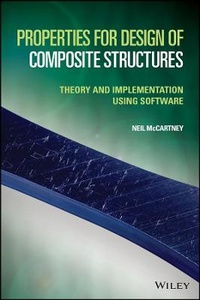
Properties for Design of Composite Structures - Theory and Implementation Using Software
Published on 1. February 2022
Software
Other digital
592 pages
978-1-118-78979-7 (ISBN)
Description
Properties for Composite Structures: Theory, Applications and Software L N McCartney, Materials Division, NPL, UK A comprehensive guide to analytical methods and source code predicting behaviour of undamaged and damaged composite materials The book provides readers with all relevant theoretical information to help them understand the ways in which thermo-elastic properties of two phase and multi-phase composites can be estimated using consistent methods from properties of reinforcement and matrix, and from geometrical data, especially volume fractions, for both undamaged and damaged composites. Properties for Composite Structures: Theory, Applications and Software focuses on the use of fibre properties that are transverse isotropic and the inclusion of the effects of thermal residual stresses. The book offers very useful explicit formulae and theoretical extensions that are not published in learned journals. Divided into four parts, the book covers: Principles, formulae for homogeneous materials and applications; Properties of undamaged composites; Properties of damaged composites; and Derivations of key results.
Key features: * Focuses on descriptions of the theoretical derivations using analytical methods that are the basis of estimating the undamaged and damaged effective properties of composite materials. * Provides computer source code to enable readers to reproduce results given in the book, and for their own purposes. * Includes previously unpublished results. Properties for Composite Structures: Theory, Applications and Software is an essential guide for designers of composite materials and composite engineering components.
Key features: * Focuses on descriptions of the theoretical derivations using analytical methods that are the basis of estimating the undamaged and damaged effective properties of composite materials. * Provides computer source code to enable readers to reproduce results given in the book, and for their own purposes. * Includes previously unpublished results. Properties for Composite Structures: Theory, Applications and Software is an essential guide for designers of composite materials and composite engineering components.
More details
Language
English
Place of publication
New York
United States
Target group
Professional and scholarly
Dimensions
Height: 250 mm
Width: 150 mm
Thickness: 15 mm
Weight
666 gr
ISBN-13
978-1-118-78979-7 (9781118789797)
Copyright in bibliographic data and cover images is held by Nielsen Book Services Limited or by the publishers or by their respective licensors: all rights reserved.
Schweitzer Classification
Other editions
Additional editions
Neil McCartney
Properties for Design of Composite Structures
Theory and Implementation Using Software
E-Book
06/2022
1st Edition
Wiley
€114.99
Available for download
Neil McCartney
Properties for Design of Composite Structures
Theory and Implementation Using Software
E-Book
06/2022
1st Edition
Wiley
€114.99
Available for download
Person
Neil McCartney graduated with a PhD in Mathematics at Manchester University in 1968 and has spent the whole of his career at the National Physical Laboratory undertaking theoretical research associated with many aspects of materials science. He is currently an Emeritus Senior NPL Fellow. For many years he studied damage initiation and growth in unidirectional fibre reinforced composites and their laminates, with applications to multi-layered materials involving metals, ceramics and polymers. Current work undertaken includes modelling of polymer electrolyte membrane fuel cells, and of multi-layered piezoelectric systems subject to mechanical, thermal and electrical stimulation. He was Visiting Professor in the Dept. of Materials Science and Engineering, University of Surrey, March 1995 to 31 August 2010, and Visiting Professor in the Centre for Collaborative Research, The University of Tokyo, Japan, 1 February to 8 May 1999. He is a Fellow of the Institute of Mathematics and its Applications and a Chartered Mathematician.