

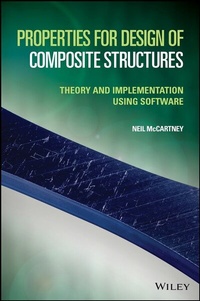
Properties for Design of Composite Structures
Description

A comprehensive guide to analytical methods and source code to predict the behavior of undamaged and damaged composite materials
In Properties for Design of Composite Structures: Theory and Implementation Using Software, distinguished researcher Dr. Neil McCartney delivers a unique and insightful approach to the development of predictive methods for the properties of undamaged and damaged laminated composite materials. The book focuses on presenting compact analytical formulae for several important effective properties--including mechanical, thermal, and electrical--that can be applied to a variety of reinforcement geometries.
The author introduces a compact notation that enables an explicit treatment of laminate property determination, including the out-of-plane shear properties required for three-dimensional numerical simulations of structural features using finite and boundary element analyses. There is also a detailed consideration of ply crack closure and a useful study of the interrelationships between the effective thermoelastic constants of damaged laminates.
The book also offers:
* A thorough introduction to the principles and formulae for homogenous materials and applications, including continuum and fracture concepts for homogeneous materials
* A comprehensive exploration of the properties of undamaged composites, including undamaged composite materials with multiple phases and the properties of a single undamaged lamina
* Practical discussions of the properties of damaged composites, including matrix cracking in UD composites and damaged laminates
* Consideration of effects of delamination, fatigue, and environmentally induced damage
* In-depth examinations of derivations of key results, including the analysis of bridged cracks and stress transfer mechanics for cross-ply and general symmetric laminates
Perfect for composite design engineers in all types of material-supplying industries and manufacturing companies, Properties for Design of Composite Structures: Theory and Implementation Using Software will also earn a place in the libraries of undergraduate and graduate students in engineering, aerospace, and materials departments.
More details
Other editions
Additional editions
Person
Neil McCartney graduated with a PhD in Mathematics from Manchester University in 1968 and spent the whole of his career at the National Physical Laboratory (NPL) undertaking theoretical research associated with many aspects of materials science. He is currently an Emeritus Senior NPL Fellow. For many years he studied damage initiation and growth in unidirectional fibre reinforced composites and their laminates, with applications to multi-layered materials involving metals, ceramics, and polymers. His current work includes modelling of polymer electrolyte membrane fuel cells and batteries, and of multi-layered piezoelectric systems subject to mechanical, thermal, and electrical stimulation. He was Visiting Professor in the Department of Materials Science and Engineering, University of Surrey, March 1995 to 31 August 2010, and Visiting Professor in the Centre for Collaborative Research, The University of Tokyo, Japan, 1 February to 8 May 1999. He is a Fellow of the Institute of Mathematics and its Applications and a Chartered Mathematician.
Content
Preface vii
About the Companion Website ix
1 Introduction 1
2 Fundamental Relations for Continuum Models 5
3 Maxwell's Far-field Methodology Applied to the Prediction of Effective Properties of Multiphase Isotropic Particulate Composites 43
4 Maxwell's Methodology for the Prediction of Effective Properties of Unidirectional Multiphase Fibre-reinforced Composites 65
5 Reinforcement with Ellipsoidal Inclusions 97
6 Properties of an Undamaged Single Lamina 111
7 Effective Thermoelastic Properties of Undamaged Laminates 129
8 Energy Balance Approach to Fracture in Anisotropic Elastic Material 163
9 Ply Crack Formation in Symmetric Cross-ply Laminates 189
10 Theoretical Basis for a Model of Ply Cracking in General Symmetric Laminates 223
11 Ply Cracking in Cross-ply Laminates Subject to Biaxial Bending 249
12 Energy-based Delamination Theory for Biaxial Loading in the Presence of Thermal Stresses 271
13 Energy Methods for Fatigue Damage Modelling of Laminates 297
14 Model of Composite Degradation Due to Environmental Damage 329
15 Maxwell's Far-field Methodology Predicting Elastic Properties of Multiphase Composites Reinforced with Aligned Transversely Isotropic Spheroids 345
16 Debonding Models and Application to Fibre Fractures and Matrix Cracks 379
17 Interacting Bridged Ply Cracks in a Cross-ply Laminate 425
18 Theoretical Basis for a Model of Ply Cracking in General Symmetric Laminates 447
19 Stress-transfer Mechanics for Biaxial Bending 479
Appendix A: Solution for Shear of Isolated Spherical Particle in an Infinite Matrix 503
Appendix B: Elasticity Analysis of Two Concentric Cylinders 510
Appendix C: Gibbs Energy per Unit Volume for a Cracked Laminate 518
Appendix D: Crack Closure Conditions for Laminates 523
Appendix E: Derivation of the Solution of Nonlinear Equations 531
Appendix F: Analysis for Transversely Isotropic Cylindrical Inclusions 536
Appendix G: Recurrence Relations, Differential Equations and Boundary Conditions 541
Appendix H: Solution of Differential Equations 546
Appendix I: Energy Balance Equation for Delamination Growth 551
Appendix J: Derivation of Energy-based Fracture Criterion for Bridged Cracks 554
Appendix K: Numerical Solution of Integral Equations for Bridged Cracks 560
Index 565
