

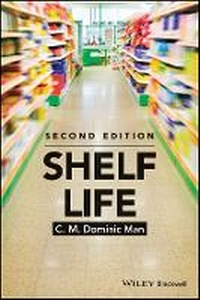
Shelf Life, 2e
Published on 27. February 2015
Software
Other digital
152 pages
978-1-118-34623-5 (ISBN)
Description
Shelf life, a term recognised in EU/UK food legislation, may bedefined as the period of time for which a food product will remainsafe and fit for use, provided that it is kept in defined storageconditions. During this period, the product should retain itsdesired sensory, chemical, physical, functional and microbiologicalcharacteristics, as well as accurately comply with any nutritionalinformation printed on the label. Shelf life therefore refers to a number of different aspects; each foodproduct has a microbiological shelf life, a chemical shelf life,and a sensory (or organoleptic) shelf life. These categoriesreflect the different ways in which a food product will deteriorateover time. Ultimately the shelf life of a food product is intendedto reflect the overall effect of these different aspects. Shelf life has always been an important facet of industrial foodpreparation and production, as food and drink are often produced inone area and then distributed to other areas for retailing andconsumption.
Globalised distribution and supply chains make itimperative that food should survive the transit between producerand consumer as a perishable commodity, food carries a highrisk of spoilage. As such, a realistic, workable and reproducibleshelf life has to be determined every time a new food product isdeveloped and marketed; shelf life determination of food has becomean integral part of food safety, quality assurance, productdevelopment, marketing, and consumer behaviour. Dominic Man s Shelf Life, now in a revised and updatedsecond edition, encompasses the core considerations about shelflife. Section 1 introduces shelf life, describes its relationshipto food safety, and provides answers to the frequently askedquestions around shelf life determination and testing which are amanager s chief concerns. Section 2 covers the science of thevarious ways in which food deteriorates and spoils, including thephysical, chemical and microbiological changes. Section 3 looks atshelf life in practice, using case studies of different products toillustrate how shelf life may be determined in real life settings.This book will be invaluable to both practitioners and students inneed of a succinct and comprehensive overview of shelf lifeconcerns and topics.
Also available Biological Controls for Preventing FoodDeterioration Edited by Neeta Sharma ISBN 978-1-118-53306-2 Practical Food Safety Edited by Rajeev Bhat and Vicente M. Gomez-Lopez ISBN 978-1-118-47460-0 Lactic Acid Bacteria Edited by Wilhelm H. Holzapfel and Brian J.B. Wood ISBN 978-1-4443-3383-1
Globalised distribution and supply chains make itimperative that food should survive the transit between producerand consumer as a perishable commodity, food carries a highrisk of spoilage. As such, a realistic, workable and reproducibleshelf life has to be determined every time a new food product isdeveloped and marketed; shelf life determination of food has becomean integral part of food safety, quality assurance, productdevelopment, marketing, and consumer behaviour. Dominic Man s Shelf Life, now in a revised and updatedsecond edition, encompasses the core considerations about shelflife. Section 1 introduces shelf life, describes its relationshipto food safety, and provides answers to the frequently askedquestions around shelf life determination and testing which are amanager s chief concerns. Section 2 covers the science of thevarious ways in which food deteriorates and spoils, including thephysical, chemical and microbiological changes. Section 3 looks atshelf life in practice, using case studies of different products toillustrate how shelf life may be determined in real life settings.This book will be invaluable to both practitioners and students inneed of a succinct and comprehensive overview of shelf lifeconcerns and topics.
Also available Biological Controls for Preventing FoodDeterioration Edited by Neeta Sharma ISBN 978-1-118-53306-2 Practical Food Safety Edited by Rajeev Bhat and Vicente M. Gomez-Lopez ISBN 978-1-118-47460-0 Lactic Acid Bacteria Edited by Wilhelm H. Holzapfel and Brian J.B. Wood ISBN 978-1-4443-3383-1
More details
Language
English
Place of publication
New York
United States
Target group
Professional and scholarly
Dimensions
Height: 250 mm
Width: 150 mm
Thickness: 15 mm
Weight
666 gr
ISBN-13
978-1-118-34623-5 (9781118346235)
Copyright in bibliographic data and cover images is held by Nielsen Book Services Limited or by the publishers or by their respective licensors: all rights reserved.
Schweitzer Classification
Other editions
Additional editions
Person
Dominic Man is a food scientist with 40 years experience in technical development and food safety and qualitymanagement in the UK food industry. He has worked for a number offood companies covering product categories of frozen foods, chilledready meals and ambient cakes, pastries and biscuits. He hasconducted academic research in HACCP, sensory evaluation, stabilityof water-soluble vitamins, and currently, long-term storageproperties of green teas. He has successfully managedgovernment-industry funded KTP projects, and carried outconsultancy work for the industry. He is a part-time lecturer atLondon South Bank University and a consultant of its London FoodCentre.
Content
Preface to the Second Edition viii Preface to the First Edition ix Section 1 Introduction to shelf life of foods Frequently asked questions 1 1.1What is shelf life? 1 1.2 Why are food safety and shelf life related? 2 1.3 Who should be interested in shelf life of foods? 5 1.4 Who is responsible for determining shelf life? 6 1.5 Is it illegal to give a wrong shelf life to a food product?7 1.6 How long a shelf life should my product have? 10 1.7 What is accelerated shelf life testing? 12 1.8 What are the resources required for determining shelf life?15 1.9 How is the end of shelf life normally decided? 16 1.10 How do we ensure that the shelf lives established for ourproducts are accurate and reproducible? 17 1.11 Can mathematical/computer models help in shelf lifedetermination? 20 1.12 What is challenge testing? 30 1.13 Can the shelf life of my product be extended? 31 1.14 How are storage tests and trials set up for determiningshelf life? 36 1.14.1 Objective of the storage trial 36 1.14.2 Storage conditions 36 1.14.3 Samples of storage trials 37 1.14.4 Sampling schedule 38 1.14.5 Shelf life tests 38 1.15 Food waste and shelf life: What is the problem? 39 1.16 Summary 40 Section 2 The ways food deteriorates and spoils 41 2.1 Mechanisms of food deterioration and spoilage 41 2.1.1 Physical changes and mechanisms 41 2.1.2 Chemical and/or biochemical changes 46 2.1.3 Light-induced changes 57 2.1.4 Microbiological changes 58 2.2 factors influencing the shelf life of foods 62 2.2.1 Intrinsic factors 62 2.2.2 Extrinsic factors 71 2.2.3 Interaction between intrinsic and extrinsic factors 76 2.2.4 Consumer handling and use 76 2.2.5 Commercial considerations 77 2.3 Summary 77 Section 3 Determining shelf life in practice 79 3.1 Case study 1 chilled recipe dish 79 3.1.1 The product, 79 3.1.2 The process, 79 3.1.3 Food safety, 80 3.1.4 Mechanism(s) of shelf life deterioration, 81 3.1.5 Shelf life determination storage trials, 81 3.1.6 Predicting shelf life, 82 3.1.7 Assurance of assigned shelf life the HACCPapproach, 82 3.2 Case study 2 savoury potato snack, 83 3.2.1 The product, 83 3.2.2 The process, 83 3.2.3 Food safety, 83 3.2.4 Mechanism(s) of shelf life deterioration, 84 3.2.5 Shelf life determination storage trials, 85 3.2.6 Assurance of assigned shelf life the HACCPapproach, 86 3.3 Case study 3 carbonated soft drink, 86 3.3.1 The product, 86 3.3.2 The process, 87 3.3.3 Food safety, 88 3.3.4 Mechanism(s) of shelf life determination, 88 3.3.5 Shelf life determination storage trials, 88 3.3.6 Assurance of assigned shelf life the HACCPapproach, 89 3.4 Case study 4 condiment sauce, 91 3.4.1 The product, 91 3.4.2 The process, 91 3.4.3 Food safety, 91 3.4.4 Mechanism(s) of shelf life deterioration, 91 3.4.5 Shelf life determination storage trials, 93 3.4.6 Assurance of assigned shelf life the HACCPapproach, 94 3.5 Case study 5 frozen baked cake, 95 3.5.1 The product, 95 3.5.2 The process, 95 3.5.3 Food safety, 95 3.5.4 Mechanisms(s) of shelf life deterioration, 95 3.5.5 Shelf life determination storage trials, 96 3.5.6 Assurance of assigned shelf life the HACCPapproach, 97 3.6 Summary, 98 Epilogue, 101 Appendix A: The arrhenius model, 109 Appendix B: The CIMSCEE formulae for microbiological safety andstability, 111 References, 115 Index, 000