

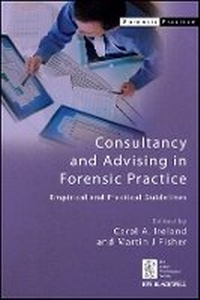
Consultancy and Advising in Forensic Practice - Empirical and Practical Guidelines
Published on 29. March 2010
Software
Other digital
290 pages
978-0-470-66150-5 (ISBN)
Description
The first publication to apply the modern theory and techniques in the consultancy process, presenting a clear, practical approach targeted specifically at forensic issues and contexts. * The first publication to apply consultancy literature to a forensic setting* Provides a combination of the theoretical and practical underpinnings needed in consultancy work, offering a development of knowledge with practical application* Brings together papers from researchers, academics, practitioners and consultants within forensic psychology whilst drawing upon expertise in business consultancy and administration* Chapters combine psychological, ethical, managerial and evaluative aspects into themed summaries* Offers directions for further study and practice development
Reviews / Votes
"Consultancy and advising in forensic practice covers a range of topics in relation to the involvement of psychological approaches in forensic work within the consultation process and training approaches ... It is a practical guide and is very informative, and it is careful in its application of structures and theories, and advises understanding theoretical knowledge and deliberation about the best approach for any given area." (British Journal of Occupational Therapy, 1 August 2011)More details
Language
English
Place of publication
Hoboken
United Kingdom
Publishing group
John Wiley and Sons Ltd
Target group
Professional and scholarly
Dimensions
Height: 226 mm
Width: 163 mm
Thickness: 22 mm
Weight
568 gr
ISBN-13
978-0-470-66150-5 (9780470661505)
Copyright in bibliographic data and cover images is held by Nielsen Book Services Limited or by the publishers or by their respective licensors: all rights reserved.
Schweitzer Classification
Other editions
Additional editions
Carol A. Ireland | Martin J. Fisher
Consultancy and Advising in Forensic Practice
Empirical and Practical Guidelines
E-Book
02/2010
1st Edition
Wiley
€42.99
Available for download
Persons
Carol A. Ireland is a Chartered Psychologist, Forensic Psychologist and Chartered Scientist. She works at the University of Central Lancashire as the Director of Studies for the MSc in Forensic Psychology, and leads on the postgraduate qualifications for the Child Exploitation Online Protection Agency (CEOP). In addition, Dr Ireland works for Mersey Care NHS Trust at Ashworth High Secure Hospital, where she is lead for group sex offender therapies and crisis (hostage) negotiation. She manages her own consultancy firm, delivering expert witness reports, training and consultancy, and is currently Chair of the British Psychological Society's Division of Forensic Psychology. Martin J. Fisher is a Chartered Psychologist, Forensic Psychologist, an Associate Fellow of the British Psychology Society and a Chartered Scientist. He currently works as Consultant Forensic Psychologist in the Public Sector Bids Unit of NOMS, is an Honorary Consultant Forensic Psychologist at a Regional Secure Unit, and a visiting lecturer in Forensic Psychology at Portsmouth University. He has delivered crisis negotiation and other consultancy services to prison governors and senior management since 1992. As well as being the Continuing Professional Development Lead, he is the Consultations Lead for the British Psychological Society Division of Forensic Psychology.
Content
Series Editors' Preface. Notes on Contributors. Acknowledgements. Part I: Consultancy and Advising from a Theoretical Perspective. 1. The Role of a Consultant: Function, Skills, Competences and Presentation (Carol A. Ireland). 2. Key Stages and Factors in the Consultancy Process and Relationship: The Importance of Stakeholders, Organisational Boundaries, Culture and Their Management (Carol A. Ireland). 3. Theoretically Driven Training and Consultancy: From Design to Evaluation (David Vickers, Eliza Morgan and Alice Moore). 4. Ethical Considerations in the Consultancy and Advisory Process (Susan Cooper and Martin Fisher). Part II: Consultancy and Advising from a Practical Perspective. 5. The Application of Cognitive Interview Techniques as Part of an Investigation (Andy Griffiths and Becky Milne). 6. Acting as the Consultant Advisor in a Crisis Situation (Martin Fisher and Carol A. Ireland). 7. Legal Consulting: Providing Expertise in Written and Oral Testimony (Jane L. Ireland). 8. The Development of a Practical Behavioural Change Framework: A Case Study within a National Law Enforcement Agency (Simon Keslake and Ian Pendlington). 9. Examining the Link between Performance and Employee Engagement in a Forensic Setting: Case Enough to Perform Well? (Suzy Dale). 10. Inspecting Secure Institutions (Louise Falshaw). 11. Effective Training in Action: From Contracting to Evaluation (Eliza Morgan, David Vickers and Alice Moore). 12. Systemic Failure and Human Error (Adrian Needs). 13. Project Management: Towards More Effective Applied Psychology (Roisin Hall and Donald Darroch). References. Index.