

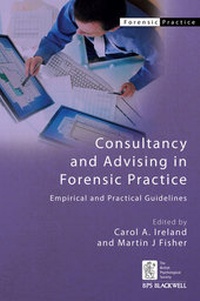
Consultancy and Advising in Forensic Practice
Empirical and Practical Guidelines
1st Edition
Published on 1. February 2010
290 pages
978-0-470-66149-9 (ISBN)
Description

The first publication to apply the modern theory and techniques inthe consultancy process, presenting a clear, practical approachtargeted specifically at forensic issues and contexts.
* The first publication to apply consultancy literature to aforensic setting
* Provides a combination of the theoretical and practicalunderpinnings needed in consultancy work, offering a development ofknowledge with practical application
* Brings together papers from researchers, academics,practitioners and consultants within forensic psychology whilstdrawing upon expertise in business consultancy andadministration
* Chapters combine psychological, ethical, managerial andevaluative aspects into themed summaries
* Offers directions for further study and practicedevelopment
Reviews / Votes
"This practical book is easy to read, with helpful tables and figures, and gives readers a good sense of the consultation process. Its step-by-step approach will make it helpful to individuals who are beginning to do work in this area." (Doody's, 14 October 2011) "Consultancy and advising in forensic practice covers a range of topics in relation to the involvement of psychological approaches in forensic work within the consultation process and training approaches . . . It is a practical guide and is very informative, and it is careful in its application of structures and theories, and advises understanding theoretical knowledge and deliberation about the best approach for any given area." (British Journal of Occupational Therapy, 1 August 2011) 'This is an erudite text that takes the psychological clientservice model back a step or two and uses it to inform howconsultant psychologists can work better with the organisationsthat fund their work. This is important since psychologists aregenerally trained in working with client's best interests in mind,but not in how to provide services with the organisation'sinterests in mind. This book provides guidance and practical adviceon how to do the latter more effectively and comprehensively. 'Organisations have responsibilities to deliverevidence-based services: psychologists have the skills to deliverthe services, but need to be aware of and provide evaluationevidence that supports the over-arching values and needs of theorganisations that hire them. Such evaluation evidence may indicatethat changes are required; but then such changes would bedefensible and evidence-based, and not merely a change for the sakeof change. In sum, this is an excellent book for all consultantpsychologists and I thoroughly recommend it as a core text for anypractitioner's book shelf.' --Douglas P. Boer, Associate Professor of Psychology,The University of Waikato, New Zealand 'This innovative text has long been needed and makes auniquely valuable contribution to forensic practice. It covers boththeoretical and practical issues, and will be of great interest andvalue to all professionals working in the forensicarena.' --David Farrington, Professor of PsychologicalCriminology, Cambridge University, UKMore details
Other editions
Additional editions
Carol A. Ireland | Martin J. Fisher
Consultancy and Advising in Forensic Practice
Empirical and Practical Guidelines
Book
04/2010
Wiley
€51.38
Article exhausted; check different version
Carol A. Ireland | Martin J. Fisher
Consultancy and Advising in Forensic Practice
Empirical and Practical Guidelines
Book
04/2010
Wiley
€111.42
Article exhausted; check different version
Carol A. Ireland | Martin J. Fisher
Consultancy and Advising in Forensic Practice - Empirical and Practical Guidelines
Software
03/2010
Wiley
€103.26
No shipping information available
Persons
Carol A. Ireland is a Chartered Psychologist, ForensicPsychologist and Chartered Scientist. She works at the Universityof Central Lancashire as the Director of Studies for the MSc inForensic Psychology, and leads on the postgraduate qualificationsfor the Child Exploitation Online Protection Agency (CEOP). Inaddition, Dr Ireland works for Mersey Care NHS Trust at AshworthHigh Secure Hospital, where she is lead for group sex offendertherapies and crisis (hostage) negotiation. She manages her ownconsultancy firm, delivering expert witness reports, training andconsultancy, and is currently Chair of the British PsychologicalSociety's Division of Forensic Psychology.
Martin J. Fisher is a Chartered Psychologist, ForensicPsychologist, an Associate Fellow of the British Psychology Societyand a Chartered Scientist. He currently works as ConsultantForensic Psychologist in the Public Sector Bids Unit of NOMS, is anHonorary Consultant Forensic Psychologist at a Regional SecureUnit, and a visiting lecturer in Forensic Psychology at PortsmouthUniversity. He has delivered crisis negotiation and otherconsultancy services to prison governors and senior managementsince 1992. As well as being the Continuing ProfessionalDevelopment Lead, he is the Consultations Lead for the BritishPsychological Society Division of Forensic Psychology.
Content
Series Editors' Preface.
Notes on Contributors.
Acknowledgements.
Part I: Consultancy and Advising from a TheoreticalPerspective.
1. The Role of a Consultant: Function, Skills, Competences andPresentation (Carol A. Ireland).
2. Key Stages and Factors in the Consultancy Process andRelationship: The Importance of Stakeholders, OrganisationalBoundaries, Culture and Their Management (Carol A. Ireland).
3. Theoretically Driven Training and Consultancy: From Design toEvaluation (David Vickers, Eliza Morgan and Alice Moore).
4. Ethical Considerations in the Consultancy and AdvisoryProcess (Susan Cooper and Martin Fisher).
Part II: Consultancy and Advising from a PracticalPerspective.
5. The Application of Cognitive Interview Techniques asPart of an Investigation (Andy Griffiths and Becky Milne).
6. Acting as the Consultant Advisor in a Crisis Situation(Martin Fisher and Carol A. Ireland).
7. Legal Consulting: Providing Expertise in Written and OralTestimony (Jane L. Ireland).
8. The Development of a Practical Behavioural Change Framework:A Case Study within a National Law Enforcement Agency (SimonKeslake and Ian Pendlington).
9. Examining the Link between Performance and EmployeeEngagement in a Forensic Setting: Case Enough to Perform Well?(Suzy Dale).
10. Inspecting Secure Institutions (Louise Falshaw).
11. Effective Training in Action: From Contracting to Evaluation(Eliza Morgan, David Vickers and Alice Moore).
12. Systemic Failure and Human Error (Adrian Needs).
13. Project Management: Towards More Effective AppliedPsychology (Roisin Hall and Donald Darroch).
References.
Index.
