

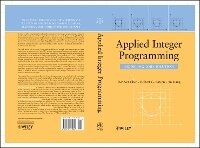
Applied Integer Programming: Modeling and Solution
Published on 19. September 2011
Software
Other digital
468 pages
978-1-118-16600-0 (ISBN)
Description
Taking an application-oriented approach, Applied Integer Programming addresses the art and science of mathematical modeling related to MIP framework. This book discusses the algorithms and associated practices that enable those models to be solved most efficiently. Organized into three parts, this comprehensive reference eases the learning hurdles in integer programming with suggestions and guidelines for practice on the job for professionals, software developers, and analysts who need to model and solve real-world optimization problems using integer-programming techniques.
Reviews / Votes
"Thoroughly classroom-tested, Applied integer programming is an excellent book for integer programming courses at the upper-undergraduate and graduate levels." (Mathematical Reviews, 2011) "The book is intended as a textbook for an application oriented course for senior undergraduate or postgraduate students, mainly with an engineering, business school, or applied mathematics background. Each chapter comes with several exercises, solutions of which are provided in an appendix. Many figures illustrate the flow of algorithms and other concepts." ( Zentralblatt MATH , 2010)More details
Language
English
Place of publication
New York
United States
Target group
Professional and scholarly
Dimensions
Height: 250 mm
Width: 150 mm
Thickness: 15 mm
Weight
666 gr
ISBN-13
978-1-118-16600-0 (9781118166000)
Copyright in bibliographic data and cover images is held by Nielsen Book Services Limited or by the publishers or by their respective licensors: all rights reserved.
Schweitzer Classification
Other editions
Additional editions
E-Book
09/2011
Wiley
€136.99
Available for download
E-Book
09/2011
Wiley
€136.99
Available for download
Person
Der-San Chen, PhD , is Professor Emeritus in the Department of Industrial Engineering at The University of Alabama. He has over thirty years of academic and consulting experience on the applications of linear programming, integer programming, optimization, and decision support systems. Dr. Chen currently focuses his research on modeling optimization problems arising in production, transportation, distribution, supply chain management, and the application of optimization and statistical software for problem solving. Robert G. Batson, PhD, PE , is Professor of Construction Engineering at The University of Alabama, where he is also Director of Industrial Engineering Programs. A Fellow of the American Society for Quality Control, Dr. Batson has written numerous journal articles in his areas of research interest, which include operations research, applied statistics, and supply chain management. Yu Dang, PhD, is Qualitative Manufacturing Analyst at Quickparts.com, a manufacturing services company that provides customers with an online e-commerce system to procure custom manufactured parts. She received her PhD in operations management from The University of Alabama in 2004.
Content
PREFACE. PART I MODELING. 1 Introduction. 1.1 Integer Programming. 1.2 Standard Versus Nonstandard Forms. 1.3 Combinatorial Optimization Problems. 1.4 Successful Integer Programming Applications. 1.5 Text Organization and Chapter Preview. 1.6 Notes. 1.7 Exercises. 2 Modeling and Models. 2.1 Assumptions on Mixed Integer Programs. 2.2 Modeling Process. 2.3 Project Selection Problems. 2.4 Production Planning Problems. 2.5 Workforce/Staff Scheduling Problems. 2.6 Fixed-Charge Transportation and Distribution Problems. 2.7 Multicommodity Network Flow Problem. 2.8 Network Optimization Problems with Side Constraints. 2.9 Supply Chain Planning Problems. 2.10 Notes. 2.11 Exercises. 3 Transformation Using 0-1 Variables. 3.1 Transform Logical (Boolean) Expressions. 3.2 Transform Nonbinary to 0-1 Variable. 3.3 Transform Piecewise Linear Functions. 3.4 Transform 0-1 Polynomial Functions. 3.5 Transform Functions with Products of Binary and Continuous Variables: Bundle Pricing Problem. 3.6 Transform Nonsimultaneous Constraints. 3.7 Notes. 3.8 Exercises. 4 Better Formulation by Preprocessing. 4.1 Better Formulation. 4.2 Automatic Problem Preprocessing. 4.3 Tightening Bounds on Variables. 4.4 Preprocessing Pure 0-1 Integer Programs. 4.5 Decomposing a Problem into Independent Subproblems. 4.6 Scaling the Coefficient Matrix. 4.7 Notes. 4.8 Exercises. 5 Modeling Combinatorial Optimization Problems I. 5.1 Introduction. 5.2 Set Covering and Set Partitioning. 5.3 Matching Problem. 5.4 Cutting Stock Problem. 5.5 Comparisons for Above Problems. 5.6 Computational Complexity of COP. 5.7 Notes. 5.8 Exercises. 6 Modeling Combinatorial Optimization Problems II. 6.1 Importance of Traveling Salesman Problem. 6.2 Transformations to Traveling Salesman Problem. 6.3 Applications of TSP. 6.4 Formulating Asymmetric TSP. 6.5 Formulating Symmetric TSP. 6.6 Notes. 6.7 Exercises. PART II REVIEW OF LINEAR PROGRAMMING AND NETWORK FLOWS. 7 Linear Programming-Fundamentals. 7.1 Review of Basic Linear Algebra. 7.2 Uses of Elementary Row Operations. 7.3 The Dual Linear Program. 7.4 Relationships Between Primal and Dual Solutions. 7.5 Notes. 7.6 Exercises. 8 Linear Programming: Geometric Concepts. 8.1 Geometric Solution. 8.2 Convex Sets. 8.3 Describing a Bounded Polyhedron. 8.4 Describing Unbounded Polyhedron. 8.5 Faces, Facets, and Dimension of a Polyhedron. 8.6 Describing a Polyhedron by Facets. 8.7 Correspondence Between Algebraic and Geometric Terms. 8.8 Notes. 8.9 Exercises. 9 Linear Programming: Solution Methods. 9.1 Linear Programs in Canonical Form. 9.2 Basic Feasible Solutions and Reduced Costs. 9.3 The Simplex Method. 9.4 Interpreting the Simplex Tableau. 9.5 Geometric Interpretation of the Simplex Method. 9.6 The Simplex Method for Upper Bounded Variables. 9.7 The Dual Simplex Method. 9.8 The Revised Simplex Method. 9.9 Notes. 9.10 Exercises. 10 Network Optimization Problems and Solutions. 10.1 Network Fundamentals. 10.2 A Class of Easy Network Problems. 10.3 Totally Unimodular Matrices. 10.4 The Network Simplex Method. 10.5 Solution via LINGO. 10.6 Notes. 10.7 Exercises. PART III SOLUTIONS. 11 Classical Solution Approaches. 11.1 Branch-and-Bound Approach. 11.2 Cutting Plane Approach. 11.3 Group Theoretic Approach. 11.4 Geometric Concepts. 11.5 Notes. 11.6 Exercises. 12 Branch-and-Cut Approach. 12.1 Introduction. 12.2 Valid Inequalities. 12.3 Cut Generating Techniques. 12.4 Cuts Generated from Sets Involving Pure Integer Variables. 12.5 Cuts Generated from Sets Involving Mixed Integer Variables. 12.6 Cuts Generated from 0-1 Knapsack Sets. 12.7 Cuts Generated from Sets Containing 0-1 Coefficients and 0-1 Variables. 12.8 Cuts Generated from Sets with Special Structures. 12.9 Notes. 12.10 Exercises. 13 Branch-and-Price Approach. 13.1 Concepts of Branch-and-Price. 13.2 Dantzig-Wolfe Decomposition. 13.3 Generalized Assignment Problem. 13.4 GAP Example. 13.5 Other Application Areas. 13.6 Notes. 13.7 Exercises. 14 Solution via Heuristics, Relaxations, and Partitioning. 14.1 Introduction. 14.2 Overall Solution Strategy. 14.3 Primal Solution via Heuristics. 14.4 Dual Solution via Relaxation. 14.5 Lagrangian Dual. 14.6 Primal-Dual Solution via Benders' Partitioning. 14.7 Notes. 14.8 Exercises. 15 Solutions with Commercial Software. 15.1 Introduction. 15.2 Typical IP Software Components. 15.3 The AMPL Modeling Language. 15.4 LINGO Modeling Language. 15.5 MPL Modeling Language. REFERENCES. APPENDIX: ANSWERS TO SELECTED EXERCISES. INDEX.