

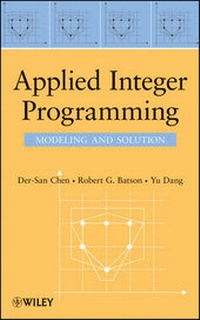
Applied Integer Programming
Description

Reviews / Votes
"Thoroughly classroom-tested, Applied integer programming is an excellent book for integer programming courses at the upper-undergraduate and graduate levels." (Mathematical Reviews, 2011) "The book is intended as a textbook for an application oriented course for senior undergraduate or postgraduate students, mainly with an engineering, business school, or applied mathematics background. Each chapter comes with several exercises, solutions of which are provided in an appendix. Many figures illustrate the flow of algorithms and other concepts." (Zentralblatt MATH, 2010)More details
Other editions
Additional editions

Persons
Content
PART I MODELING.
1 Introduction.
1.1 Integer Programming.
1.2 Standard Versus Nonstandard Forms.
1.3 Combinatorial Optimization Problems.
1.4 Successful Integer Programming Applications.
1.5 Text Organization and Chapter Preview.
1.6 Notes.
1.7 Exercises.
2 Modeling and Models.
2.1 Assumptions on Mixed Integer Programs.
2.2 Modeling Process.
2.3 Project Selection Problems.
2.4 Production Planning Problems.
2.5 Workforce/Staff Scheduling Problems.
2.6 Fixed-Charge Transportation and Distribution Problems.
2.7 Multicommodity Network Flow Problem.
2.8 Network Optimization Problems with Side Constraints.
2.9 Supply Chain Planning Problems.
2.10 Notes.
2.11 Exercises.
3 Transformation Using 0-1 Variables.
3.1 Transform Logical (Boolean) Expressions.
3.2 Transform Nonbinary to 0-1 Variable.
3.3 Transform Piecewise Linear Functions.
3.4 Transform 0-1 Polynomial Functions.
3.5 Transform Functions with Products of Binary and Continuous Variables: Bundle Pricing Problem.
3.6 Transform Nonsimultaneous Constraints.
3.7 Notes.
3.8 Exercises.
4 Better Formulation by Preprocessing.
4.1 Better Formulation.
4.2 Automatic Problem Preprocessing.
4.3 Tightening Bounds on Variables.
4.4 Preprocessing Pure 0-1 Integer Programs.
4.5 Decomposing a Problem into Independent Subproblems.
4.6 Scaling the Coefficient Matrix.
4.7 Notes.
4.8 Exercises.
5 Modeling Combinatorial Optimization Problems I.
5.1 Introduction.
5.2 Set Covering and Set Partitioning.
5.3 Matching Problem.
5.4 Cutting Stock Problem.
5.5 Comparisons for Above Problems.
5.6 Computational Complexity of COP.
5.7 Notes.
5.8 Exercises.
6 Modeling Combinatorial Optimization Problems II.
6.1 Importance of Traveling Salesman Problem.
6.2 Transformations to Traveling Salesman Problem.
6.3 Applications of TSP.
6.4 Formulating Asymmetric TSP.
6.5 Formulating Symmetric TSP.
6.6 Notes.
6.7 Exercises.
PART II REVIEW OF LINEAR PROGRAMMING AND NETWORK FLOWS.
7 Linear Programming-Fundamentals.
7.1 Review of Basic Linear Algebra.
7.2 Uses of Elementary Row Operations.
7.3 The Dual Linear Program.
7.4 Relationships Between Primal and Dual Solutions.
7.5 Notes.
7.6 Exercises.
8 Linear Programming: Geometric Concepts.
8.1 Geometric Solution.
8.2 Convex Sets.
8.3 Describing a Bounded Polyhedron.
8.4 Describing Unbounded Polyhedron.
8.5 Faces, Facets, and Dimension of a Polyhedron.
8.6 Describing a Polyhedron by Facets.
8.7 Correspondence Between Algebraic and Geometric Terms.
8.8 Notes.
8.9 Exercises.
9 Linear Programming: Solution Methods.
9.1 Linear Programs in Canonical Form.
9.2 Basic Feasible Solutions and Reduced Costs.
9.3 The Simplex Method.
9.4 Interpreting the Simplex Tableau.
9.5 Geometric Interpretation of the Simplex Method.
9.6 The Simplex Method for Upper Bounded Variables.
9.7 The Dual Simplex Method.
9.8 The Revised Simplex Method.
9.9 Notes.
9.10 Exercises.
10 Network Optimization Problems and Solutions.
10.1 Network Fundamentals.
10.2 A Class of Easy Network Problems.
10.3 Totally Unimodular Matrices.
10.4 The Network Simplex Method.
10.5 Solution via LINGO.
10.6 Notes.
10.7 Exercises.
PART III SOLUTIONS.
11 Classical Solution Approaches.
11.1 Branch-and-Bound Approach.
11.2 Cutting Plane Approach.
11.3 Group Theoretic Approach.
11.4 Geometric Concepts.
11.5 Notes.
11.6 Exercises.
12 Branch-and-Cut Approach.
12.1 Introduction.
12.2 Valid Inequalities.
12.3 Cut Generating Techniques.
12.4 Cuts Generated from Sets Involving Pure Integer Variables.
12.5 Cuts Generated from Sets Involving Mixed Integer Variables.
12.6 Cuts Generated from 0-1 Knapsack Sets.
12.7 Cuts Generated from Sets Containing 0-1 Coefficients and 0-1 Variables.
12.8 Cuts Generated from Sets with Special Structures.
12.9 Notes.
12.10 Exercises.
13 Branch-and-Price Approach.
13.1 Concepts of Branch-and-Price.
13.2 Dantzig-Wolfe Decomposition.
13.3 Generalized Assignment Problem.
13.4 GAP Example.
13.5 Other Application Areas.
13.6 Notes.
13.7 Exercises.
14 Solution via Heuristics, Relaxations, and Partitioning.
14.1 Introduction.
14.2 Overall Solution Strategy.
14.3 Primal Solution via Heuristics.
14.4 Dual Solution via Relaxation.
14.5 Lagrangian Dual.
14.6 Primal-Dual Solution via Benders' Partitioning.
14.7 Notes.
14.8 Exercises.
15 Solutions with Commercial Software.
15.1 Introduction.
15.2 Typical IP Software Components.
15.3 The AMPL Modeling Language.
15.4 LINGO Modeling Language.
15.5 MPL Modeling Language.
REFERENCES.
APPENDIX: ANSWERS TO SELECTED EXERCISES.
INDEX.
