

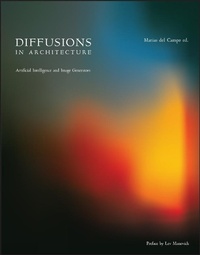
Diffusions in Architecture: Artificial Intelligence and Image Generators
Description

A guide to diffusion models and their impact on design, with insight on how this novel artificial intelligence technology may disrupt the industry
Diffusions in Architecture: Artificial Intelligence and Image Generators delves into the impact of Generative AI models and their effect on architecture design and aesthetics. The book presents an in-depth analysis of how these new technologies are revolutionizing the field of architecture and changing the way architects approach their work. The architects presented in the book focus on the application of specific AI techniques and tools used in generative design, such as Diffusion models, Dall-E2, Stable Diffusion, and MidJourney. It discusses how these techniques can generate synthetic images that are both realistic and imaginative, creating new possibilities for architectural design and aesthetics.
Twenty-two leading designers and theorists offer their insights, providing disciplinary depth by covering the full impact of these learning tools on architecture.
More details
Other editions
Additional editions
Person
Matias del Campo is a registered architect, designer, and educator. He is an Associate Professor at Taubman College of Architecture and Urban Planning, University of Michigan, director of AR2 IL - The Architecture and Artificial Intelligence Laboratory at UoM, and an affiliate faculty member of Michigan Robotics and Data Science. Matias del Campo is the co-founder of the architecture practice SPAN. His previous publications include Neural Architecture - Design and Artificial Intelligence (ORO Editions 2022) and Sublime Bodies (co-authored with Sandra Manninger, Tongji Press 2017)
Lev Manovich is a Presidential Professor at The Graduate Center, City University of New York, and the founder and director of the Cultural Analytics Lab. He is an artist, writer, and one of the most influential theorists of digital culture worldwide.
Content
Acknowledgments xi
Contents xii
Preface xvi
Lev Manovich
Prologue xxiv
Matias del Campo
Suppositions 1
Rice or Pasta? Choose Your AI 2
Mario Carpo
Taxonomy 6
Matias del Campo
Diffusions 10
Bart Lootsma
The Labors of AI 18
Sandra Manninger
An Artificial Tale 28
Ryan Vincent Manning
Resistance Is Fertile 38
Joy Knoblauch
Ontology of Diffusion Models 44
Matias del Campo
Taxonomy
Commorancies 55
The Etiology of a New Collective Architecture 56
Kory Bieg
Noise, Pixels, and Ancient Metamorphic Rocks 66
Matias del Campo
Timberpunk, Prompt Odyssey, Synthetic Ground, and Other Projects 78
Soomeen Hahm and Hanjun Kim
Computation Past Forward 88
Marco Vanucci
Diffusion Models 98
Alicia Nahmad Vazquez
Vestures 109
Design as a Latent Condition 110
Daniel Bolojan
AI, Architecture, and Art 120
Niccolo Casas
The Advent of Trees in Architecture 13
Daniel Köhler
Five Points of Architecture and AI 140
Andrew Kudless
De-Coding Visual Cliches and Verbal Biases 15
Sina Mostafavi and Asma Mehan
Light Architecture 160
Rasa Navasaityte
Driftwood Rock 170
Igor Pantic
Digital Spoliare 180
Dustin White
Estrangements 191
Imago Mundi Imaginibus Mundi 192
Cesare Battelli
3D Diffusion or 3D Disfiguration? 202
Immanuel Koh
Role Play 212
Elena Manferdini
The Doghouse 222
Sandra Manninger
Do Humans Dream of Furry Houses? 232
Virginia San Fratello
Allies in Exile 242
Kyle Steinfeld
Appendix 253
Epilogue 254
Matias del Campo
Glossary 256
Contributor Profiles 264
References 268
Bibliography 284
Index 286
Image Credits 290
About the Author 323
