

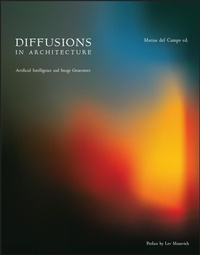
Diffusions in Architecture: Artificial Intelligence and Image Generators
1st Edition
Published on 29. April 2024
Book
Paperback/Softback
352 pages
978-1-394-19177-2 (ISBN)
Description
In-depth guide to diffusion models and their impact on design, with insight on how this novel artificial intelligence technology may disrupt the industry
Diffusions in Architecture: Artificial Intelligence and Image Generators delves into the impact of Diffusion AI algorithms and generative image models on architecture design and aesthetics. The book presents an in-depth analysis of how these new technologies are revolutionizing the field of architecture. The architects presented in the book focus on the application of specific AI techniques and tools used in generative design, such as Diffusion models, Dall-E2, Stable Diffusion, and MidJourney. It discusses how these techniques can generate synthetic images that are both realistic and imaginative, creating new possibilities for architectural design and aesthetics. This comprehensive overview of the impact of Diffusion AI algorithms and generative image models on the field of architecture shows how they are changing the way architects approach their work.
With a foreword by Lev Manovich-artist, writer and one of the world's most influential digital culture theorists.
Sharing the work and insights of a team of designers and theorists from a range of backgrounds, offering disciplinary depth, and covering the full impact of these tools and models on architecture, Diffusions in Architecture includes information on:
Fresh perspectives on design and aesthetics, with designs, images, and commentary from 22 leading architects, theorists, and designers
The potential of prompt engineering and text-to-image models applicable to a broad interdisciplinary audience
Whether image generators, or AI in general, will be an aid for human design, or potentially displace humans from the market
Fundamentals of a larger debate in the architectural discourse (and practice) on the use of image generators
Collecting the different ideas that have emerged in the field, Diffusions in Architecture provides architects, designers, concept artists, and theorists with an overview of this cornucopia of architectural imaginations produced in a common effort between humans and artificial intelligence.
Diffusions in Architecture: Artificial Intelligence and Image Generators delves into the impact of Diffusion AI algorithms and generative image models on architecture design and aesthetics. The book presents an in-depth analysis of how these new technologies are revolutionizing the field of architecture. The architects presented in the book focus on the application of specific AI techniques and tools used in generative design, such as Diffusion models, Dall-E2, Stable Diffusion, and MidJourney. It discusses how these techniques can generate synthetic images that are both realistic and imaginative, creating new possibilities for architectural design and aesthetics. This comprehensive overview of the impact of Diffusion AI algorithms and generative image models on the field of architecture shows how they are changing the way architects approach their work.
With a foreword by Lev Manovich-artist, writer and one of the world's most influential digital culture theorists.
Sharing the work and insights of a team of designers and theorists from a range of backgrounds, offering disciplinary depth, and covering the full impact of these tools and models on architecture, Diffusions in Architecture includes information on:
Fresh perspectives on design and aesthetics, with designs, images, and commentary from 22 leading architects, theorists, and designers
The potential of prompt engineering and text-to-image models applicable to a broad interdisciplinary audience
Whether image generators, or AI in general, will be an aid for human design, or potentially displace humans from the market
Fundamentals of a larger debate in the architectural discourse (and practice) on the use of image generators
Collecting the different ideas that have emerged in the field, Diffusions in Architecture provides architects, designers, concept artists, and theorists with an overview of this cornucopia of architectural imaginations produced in a common effort between humans and artificial intelligence.
More details
Language
English
Place of publication
New York
United States
Target group
Professional and scholarly
Dimensions
Height: 277 mm
Width: 220 mm
Thickness: 20 mm
Weight
1099 gr
ISBN-13
978-1-394-19177-2 (9781394191772)
Copyright in bibliographic data and cover images is held by Nielsen Book Services Limited or by the publishers or by their respective licensors: all rights reserved.
Schweitzer Classification
Other editions
Additional editions
E-Book
01/2024
1st Edition
Wiley
€38.99
Available for download
Person
Matias del Campo is a registered architect, designer, and educator. He is Associate Professor at Taubman College of Architecture and Urban Planning, University of Michigan, director of the AR2IL - The Architecture and Artificial Intelligence Laboratory at UoM, and an affiliate faculty member of Michigan Robotics and Data Science. Matias del Campo is the co-founder of the architecture practice SPAN. The practice gained wide recognition for the design of the Austrian Pavilion at the 2010 Shanghai World Expo, and more recently, for the Robot Garden at the Ford Robotics Building. SPAN's work was featured in the Venice Architecture Biennale in 2012 and 2021, at ArchiLab 2013, and the Architecture Biennale in Vienna and Buenos Aires in 2019. Solo shows include 'Formations' (MAK, Vienna) and 'Sublime Bodies' (Fab Union, Shanghai). SPAN's work is in the permanent collection of the FRAC, the MAK, the Benetton Collection, the Albertina, the Pinakothek Munich, and several private collections.
His publishing work includes two editions of AD - Evoking through Design and Machine Hallucinations (co-edited with Neil Leach) as well as the books Neural Architecture - Design and Artificial Intelligence (ORO Editions 2022) and Sublime Bodies (co-authored with Sandra Manninger, Tongji Press 2017)
His publishing work includes two editions of AD - Evoking through Design and Machine Hallucinations (co-edited with Neil Leach) as well as the books Neural Architecture - Design and Artificial Intelligence (ORO Editions 2022) and Sublime Bodies (co-authored with Sandra Manninger, Tongji Press 2017)