

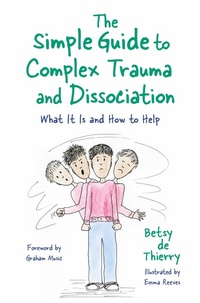
The Simple Guide to Complex Trauma and Dissociation
What It Is and How to Help
Published on 21. October 2020
144 pages
978-1-78775-315-0 (ISBN)
Description

? How does complex trauma differ from trauma?
? What is dissociation?
? How does it affect children?
? How can you help?
These questions and more are answered in this guide to understanding the nature of complex trauma and dissociation, making these seemingly complicated topics accessible to all.
Complex trauma and dissociation is a subject around which there is much confusion and misunderstanding. This can lead to children lacking the support they really need, and even misdiagnosis of the problems they are really struggling with.
Written as a complement to The Simple Guide to Child Trauma, this book aims to inform, clarify and deepen the understanding of complex trauma and resulting dissociation. It also provides practical advice for those caring for or working with these children.
? What is dissociation?
? How does it affect children?
? How can you help?
These questions and more are answered in this guide to understanding the nature of complex trauma and dissociation, making these seemingly complicated topics accessible to all.
Complex trauma and dissociation is a subject around which there is much confusion and misunderstanding. This can lead to children lacking the support they really need, and even misdiagnosis of the problems they are really struggling with.
Written as a complement to The Simple Guide to Child Trauma, this book aims to inform, clarify and deepen the understanding of complex trauma and resulting dissociation. It also provides practical advice for those caring for or working with these children.
More details
Series
Edition
Digital original
Language
English
Place of publication
London
United Kingdom
Target group
College/higher education
Professional and scholarly
Edition type
Digital original
ISBN-13
978-1-78775-315-0 (9781787753150)
Copyright in bibliographic data and cover images is held by Nielsen Book Services Limited or by the publishers or by their respective licensors: all rights reserved.
Schweitzer Classification
Other editions
Additional editions
Book
10/2020
Jessica Kingsley Publishers
€16.50
Shipment within 15-20 days
Persons
Betsy de Thierry is a practising psychotherapist and with over 30 years of experience and knowledge within the field of Complex Trauma & navigating Trauma Recovery. She is the founder of Trauma Recovery Global, which provides training and consultancy and partnerships with select organisations and practitioners to licence her Trauma Recovery Focused Model (TRFM) in 34 nations. She is also the founder of the Trauma Recovery Centre (TRC), a charity specialising in recovery from complex trauma and the founder of CTRN (Childhood Trauma Recovery Network UK). Betsy is also a qualified primary school teacher and is a mum of four brilliant sons.
Content
- Intro
- The Simple Guide to Complex Trauma and Dissociation
- Cover
- Of related interest
- Title Page
- Copyright
- Contents
- Foreword by Graham Music
- Introduction
- 1. Exploring Trauma and Symptoms of Trauma
- Complex trauma in a simple guide
- Assessing trauma
- Understanding the trauma continuum
- How is complex trauma different from trauma?
- Reflection points
- 2. Complex Trauma Symptoms
- 1. Attachment
- 2. Biology
- 3. Affect regulation
- 4. Dissociation
- 5. Behavioural control
- 6. Cognition
- 7. Self-concept
- Challenging behaviour
- Primitive threat response
- The key approach is respect for all who have experienced complex trauma
- Reflection points
- 3. Introducing Dissociation
- The window of tolerance
- Trauma symptoms left without support
- Misunderstanding and understanding dissociation
- The dissociation continuum
- Full buckets, overwhelm and multiple buckets
- Putnam's three categories of dissociation
- The subconscious
- Flashbacks
- The lead professional
- Reflection points
- 4. Thinking about Complex Dissociation
- Dissociation often experienced in complex trauma
- Compartmentalisation and dissociation
- Dissociative Identity Disorder
- The definition of DID in the DSM-5
- Other parts theories
- Memory issues
- Mapping the self states
- Switching parts
- States that are hard to work with
- Reflection points
- 5. Recovery Journey and What I Can Do
- Psycho-education
- Primary attachment figure and home atmosphere
- The stages of recovery
- Exploring the subconscious
- Dissociation that avoids exploration
- The team around the child
- Unhelpful ways to communicate
- Facial responses and tone of voice
- Listening skills
- Reflection points
- 6. Creating Safety
- Neuroception and assessing safety
- Complex trauma and neuroception
- What does safety look like?
- Creating schools and homes that are emotionally safe
- What can we do to help the child feel safe?
- Reflection points
- 7. Learning to Feel
- Safety, comfort and co-regulation
- Mindfulness in schools
- Learning to feel again
- Interoception
- Starting with simple feelings
- Reflection points
- 8. Integration and Strengthening Their Sense of Self
- Trauma processing
- A jigsaw puzzle put back together
- Integration of parts
- Mastery and identity
- Care about compliance in relationships
- Reflection points
- 9. Different Roles and Approaches
- The elements of complex trauma intervention
- Working together
- Looking after you
- Emotional neglect as a key cause of dissociation
- Grief
- Step by step
- Summary: How to help a child recover from complex trauma and/or dissociation
- Recovery from trauma specific to the severity of trauma
- Using our imagination to hope
- Glossary
- Appendix 1: Useful Contacts and Further Reading
- Appendix 2: Crisis Plan Template
- References
- Index
