

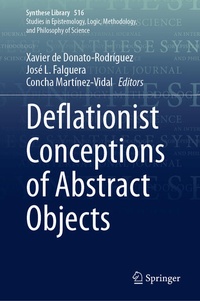
Deflationist Conceptions of Abstract Objects
Description

This book offers an overview of recent discussions on deflationary approaches to ontology and abstract objects. The essays compiled in this volume constitute previously unpublished, original material aiming at exploring current ideas on deflationary approaches to ontology and their relationship to abstract objects, covering issues ranging from the ontology of mathematics and scientific theories to the semantics of fictional expressions and possible worlds. The complete volume represents a contribution to current debates on the nature and epistemology of abstract entities. Its target audience comprises researchers, professionals, lecturers, and students of philosophy, mainly with interests in metaphysics, ontology and metaontology.
More details
Other editions
Additional editions
Persons
Concha Martínez-Vidal is Associate Professor at the University of Santiago de Compostela. She has taught different subjects related to logic and analytic philosophy. Among her publications she has: a manual for teaching logic (Lógica Clásica de Primer Orden: Estrategias de deducción, formalización y evaluación semántica (Trotta 1999, with J.L. Falguera). She has also published various papers and book-chapters. Among them: Is Second-Order Logic Logic? (The Logica Yearbook 1999), El estatuto epistemológico de la Lógica: verdad y necesidad (Técnos 2007 Filosofía de la Lógica), Normativity and its Vindication: The Case of Logic (Theoria 2004), Is Logic Objective? (Cadernos de Filosofía, Lisboa), "Leon Henkin the Reviewer"(with José Pedro Úbeda Rives in Manzano, M.; Sain, I; Alonso, E (Eds.) The Life and Work of Leon Henkin. (Springer 2014) " "Description, Explanation and Ontological Commitment" (with Rivas-de-Castro) "Putnam and contemporary fictionalism" in THEORIA. Also the last version of the entry on "Abstract Objects" in the Stanford Encyclopedia of Philosophy (with José L. Falguera and Gideon Rosen). She has edited several volumes such as: Truth in perspective (Ashgate 1996, with L. Villegas & U. Monroy), Following Putnams Trail: On Realism and Other Issues (Rodopi 2004 with Silva & Monroy), Current Topics in logic and Analytic Philosophy (USC 2007, with Falguera & Sagüillo) and lately: Abstract Objects For and Against (with José L. Falguera Springer 2020). She has participated and conducted several research projects funded by the Spanish Government. She has also organized many conferences and workshops in cooperation with other members of the group EPISTEME
Content
1 Introduction (Xavier de Donato-Rodríguez, José L. Falguera, Concha Martínez-Vidal).- 2 A Deflationary View of Ontology for Scientific Theories: A Neo-Carnapian Approach (Xavier de Donato-Rodríguez and José L. Falguera).- 3 Against Easy Realism (Tobias Alexius).- 4 From deflationism about truth to deflationism about abstract objects (Thomas Schindler).- 5 Easy Ontology Made Easier (Arvid Båve).- 6 Possible worlds and propositions (María de Ponte).- 7 Ontology and the algebraic conception of logic (Øystein Linnebo University of Oslo).- 8 Quinean Lightweight Objects (Concha Martínez-Vidal).- 9 Pragmatic Accounts of Justification, Epistemic Analyticity, and Other Routes to Easy Knowledge of Abstracta (Brett Topey).- 10 Objects, Thin Objects, Thin Access to Objects (Otávio Bueno).- 11 Deflating Fictionalism (Suki Finn).- 12 To be (thin) or not to be? Are thin objects fictional objects, or are fictional objects thin? (Mary Leng).- 13 Fictional Characters in Fictional Discourse (Manuel García-Carpintero).- 14 Ontology and Top-Down Metasemantics (Matti Eklund).- 15 Sortal Combat. Semantic Inferentialism and Ontological Deflationism About Abstract Objects (James Henry Collin).- 16 The implicature view of ontological commitments and denials (Jody Azzouni).- 17 The (Linguistic) Foundations of Arithmetic (Robert Schwartzkopff).- Index.
